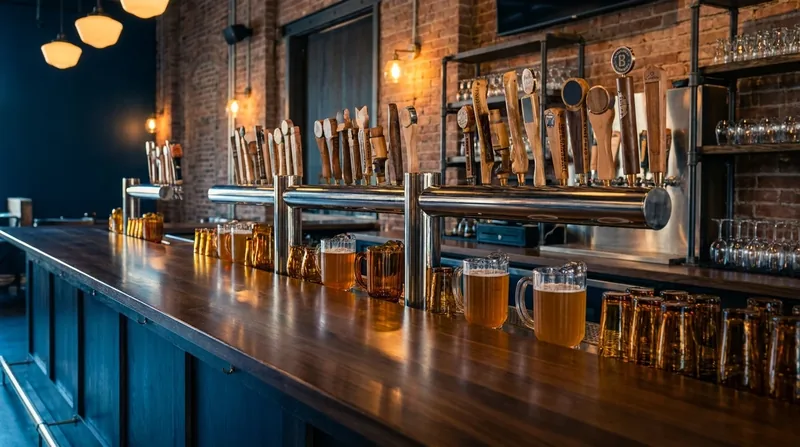
How to Start a Craft Brewery in Virginia: ABC Brewery License $380 to $4,690 and the 20 Percent Own-Beer Rule
How to Start a Craft Brewery in Virginia: ABC Brewery License $380 to $4,690 and the 20 Percent Own-Beer Rule
Starting a brewery in Virginia involves three separate approvals that new owners often mix up. The Virginia Alcoholic Beverage Control Authority (ABC) issues the state brewery license. Your city or county handles zoning and, in many places, a local business license. The federal Alcohol and Tobacco Tax and Trade Bureau (TTB) handles federal approval, which is separate from everything in this guide and which you should confirm directly with TTB. The State Corporation Commission (SCC) forms your company, but it issues no business license. Virginia has no general statewide business license.
This guide covers the manufacturing side of a brewery with a taproom, including the state license, the owned-brands rule, and the farm brewery option. It follows the order most first-time brewers should work in: choose your license type, form the business, confirm zoning, check the local license, apply to ABC, and then set up taxes and food permits for the taproom. If you plan to run a bar that pours other brands, that is a retail question and is covered on the bar page.
Informational note: This article is informational content, not legal or tax advice. A brewery involves leases, loans, insurance, and recurring tax filings, so talk with a Virginia attorney and a CPA before you sign a lease or file your first return.
What You Need Before You Start
Gather these items before you file anything. A missing document usually delays an application rather than sinking it, but delays are expensive when you are paying rent on a building you cannot yet open.
Equipment and ingredients
- A brewhouse sized to your target output, with mash and boil vessels, a heat source, and a wort chiller
- Fermenters and brite tanks, plus cold storage that holds them at controlled temperature
- Raw ingredients: malted barley and other grains, hops, yeast, and treated water
- Cleaning and sanitizing supplies, plus a basic lab area for gravity and quality checks
- Packaging: kegs, cans or bottles, labels, and reusable growlers if you plan to fill them for takeout
Paperwork and planning documents
- Articles of Organization (Form LLC1011) if you form an LLC, or Articles of Incorporation (Form SCC619) if you form a corporation
- A lease or purchase agreement made contingent on zoning and license approval
- Written confirmation from the local planning or zoning office that a brewery is allowed at your address
- A floor plan of the production area and taproom, which you will likely need for zoning and licensing reviews; confirm the exact requirement with ABC and your locality
- Insurance quotes for liquor liability and product liability coverage
Step-by-Step: Opening a Virginia Brewery
Step 1: Choose between a brewery license and a limited brewery license
The standard brewery license under Va. Code 4.1-206.1 lets you manufacture beer and sell and ship it in closed containers to licensed wholesalers. It also lets you ship to buyers outside Virginia for resale outside the state. At the licensed premises, you may sell beer for on-premises consumption, which is what a taproom does. You may also sell beer in closed containers for off-premises consumption, including growlers and other reusable containers.
A limited brewery, often called a farm brewery, is a smaller version tied to agricultural land. It has its own location rules, covered in the farm brewery section below. Decide which license fits before you buy or lease a building, because the land requirements for a farm brewery are strict.
Step 2: Understand the 20 percent own-beer rule
The brewery license lets you sell the brands of beer your brewery owns for on-premises consumption. That privilege comes with a condition: at least 20 percent of the volume of beer sold for on-premises consumption in a calendar year must be manufactured on the licensed premises. If your taproom pours mostly beer brewed somewhere else, you can fall below that threshold.
Plan your tap list around the rule from day one. Track on-premises beer volume by brand and by calendar year so you can prove compliance if ABC asks. If you want to pour other brewers' beer, the brewery license alone does not cover it. A taproom that pours other brewers' beer, wine, or spirits needs an additional retail license, and the specific rules for that are something to confirm directly with ABC.
Step 3: Form your business with the SCC
Most breweries form an LLC. Virginia charges $100 for Articles of Organization (Form LLC1011), filed online through the SCC Clerk's Information System at https://cis.scc.virginia.gov/. Your name must include a required ending such as LLC, L.L.C., or Limited Liability Company, and it must be distinguishable from names already on file.
If you want to lock in a name while you finish planning, you can reserve it for $10 for 120 days. A name reservation can be renewed during the 45 days before it expires. Online filings can be expedited: next day service costs $50 or $100 (submitted by 2:00 PM Eastern, with a response by 4:00 PM the next business day), and same day service costs $200 (submitted by 10:00 AM Eastern, with a response by 4:00 PM). Expedited service is online only and nonrefundable.
Virginia requires a registered agent with a Virginia street address who is available during business hours and who is either a Virginia State Bar member or a member, manager, officer, trustee, or general partner of the entity. The entity cannot serve as its own agent. Virginia LLCs file no annual report. Instead, they pay a $50 annual registration fee to the SCC. The fee is due the last day of the 12th month after the month the LLC was organized, and then every year after that. The SCC assesses it about two months ahead. A late payment adds a $25 penalty, and the LLC is canceled at the end of the third month after the due date.
If you will brew under a name other than your legal entity name, file an Assumed Name Certificate with the SCC for $10. Do not file it with the circuit court.
Step 4: Confirm zoning before you sign a lease
Zoning is a local decision, and it is the step that stops more brewery projects than any other. Contact the planning or zoning office in your city or county and ask in writing whether a brewery with a taproom is a permitted use at the address you are considering. Ask whether a special permit or public hearing is required, how the locality treats outdoor seating, and what parking rules apply. Get the answer in writing and attach it to your lease discussions. A verbal assurance from a leasing agent is not zoning approval.
Step 5: Check the local business license (BPOL)
Virginia's local business license is the Business, Professional and Occupational License (BPOL) tax under Va. Code 58.1-3700 and following. Each city, county, or town administers its own BPOL, usually through the Commissioner of the Revenue. This is a local tax, not a state license, and not every locality levies a general one. Va. Code 58.1-3704 allows a locality to levy none. Some counties, including Stafford, Rockingham, Bedford County, Washington County, Montgomery County, Louisa, and Fluvanna, do not levy a general county license. A town within a county may levy its own tax in place of the county tax. Never assume your locality requires a license until you confirm it.
The statute sets a floor based on population for localities that do levy a license. A locality with more than 50,000 people cannot require a license for gross receipts under $100,000. A locality with 25,000 to 50,000 people cannot require a license for gross receipts under $50,000. No floor applies to a locality under 25,000 people. Localities over 50,000 may waive the license for gross receipts up to $200,000, but confirm that waiver ceiling with your locality. Localities set their own rates and deadlines. For the local brewery license tax under Va. Code 4.1-233.1, the statutory maximums are $250 for up to 500 barrels and $1,000 above 500 barrels. These are maximums, so ask your Commissioner of the Revenue for the actual amount and filing schedule. For more detail, see the BPOL page.
Step 6: Apply for the ABC brewery license
The state annual fee for a brewery license is tiered by the volume of beer you manufacture during the license year:
| Barrels manufactured in the license year | State annual fee |
|---|---|
| Not more than 500 barrels | $380 |
| Not more than 10,000 barrels | $2,350 |
| More than 10,000 barrels | $4,690 |
The tier is based on beer manufactured during the license year in which the license is granted. For a first-year license, ask ABC how the tier is determined before you project costs, because a new brewery's first-year volume is hard to predict. Ask ABC for the application fee and the expected processing time as well, since those details are set by ABC and can change. Apply only after your zoning confirmation and SCC filing are in hand, because ABC will expect the premises and entity to be established.
Step 7: Set up your tax accounts
Taproom sales of beer and food are taxable retail sales. You will need a sales and use tax permit from the Virginia Department of Taxation (Virginia Tax) at https://www.tax.virginia.gov/sales-and-use-tax. Virginia's state sales tax is a 5.3 percent base rate, which combines state and local tax. Some localities are higher: 6 percent in the regional-tax localities, 6.3 percent in eight localities, and 7 percent in the Historic Triangle (James City County, Williamsburg, and York County). Your locality determines which rate applies to your taproom, so confirm your exact rate with Virginia Tax.
Counties may also levy a meals tax of up to 6 percent on prepared food under Va. Code 58.1-3833. Check your locality for whether one applies. Beer excise tax filings are handled through ABC and Virginia Tax, so ask both how and when to file. Federal excise tax questions belong with TTB. This guide does not list excise rates because they change and depend on your operations.
Step 8: Get the food permits if your taproom serves food
Serving food from a kitchen requires a Virginia Department of Health (VDH) food permit before you open. The current fees are $40 for plan review and $40 for the permit. A food establishment also needs a Certified Food Protection Manager unless an exemption applies. Virginia has no statewide food handler card, so do not confuse the manager certification with a basic card requirement.
Food trucks often partner with taprooms, which is a practical way to offer food without a full kitchen. Each food truck, however, needs its own permits. The partnership does not transfer the permits. See the food truck page for the details on that arrangement.
Step 9: Plan your hiring and insurance
Virginia's minimum wage is $12.77 in 2026, $13.75 in 2027, and $15.00 in 2028, so build those rates into your payroll budget. Workers' compensation coverage is required once you have three or more employees under Va. Code 65.2-101. Many brewers buy it earlier because a single injury on a brewhouse floor can be expensive. Liquor liability and product liability insurance are standard for a taproom and brewery. Get quotes from several carriers, because premiums vary widely with your size, location, and operations, and this guide does not estimate them.
The Farm Brewery Option: Limited Brewery License
A limited brewery license covers a brewery that makes no more than 15,000 barrels a year and sits on a farm in Virginia. To qualify, the land must be zoned agricultural, or otherwise permitted by the locality for limited brewery use. Land zoned residential conservation does not count. The farm must be owned or leased by the brewery or its owner. Agricultural products such as barley, other grains, hops, or fruit used in the beer must be grown on that farm.
The licensed premises are limited to the part of the farm where those products are grown that is contiguous to the brewery. The residence and its curtilage are excluded. ABC may approve other portions of the farm after notice to the local governing body. The fees are the same as the standard brewery license, and a limited brewery is otherwise treated as a brewery.
Zoning for farm breweries varies by locality. Before you buy land, get written confirmation from the planning office that a limited brewery is allowed on that parcel, and confirm that the crops you plan to use can legally be grown there. Buying farmland first and then learning the zoning does not work.
Cider and mead are treated as wine under Virginia law, so a producer of those beverages usually uses a farm winery license instead. See the farm winery page for that route.
Common Mistakes to Avoid
- Buying or leasing before zoning is confirmed. Get written zoning approval first, and make your lease contingent on it.
- Assuming a state business license exists. Virginia has none. The SCC forms your entity, ABC licenses the brewery, and any general business license is local.
- Assuming every locality requires a BPOL license. Some localities levy none, and the population floors can exempt small gross receipts.
- Budgeting only the $380 fee. The state fee rises to $2,350 or $4,690 as barrel volume grows, and local license taxes add to the total.
- Forgetting the own-beer rule. A taproom that pours mostly guest beer can fall below the 20 percent threshold and lose compliance.
- Pouring other brewers' beer without the right retail license. Ask ABC what additional license your taproom needs.
- Serving food without a VDH permit. A kitchen serving food needs its own permit and a Certified Food Protection Manager unless exempt.
- Missing the LLC annual registration fee. The $50 fee has a due date and a $25 late penalty. Calendar it.
- Filing a DBA with the circuit court. An Assumed Name Certificate is filed with the SCC for $10.
- Hiring a third employee without workers' compensation. Coverage is required at three or more employees.
Expected Results and What to Plan For
A well-prepared brewery often reaches its opening date with its entity, zoning, state license, and tax accounts in order, but timelines depend on your locality, your ABC review, and your build-out. You may see a delay in any of those areas. Plan for that possibility in your lease terms and your cash reserves rather than assuming a fixed timeline.
Taproom revenue and brewery volume may grow over time as distribution and tap-room traffic develop. Results vary widely by market, product, and management, and no outcome is guaranteed. This guide makes no claims about the health effects of beer. Any statements you make on labels, cans, or marketing materials may be subject to federal rules, so check those with TTB before you print them.
Where to Get Help
The Virginia Small Business Development Center network offers free and low-cost advising for new businesses at https://www.virginiasbdc.org/. The SBA Richmond district office, which serves the state, is at https://www.sba.gov/district/richmond. For the SCC, visit https://www.scc.virginia.gov/businesses/. For tax registration, visit https://www.tax.virginia.gov/.
Disclaimer
This article is informational content about starting a brewery in Virginia. It is not legal or tax advice. Fees, thresholds, and deadlines can change, and local rules vary. Confirm each figure with the agency named in the article before you rely on it, and consult a qualified Virginia attorney and CPA for your specific situation.
Keep exploring: related Virginia guides
- Virginia Cottage Food Law 2026
- How to Start a Farm Winery in Virginia
- How to Start a Vending Machine Business in Virginia
- How to Start an Oyster Farm in Virginia
- How to Start an LLC in Virginia
- Virginia Business License
- Cost to Start a Business in Virginia
- All Virginia business types
- Every Virginia guide in one place