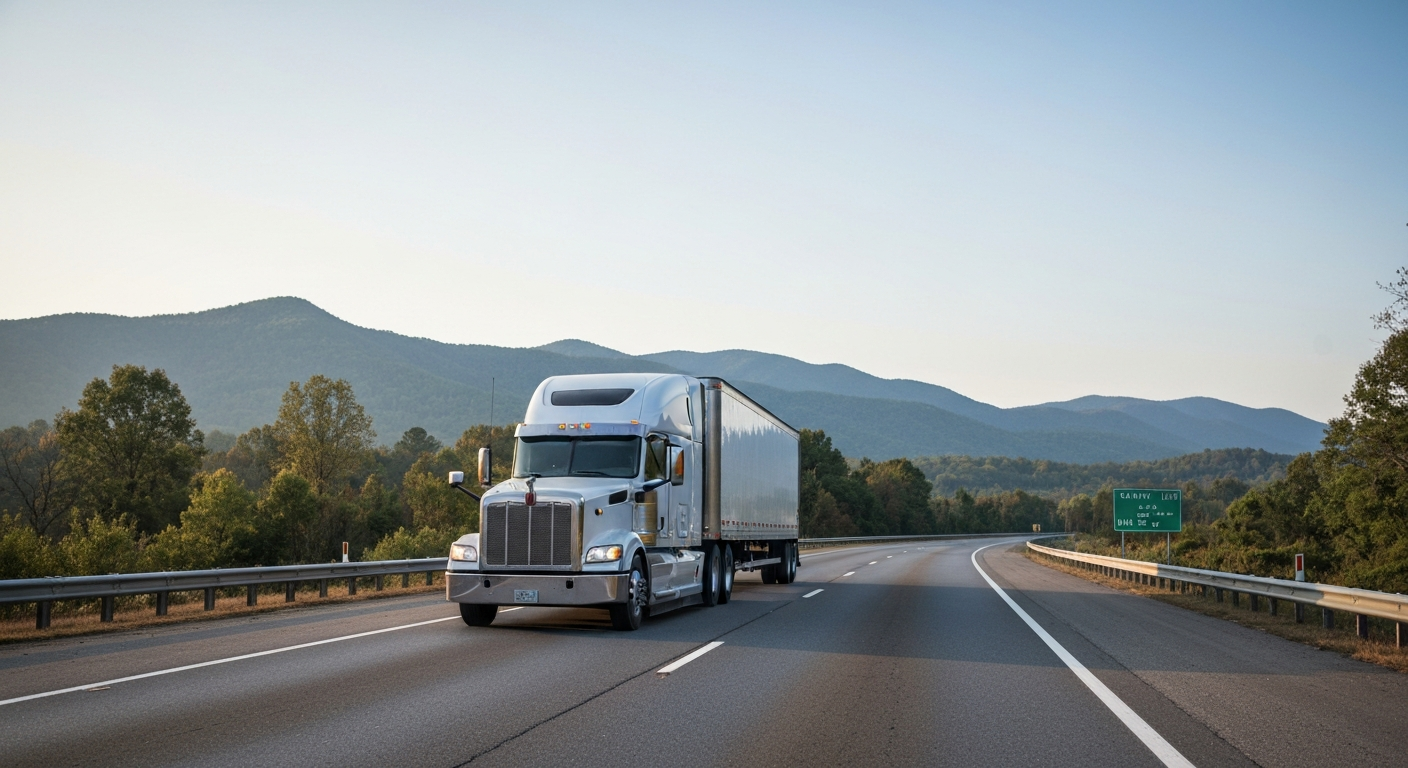
How to Start a Trucking or Freight Business in Virginia
How to Start a Trucking or Freight Business in Virginia
Starting a trucking business in Virginia means dealing with two separate regulatory systems at once — federal and state — before you ever load a single pallet. The FMCSA controls interstate operations. Virginia DMV Motor Carrier Services handles the state side. You need both, and the sequence matters.
This isn’t a low-barrier business to enter. Insurance alone can run $25,000 a year. Equipment costs hit six figures fast. But freight demand is real and consistent, and owner-operators who get the compliance right build durable businesses. Here’s exactly what that compliance looks like.
Federal Registration
Most of what makes trucking complicated happens at the federal level. The FMCSA (Federal Motor Carrier Safety Administration) oversees commercial vehicle operators across state lines, and their registration requirements stack on top of each other.
USDOT Number
Your first step is getting a USDOT number. This is required for any commercial vehicle with a Gross Vehicle Weight Rating (GVWR) of 10,001 pounds or more — which covers basically every truck you’d use to haul freight. It’s also required if you’re transporting 15 or more passengers (including the driver), or if you’re carrying hazardous materials that require placarding, regardless of vehicle size.
Register at the FMCSA portal: safer.fmcsa.dot.gov. The registration is free. You’ll complete the MCS-150 form (Motor Carrier Identification Report), which asks for your business information, vehicle count, and the type of operation you’re running. Keep this updated — you’re required to update your MCS-150 every two years, or whenever your operation changes significantly.
MC Number (Operating Authority)
If you’re hauling freight across state lines for hire, you also need an MC number — also called operating authority. This is separate from your USDOT number. The MC number specifically authorizes you to operate as a for-hire carrier in interstate commerce.
Apply through the FMCSA’s Unified Registration System (URS) at fmcsa.dot.gov. The filing fee is $300 per authority type. After you file, FMCSA publishes your application for a 10-day protest period. If no one objects (and typically no one does for standard dry van freight), your authority gets granted.
Your MC authority doesn’t become active until you’ve also filed your BOC-3 and proof of insurance. All three pieces have to be in place.
BOC-3 Filing
The BOC-3 is a form that designates process agents in every state where you’ll operate. A process agent is essentially a legal representative — someone who can receive legal documents on your behalf in that state if you’re ever involved in litigation.
You don’t file the BOC-3 yourself. You hire a process agent company to do it, and they file on your behalf with FMCSA. Cost is typically $20-$40 as a one-time fee. Several companies specialize in this — a quick search for “BOC-3 filing service” turns up plenty of options. This has to be filed before your MC authority activates.
UCR (Unified Carrier Registration)
Every motor carrier with a USDOT number must register annually through the Unified Carrier Registration program. UCR is a state-administered program that collects fees from interstate carriers — the money funds state motor carrier safety programs.
Your fee is based on fleet size. For a single truck, it’s currently around $76 per year. Larger fleets pay more on a tiered scale. You register at ucr.gov and can register your base state as Virginia. This renews annually, typically with registration windows opening in the fall for the following year.
Don’t skip this. UCR non-compliance can get you put out of service during a roadside inspection.
FMCSA New Entrant Safety Audit
Here’s something most new carriers don’t know about until it’s too late: FMCSA puts every new carrier through an 18-month probationary period called the New Entrant program. During this window, FMCSA will conduct a safety audit — an examination of your safety management controls, your driver qualification files, your hours-of-service records, your vehicle maintenance records, and your drug and alcohol testing program.
The audit is pass/fail. If you fail, your operating authority gets revoked. If you pass, you graduate out of new entrant status and continue operating normally.
The audit typically happens sometime in the first 12 months, not necessarily at the 18-month mark. Be ready from day one. Keep your driver files complete, your maintenance logs current, and your drug testing program enrolled before you haul a single load.
Virginia State Registration
Federal registration doesn’t replace state-level requirements — it stacks on top of them. Virginia DMV Motor Carrier Services handles the state side of commercial vehicle operations.
Start at dmv.virginia.gov under the Motor Carrier Services section.
Intrastate vs. Interstate
If you’re operating entirely within Virginia — picking up and delivering within state lines only — you still need a USDOT number, but you may not need an MC number from FMCSA. Intrastate carriers are regulated primarily by Virginia rather than FMCSA for operational authority purposes.
That said, Virginia has adopted federal safety regulations for intrastate commercial carriers, so the CDL requirements, hours-of-service rules, and vehicle inspection standards apply to you whether you cross state lines or not.
If there’s any chance your loads will cross state lines — even occasionally — get the MC authority. Operating interstate for hire without it is a serious violation.
IFTA (International Fuel Tax Agreement)
Once you’re operating interstate, you’re required to participate in IFTA — the International Fuel Tax Agreement. Virginia is your base state for IFTA registration since that’s where your trucks are based.
IFTA simplifies fuel tax reporting across multiple states. Instead of filing separately with every state you drive through, you file one quarterly report with Virginia DMV Motor Carrier Services. You report total miles driven in each state and total fuel purchased, and Virginia handles the calculation of what’s owed to which state.
You apply for IFTA credentials through Virginia DMV Motor Carrier Services. You’ll receive an IFTA license and decals for each qualifying vehicle. Decals must be displayed on the cab. Quarterly filings are due January 31, April 30, July 31, and October 31.
Overweight and Oversize Permits
If your loads exceed standard legal weight or dimension limits, you need permits before you move them. In Virginia, these are issued by Virginia DMV as well. Standard legal weight is 80,000 lbs gross on interstate highways. Loads exceeding that, or exceeding width, height, or length limits, require a special permit.
Single-trip permits, annual permits, and superload permits (for extremely heavy or wide loads) are all available. The permitting process and fees vary by load type. If you’re planning to haul oversize loads regularly, factor permit costs and route approval time into your planning.
CDL and Compliance
The trucks need to be registered. The drivers need to be qualified. These are separate requirements that both matter.
CDL Class A vs. Class B
CDL Class A covers combination vehicles — a tractor pulling a trailer — where the combined Gross Combination Weight Rating (GCWR) exceeds 26,001 lbs and the trailer alone exceeds 10,000 lbs GVWR. This is the standard license for over-the-road freight hauling with a semi-truck and trailer. Most commercial freight drivers need a Class A.
CDL Class B covers single vehicles with a GVWR over 26,001 lbs, or such a vehicle towing a trailer that doesn’t exceed 10,000 lbs GVWR. Think straight trucks, dump trucks, and large delivery vehicles. If you’re running box trucks in a local delivery operation, Class B may be sufficient.
Both require passing the CDL knowledge tests and skills tests through Virginia DMV. Hazmat endorsements, tanker endorsements, and doubles/triples endorsements each require additional testing.
ELDT (Entry Level Driver Training)
Since February 2022, anyone obtaining a CDL for the first time — or upgrading to a new CDL class, or adding certain endorsements — must complete Entry Level Driver Training (ELDT) through an FMCSA-registered training provider. This isn’t optional and can’t be self-completed.
ELDT requires both theory (classroom or online) and behind-the-wheel training from a provider listed on FMCSA’s Training Provider Registry (TPR) at tpr.fmcsa.dot.gov. The training provider reports completion directly to FMCSA. The CDL testing office can see your completion status before you test.
If you’re hiring drivers who already hold CDLs and aren’t changing class or endorsements, ELDT doesn’t apply to them.
ELD Mandate
If your drivers are required to keep records of duty status (hours-of-service logs), they’re almost certainly required to use an Electronic Logging Device (ELD). Paper logs are no longer compliant for most carriers.
The ELD automatically records driving time, engine hours, vehicle miles, and location. It syncs with the driver’s records of duty status. During a roadside inspection, the driver provides the officer with a display of their logs directly from the ELD.
ELDs must be registered with FMCSA. You can find a list of compliant devices at eld.fmcsa.dot.gov. Devices run $200-$800 per unit, plus monthly service fees of $20-$50. Budget for this from day one — non-compliance results in drivers being placed out of service.
Short-haul exemptions exist for drivers who operate within a 150 air-mile radius and return to their starting point each day, but most freight operations don’t qualify.
Drug and Alcohol Testing Program
Every CDL driver subject to DOT regulations must be enrolled in a DOT-compliant drug and alcohol testing program. As a motor carrier, you’re responsible for:
- Pre-employment testing before a driver operates a commercial vehicle
- Random testing at a minimum annual rate of 50% for drugs and 10% for alcohol
- Post-accident testing after qualifying accidents
- Reasonable suspicion testing when a supervisor observes signs of impairment
- Return-to-duty and follow-up testing after a violation
You need to join a DOT-compliant consortium or set up your own testing program. Most small carriers join a consortium — a third-party administrator that pools carriers together for random testing and handles the administrative requirements. Cost is typically $100-$200/year per driver for consortium membership, plus the cost of individual tests.
FMCSA’s Drug and Alcohol Clearinghouse (clearinghouse.fmcsa.dot.gov) is mandatory. You must query the Clearinghouse before hiring any new CDL driver, and run annual queries on current drivers.
Insurance Requirements
Trucking insurance is expensive. There’s no way around it. And the minimums are set by federal law, not by what’s cheapest to buy.
General Freight: $750,000 Minimum
For property carriers hauling general freight in interstate commerce, FMCSA requires a minimum of $750,000 in liability coverage. This covers bodily injury and property damage to third parties.
In practice, many shippers and brokers require $1,000,000 in liability before they’ll work with you, regardless of the federal minimum. Budget for the higher number.
Hazmat Carriers: $1,000,000-$5,000,000
Hazardous materials carriers face significantly higher minimums — $1,000,000 for most hazmat operations, and up to $5,000,000 for certain types of hazardous cargo (bulk oil, compressed gases, explosives). The specific minimum depends on the type and quantity of hazmat you’re hauling.
If you’re starting a general freight operation, avoid hazmat until your business is established. The insurance cost alone is a meaningful operational burden.
Cargo Insurance
Liability insurance covers damage you cause to others. Cargo insurance covers the freight you’re hauling. For household goods carriers, FMCSA requires a minimum of $100,000 in cargo insurance. For general freight, there’s no federal cargo insurance minimum — but shippers require it, and you need it.
Most carriers carry $100,000 in cargo coverage. If you’re hauling high-value electronics or similar cargo, you may need more.
Workers’ Compensation
Virginia requires workers’ compensation insurance once you have three or more employees. If you’re a sole operator, it doesn’t apply to you directly — but the moment you hire drivers, track this carefully. Virginia’s workers’ comp requirement kicks in at employee three, not employee five or ten like some states.
Startup Costs at a Glance
Trucking is capital-intensive. Here’s what a realistic one-truck startup looks like in Virginia.
Business formation:
- LLC: $100 to file Articles of Organization with Virginia SCC, plus $50/year in annual registration fees
Federal registrations:
- USDOT number: free
- MC operating authority: $300 filing fee
- BOC-3 filing: $20-$40
- UCR (annual): ~$76 for a single truck
Equipment:
- Used semi-truck (Class 8): $30,000-$80,000 depending on age, mileage, and spec
- New semi-truck: $100,000-$180,000
- Used dry van trailer: $20,000-$50,000
- Newer or reefer trailers run higher
Insurance:
- Annual commercial trucking insurance: $10,000-$25,000+ for a single truck, depending on cargo type, driver history, and coverage levels. New entrant carriers typically pay at the top of this range.
Training:
- CDL training (if needed): $3,000-$7,000 at a commercial driving school
Total lean startup — one truck, owner-operator: Realistically, $60,000-$150,000 to get rolling, depending heavily on whether you’re buying used or new equipment and what your insurance comes in at.
Most owner-operators finance the truck. Cash-flowing the insurance premium from the start is harder. Have at least $15,000-$20,000 in working capital beyond your equipment costs before you start.
What to Do First
The sequence matters. Here’s the practical order:
- Form your LLC with Virginia SCC ($100 at cis.scc.virginia.gov)
- Get your EIN from IRS.gov (free)
- Register for your USDOT number via the FMCSA portal
- Apply for MC operating authority ($300) and file your BOC-3
- Secure your insurance and file proof with FMCSA to activate your authority
- Register for UCR at ucr.gov
- Register with Virginia DMV Motor Carrier Services for state-level compliance
- Enroll in a DOT drug and alcohol testing consortium
- Ensure your drivers have valid CDLs and are ELDT-compliant
- Install a compliant ELD before the first load
The 18-month new entrant audit window starts the moment your operating authority is granted. Get your compliance infrastructure — driver files, maintenance records, drug testing program — set up before you haul your first load, not after.