How to Start a Plumbing Business in Virginia
How to Start a Plumbing Business in Virginia
Virginia doesn’t let just anyone hang out a plumbing shingle. Before you book your first job, you need two separate licenses from DPOR — a tradesman license proving you can actually do the work, and a contractor license giving you legal authority to run a business doing it. Get your LLC registered, carry the right insurance, and pull a local BPOL license, and you’re set.
That’s the whole roadmap. Here’s every step in detail.
Virginia Plumbing License Path
The tradesman license is your foundation. Without it, you can’t hold a contractor license for plumbing work. DPOR’s Board for Contractors issues both, and you’ll want to get your tradesman credentials sorted before you touch the contractor application.
Journeyman Plumber
The journeyman plumber license has one of the more flexible qualification structures among the Virginia trades. There are five paths to the exam, depending on how much experience you have versus formal training:
- 4 years of experience + 240 hours of formal vocational training
- 5 years of experience + 160 hours of training
- 6 years of experience + 80 hours of training
- 7+ years of experience + 40 hours of training
- Associate degree in a related field + 2 years of experience
If you’ve been working in the field for years without much classroom time, the 7-years-plus-40-hours path is your cleanest route. That 40-hour minimum is achievable through a short vocational course or apprenticeship program module. On the other end, if you went through a formal trade program and have solid classroom hours, you can qualify in four years.
The journeyman exam is 80 questions, 210 minutes, and requires a 75% passing score — 60 correct answers out of 80. Expect questions on the Virginia Uniform Statewide Building Code, plumbing materials, water supply systems, drainage, and fixture installation. The exam fee is approximately $100.
Master Plumber
Once you hold a journeyman license, the master path is straightforward: one year of experience as a licensed journeyman plumber. That’s the minimum. After that year, you’re eligible to sit for the master exam, which is also 210 minutes with a $125 fee.
The master license matters because it’s typically what you’ll list as your qualifying license when you apply for Class A or Class B contractor status. It signals to clients — especially commercial ones — that someone with documented advanced expertise is running the operation.
The tradesman license fee itself is $130, separate from exam fees.
NEW: Residential Plumber License (April 2025)
This is genuinely worth paying attention to. Effective April 1, 2025, Virginia introduced a Residential Plumber license as a distinct credential under DPOR. It requires less experience than the full journeyman license and limits work to residential structures — but for someone who wants to start a one-person residential service and repair business as quickly as possible, this is a real option.
Think of it as a stepping stone. You can get licensed sooner, start building your client base and business infrastructure, and work toward your journeyman license while the business is already running. You won’t be able to take commercial jobs, but the residential market — service calls, water heater replacements, fixture installs, drain clearing — is substantial enough to build a real business on.
If you’re already at journeyman or master level, skip it. But if you’re a few years short of journeyman qualifications and eager to go independent, the residential license is a path that didn’t exist before 2025.
Contact DPOR at (804) 367-8511 or visit dpor.virginia.gov for current experience requirements on the residential plumber credential, as specifics continue to be published following the April rollout.
Contractor License for Your Business
The tradesman license proves your plumbing skills. The contractor license is what legally allows you to run a business — accept contracts, charge for work, and operate as a plumbing company in Virginia. You need both.
DPOR issues three contractor license classes, and your project size determines which one you need. Importantly, your years of plumbing experience count directly toward the contractor experience requirement — you’re not starting from scratch.
Class C — The Starting Point for Most Solo Operators
Fee: $235 | Experience required: 2 years | Project limit: up to $10,000 per project
Class C is where most solo plumbers launching their first business start. The $10,000 per-project cap covers a wide range of residential and light commercial work — water heater replacements, bathroom remodels, repipes on smaller homes, service and repair calls. There’s no minimum net worth requirement for Class C.
Two years of documented plumbing experience is the bar. If you’ve been working as a journeyman, you’ve cleared it.
Class B — For Larger Projects
Fee: $370 | Experience required: 3 years | Project limit: up to $120,000 | Net worth: $15,000 minimum
Class B opens up larger residential projects and most commercial work. The $15,000 net worth requirement is documented through a balance sheet — it’s not a bond or cash deposit, just proof that your business has some financial standing.
Class A — Full Commercial
Fee: $385 | Experience required: 5 years | Project limit: no cap | Net worth: $45,000 minimum
Class A has no project ceiling. If you’re targeting general contractors, property management companies, or new construction on commercial buildings, you’ll eventually need this.
Pre-License Education (Required for All Classes)
All three contractor classes require 8 hours of pre-license education before you can apply. The courses cover Virginia contractor law, business practices, and safety requirements. Cost runs $200-$400 depending on the provider. DPOR maintains a list of approved course providers.
You file the contractor application through DPOR’s online system at dpor.virginia.gov. The application includes your tradesman license number, proof of pre-license education, a financial statement (for Class B/A), and the filing fee.
Business Formation and Registration
With your licenses handled — or in progress — the business side runs through three steps: form your LLC, get your EIN, and register for state taxes.
Form an LLC with the Virginia SCC
An LLC isn’t legally required, but it separates your personal assets from business liability. For a plumbing business, where a bad install can mean a flooded basement and a six-figure insurance claim, that separation matters.
File Articles of Organization online through the Virginia State Corporation Commission at cis.scc.virginia.gov. The filing fee is $100. Annual registration costs $50/year, due each year on the anniversary of your formation. That’s it — no Virginia franchise tax, no minimum annual fee beyond the $50.
Get Your EIN
Your Employer Identification Number is free from the IRS at irs.gov/ein. Takes about 10 minutes online. You need it to open a business bank account, hire employees, and file taxes. Do this the same day you form your LLC.
Register with the Virginia Department of Taxation
Register your business at tax.virginia.gov. You’ll set up accounts for employer withholding if you plan to hire, and any other applicable state taxes.
One thing worth knowing about plumbing specifically: labor services in Virginia are generally not subject to sales tax. If you’re charging for your time and work, that’s typically exempt. However, if you separately itemize parts and materials on an invoice — and sell them as a distinct line item rather than as part of a lump-sum contract — those materials may be taxable. The safest approach for most small plumbing businesses is to use lump-sum contract pricing, which keeps the labor and materials bundled and avoids the sales tax complexity. When in doubt, check with the Virginia Department of Taxation or a Virginia CPA.
BPOL License
Virginia has no statewide general business license. Instead, every locality (city or county) issues its own Business, Professional, and Occupational License under the BPOL system. You’ll register with the locality where your business is based, pay a BPOL tax based on gross receipts, and renew annually.
Here’s what most guides skip: your locality will verify your DPOR contractor license before issuing a BPOL license for a plumbing business. Get the contractor license first, or at minimum have your application in process, before you walk into the county or city business license office.
BPOL rates vary by locality and business classification. Contact your city or county commissioner of the revenue to get the current rate schedule.
Insurance Requirements
Plumbing work carries real liability exposure. A failed pipe joint, an improperly installed water heater, a drain line that backs up — any of these can cause significant property damage. Insurance isn’t optional if you’re running a legitimate operation.
General Liability is your baseline. A $1 million per-occurrence policy is the standard recommendation for a plumbing contractor. Most property managers and general contractors won’t hire you without it, and some will require $2 million aggregate. Expect to pay $1,500-$4,000/year depending on your payroll and revenue.
Workers’ Compensation becomes required under Virginia law once you have three or more employees. That threshold includes part-time workers, seasonal hires, and — critically — employees of subcontractors you use. If you bring in a sub and their worker is on your job site, their employees may count toward your threshold. Penalties for non-compliance run up to $250/day uninsured, with a maximum of $50,000 plus costs. Even if you’re under the threshold, carrying workers’ comp voluntarily protects you. More information at workcomp.virginia.gov.
Commercial Auto Insurance covers your service vehicle for business use. Personal auto policies don’t cover commercial use — if you’re in an accident driving to a job, a personal policy can deny the claim.
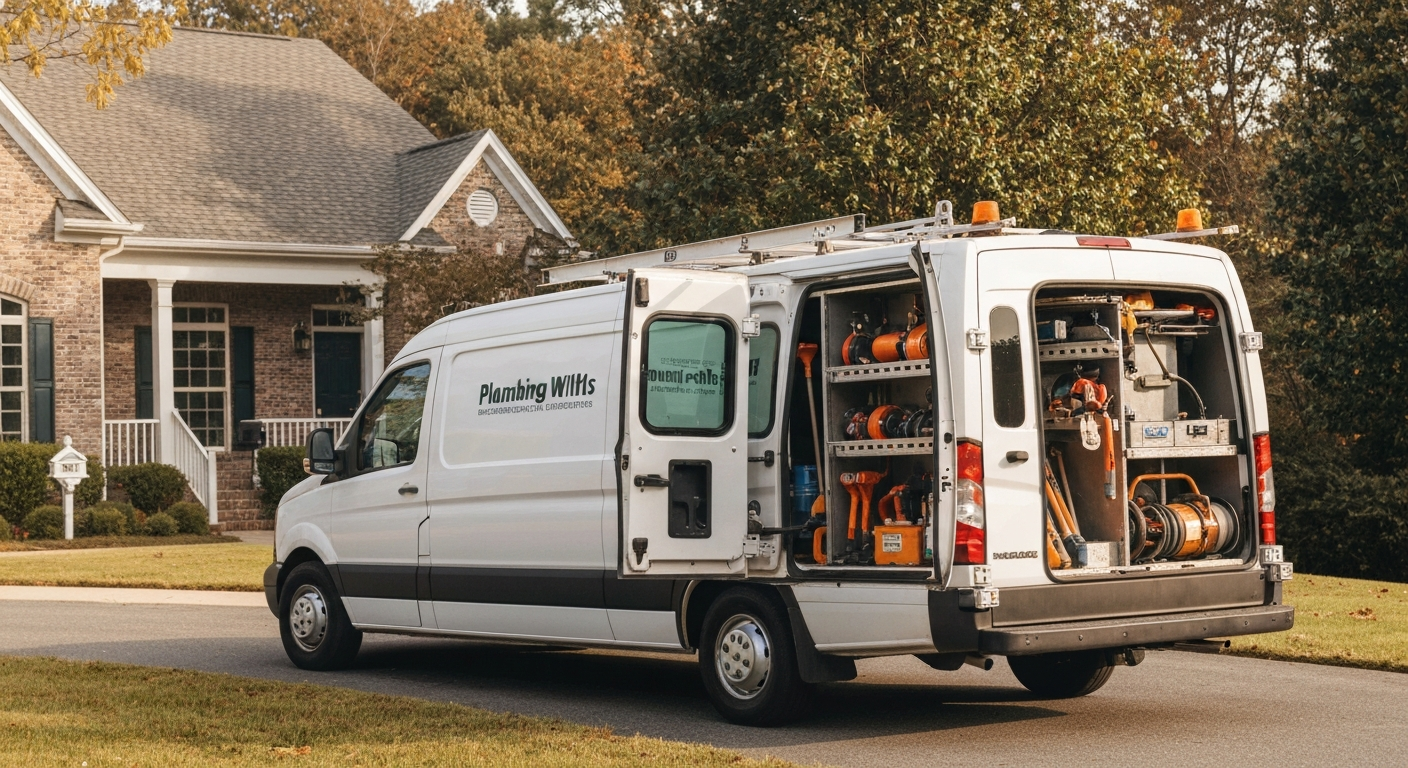
Tools and Equipment Coverage protects your gear against theft and damage. A fully outfitted plumbing van can carry $15,000-$30,000 in tools and materials. This coverage is relatively cheap given that exposure.
Professional Liability / Errors and Omissions covers claims arising from faulty workmanship — the water heater you installed that leaked, the drain line that wasn’t properly sloped. General liability covers property damage; E&O covers the cost of your mistakes. For a plumbing contractor, it’s worth having.
Budget: $4,000-$12,000/year depending on your size, number of vehicles, employee count, and coverage limits. Get quotes from at least three carriers, including insurers that specialize in contractor coverage.
Startup Costs at a Glance
Numbers are more useful than vague ranges, so here’s the actual breakdown for launching a solo or small-crew plumbing business in Virginia:
| Item | Cost |
|---|---|
| LLC filing (Virginia SCC) | $100 + $50/year |
| Tradesman license fee | $130 |
| Journeyman exam | ~$100 |
| Master exam (if applicable) | ~$125 |
| Contractor license (Class C) | $235 |
| Contractor license (Class B) | $370 |
| Contractor license (Class A) | $385 |
| Pre-license education | $200–$400 |
| BPOL license | Varies by locality |
| General liability insurance | $1,500–$4,000/year |
| Workers’ comp (if applicable) | Included in $4K–$12K range |
| Insurance total | $4,000–$12,000/year |
| Service vehicle (van or truck) | $20,000–$45,000 |
| Plumbing tools and equipment | $5,000–$20,000 |
| Drain camera and locator equipment | $3,000–$10,000 |
Total startup estimate for a Class C, solo operator: $12,000-$30,000 — assuming you already own or can finance a vehicle, and you’re buying a functional but not exhaustive tool set. The drain camera alone is worth including from day one; it differentiates you immediately and pays for itself fast.
If you’re going Class B or A from the start, add $135-$150 to the license cost and factor in higher insurance minimums. The vehicle and equipment costs are the same either way.
Your Next Step
If you already hold a journeyman or master plumber license, your first move is the contractor application through dpor.virginia.gov. Complete the 8-hour pre-license course, gather your financial documents if you’re going Class B or A, and file.
If you’re still working toward your tradesman license — or curious about the new Residential Plumber credential — call DPOR directly at (804) 367-8511. They can confirm current exam requirements and whether your specific experience combination qualifies you for the journeyman exam or the new residential path.
Form the LLC and get your EIN in parallel. Neither requires your licenses to be finalized, and having the business entity in place before you start spending money on equipment is just smart structure.