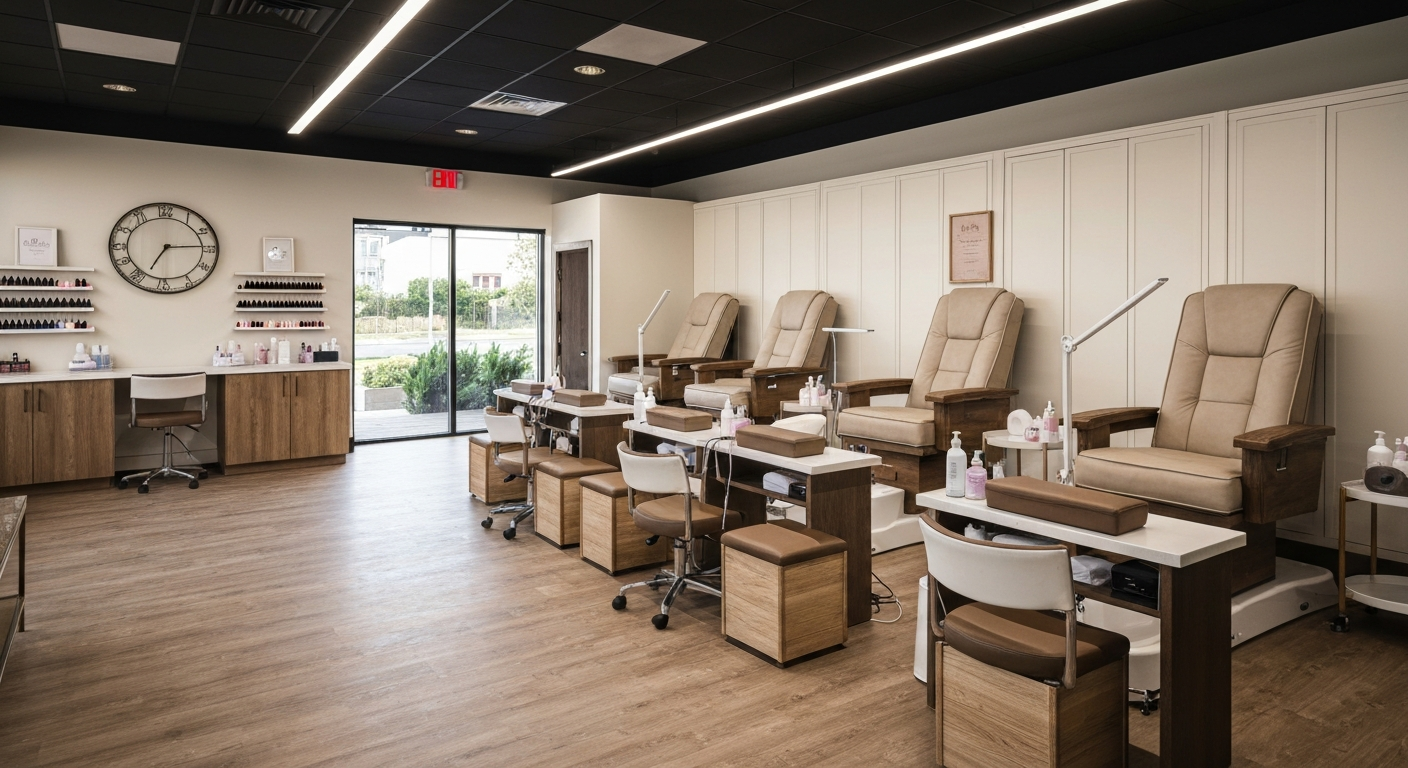
How to Start a Nail Salon Business in Virginia
How to Start a Nail Salon Business in Virginia
Virginia’s nail salon industry runs through a single regulatory body: the DPOR Board for Barbers and Cosmetology. Get licensed through them, meet their facility standards, and you’re operating legally. Skip any part of it, and you’re looking at a Class 1 misdemeanor. That’s not hyperbole — it’s the actual criminal classification Virginia assigns to performing nail services without a license.
The good news is that nail salons have a relatively straightforward licensing path compared to other beauty businesses. Nail technicians need just 150 hours of training — the lowest of any cosmetology discipline in Virginia. The trickier part is the salon itself, particularly ventilation. Acrylic nails, gel systems, and polish removers generate chemical fumes that are both a health hazard and a DPOR compliance issue. That’s where owners often get surprised.
Here’s everything you need to open a licensed nail salon in Virginia.
DPOR Nail Salon License
Any establishment offering nail care services in Virginia must hold a DPOR salon license. This applies whether you’re opening a standalone nail salon, adding nail services to an existing beauty business, or renting out stations to independent nail technicians. The license comes from the DPOR Board for Barbers and Cosmetology, reachable at (804) 367-8509 or [email protected].
The licensing requirement extends to who can work in that salon. Only licensed nail technicians and licensed cosmetologists may legally perform nail care services for compensation in Virginia. Hiring someone who’s “almost done with training” or letting an unlicensed employee fill in during a busy Saturday isn’t a gray area — it’s the kind of situation DPOR inspectors look for.
Your salon also has to meet specific facility requirements before DPOR issues the license. That means proper ventilation systems, sanitation stations for tools and implements, and compliant waste disposal setups. DPOR will inspect the space. The facility has to be ready — not almost ready, not “we’re installing the ventilation next week.”
The Class 1 misdemeanor classification for unlicensed nail services is worth taking seriously. Virginia Code puts it in the same category as reckless driving. Individual technicians, not just salon owners, face exposure here. If someone on your staff is performing services without a current license, that’s their criminal liability and your business problem.
Nail Technician License
The training requirement for a Virginia nail technician license is 150 hours at a DPOR-approved school. For context, cosmetologists need 1,500 hours. Barbers need 1,100. Nail technicians need 150. That’s genuinely low, and it matters for staffing: your talent pipeline is much faster to fill than in other parts of the beauty industry.
The alternative path is a 2,000-hour apprenticeship under a licensed nail technician. Almost nobody does this — the math doesn’t work out. School is faster by an order of magnitude.
After completing training, candidates must pass both a written and practical exam. Virginia uses the National Nail Technology exam for this. The written exam is $99 and the practical exam is $95, for a combined exam cost of $194. There’s also an application fee to DPOR on top of that.
Once licensed, nail technicians do not need continuing education to renew. The license expires every two years, and renewal is mostly administrative — pay the fee, submit the renewal. Compare that to massage therapists, who need 24 CEU hours per renewal cycle, and you’ll appreciate how simple nail tech licensing maintenance is.
One important note for salon owners thinking about staffing: verify every technician’s license before they touch a client. DPOR’s license lookup is public and free at dpor.virginia.gov. Make it a hiring policy, not an afterthought.
Ventilation and Safety
This is where nail salon compliance diverges from almost every other beauty business in Virginia. Hair salons worry about plumbing and sanitation. Nail salons have all of that plus a significant chemical exposure problem.
Acrylic nail application uses ethyl methacrylate (EMA) monomers. Gel systems use photoinitiators that off-gas under UV/LED curing lamps. Polish removers are acetone-heavy. In an enclosed space with multiple stations running simultaneously, these fumes accumulate fast. Long-term exposure causes respiratory issues, skin sensitization, and neurological effects in nail technicians — the research on this goes back decades, and it’s why OSHA and state regulators take it seriously.
DPOR inspects ventilation as part of the salon licensing process. This is not a box-checking exercise. If your ventilation doesn’t meet requirements, you don’t get licensed. If it deteriorates after licensing, you risk violations during follow-up inspections. Getting ventilation right upfront is both a compliance requirement and a practical investment in your staff’s health.
OSHA’s guidelines specifically recommend local exhaust ventilation (LEV) at each individual nail station — not just general room ventilation from overhead HVAC. The difference matters. A ceiling vent pulls fumes up and across the room, exposing everyone in the path. A local exhaust system captures fumes at the source, right at the nail table, before they disperse.
The industry standard for this is downdraft ventilation tables. These are nail stations with built-in exhaust fans that pull air downward through a filter, capturing fumes at nail level. Expect to pay $300–$800 per table depending on quality and brand. For a six-station salon, that’s $1,800–$4,800 just in ventilation-integrated furniture — before you add ducting, fans, and filtration systems for pedicure areas.
For the broader salon ventilation system, budget $2,000–$5,000. If your space needs significant ductwork or has an HVAC system that wasn’t designed for chemical fume management, costs can go higher. Get quotes from HVAC contractors who have done nail salon builds before — this is a specialty installation, not a standard commercial HVAC job.
One practical move: contact DPOR before buildout to confirm what their inspectors look for. The Board for Barbers and Cosmetology has specific standards, and a pre-inspection conversation can save you from expensive do-overs.
Startup Costs at a Glance
Nail salons have a wide cost range depending on size, location, and how much you’re building out from scratch. Here’s a realistic breakdown.
Business Formation
Form an LLC through the Virginia State Corporation Commission at cis.scc.virginia.gov. The filing fee is $100, and the annual registration fee is $50 per year. You’ll also need an EIN from the IRS — that’s free at irs.gov/ein. Get the LLC formed before you sign a lease or open any business accounts.
DPOR Nail Salon License
The salon license application goes through DPOR’s Board for Barbers and Cosmetology. Application fees apply — contact DPOR directly at (804) 367-8509 or check dpor.virginia.gov for current amounts, as fees can change. Factor this into your pre-opening budget alongside your inspection timeline. DPOR needs to inspect the physical space, so you can’t apply until your buildout is substantially complete.
Equipment
Nail stations range from $300 to $600 each for basic units, or $500–$800+ for downdraft ventilation tables. For a six-to-ten station salon, budget $2,000–$6,000 total on stations. Pedicure spa chairs are the biggest single equipment expense. Entry-level models start around $600–$800, but quality mid-range chairs with massage functions and pipeless jet systems run $1,500–$2,500 each. Four to six pedicure chairs puts you at $4,000–$15,000 depending on what you buy.
Don’t cheap out on pedicure chairs. Clients notice immediately, and low-quality pipeless systems are harder to sanitize — which creates both DPOR compliance issues and hygiene problems you can’t afford in a nail salon.
Ventilation System
As covered above: $2,000–$5,000 for a proper local exhaust system. If you’re buying downdraft tables, some of that overlaps with your station cost. Make sure you’re not double-counting in your budget.
Product Inventory
Stock up on gel polishes, acrylic powder and liquid, nail polish (expect 200+ colors if you’re doing full services), UV/LED lamps, drill bits, files, buffers, cuticle tools, sanitizing solutions, and disposables like liners for pedicure bowls. A reasonable opening inventory for a six-station salon runs $2,000–$5,000. Buy from a distributor like OPI, CND, or a wholesale beauty supplier rather than retail — your margins depend on it.
Build-Out
This is where costs vary most. Pedicure stations require plumbing — each chair needs a water supply and drain. If your space doesn’t have plumbing roughed in where you need it, you’re paying for new runs. Flooring in nail salons has to be easy to clean and chemical-resistant; luxury vinyl plank is common. Add lighting, reception area, retail display, and basic decor.
For a turnkey build-out of a 1,000–1,500 square foot salon, budget $10,000–$30,000. Lower end assumes favorable plumbing placement and minimal cosmetic work. Upper end includes significant plumbing relocation, custom millwork, and a polished interior.
Local Business License (BPOL)
Virginia has no statewide general business license. Every locality handles this separately under the BPOL (Business, Professional, and Occupational License) system. Your city or county levies this tax based on gross receipts, not net income. Rates and minimum fees vary — contact your local Commissioner of the Revenue to find out your locality’s rate before opening. Some localities charge a flat minimum in year one if you haven’t yet generated receipts.
Insurance
Budget $1,000–$3,000 per year for a business owner’s policy that includes general liability and property coverage. Nail salons should also carry professional liability (errors and omissions) coverage given the nature of services. If you have three or more employees — including part-time and temporary workers — Virginia requires workers’ compensation insurance. That’s a separate cost on top of your general liability.
Totals
A lean six-station salon with solid but not luxurious equipment: $25,000–$50,000 to open. A mid-range salon with ten or more stations, full pedicure service, and a well-finished interior: $50,000–$100,000. These ranges assume you’re leasing space, not buying it, and exclude working capital for the first few months of operation.
Getting Started
The critical path here is: form your LLC, secure your space, build out with ventilation first in mind, then apply to DPOR for your salon license once the space is ready for inspection. Don’t hire staff until their individual licenses are verified. Don’t open until DPOR has approved the salon.
The DPOR Board for Barbers and Cosmetology handles both the salon license and the individual nail technician licenses. Reach them at (804) 367-8509 or [email protected]. For business formation, the Virginia SCC is at cis.scc.virginia.gov or (804) 371-9733.
Ventilation is the thing that trips up first-time nail salon owners more than any other compliance issue. Get quotes from HVAC contractors who know nail salons, spec out downdraft tables when you order stations, and confirm your setup with DPOR before your final buildout. Everything else on this list is standard small business work. The ventilation is specific to you.