How to Start a Med Spa Business in Virginia
How to Start a Med Spa Business in Virginia
Virginia doesn’t require you to be a doctor to own a medical spa. That’s the headline. Non-physicians — entrepreneurs, investors, nurses with business ambitions — can hold the LLC or corporation outright. But that ownership flexibility comes with a firm condition: every medical procedure performed in your facility must be supervised by a licensed physician serving as medical director. No exceptions.
That distinction matters enormously. Some states restrict ownership to licensed medical professionals entirely. Virginia opens the door wider, which is why you’re seeing real investor and operator interest in the space here. But the medical director isn’t a checkbox or a name on a letterhead — they carry legal responsibility for clinical protocols, staff training, and treatment oversight. Getting that relationship right is the foundation of a compliant, defensible business.
Here’s what building that business actually looks like.
Ownership and Business Structure
Your first decision is how to hold the business. Virginia recognizes LLCs, corporations, and partnerships as valid ownership structures for a med spa — none of these require a physician as owner. An LLC is the most common choice for new operators: it limits your personal liability, gives you flexible tax treatment, and costs $100 to form through the Virginia State Corporation Commission. Annual registration runs $50. That’s genuinely cheap compared to most states.
A corporation works if you’re planning to bring in investors, issue equity, or eventually pursue an acquisition. More administrative overhead, but more structural flexibility if you’re thinking beyond a single location. Partnerships are less common for med spas given the liability exposure, but they’re legally available.
One structure worth knowing: the Management Services Organization (MSO). This is specifically designed for situations where a non-physician owns the business but wants a clean legal separation between the business entity and the clinical operation. The MSO (your company) owns the real estate, equipment, and administrative infrastructure, and contracts with a physician-owned professional corporation that handles the clinical side. It’s more complex to set up — you’ll want a healthcare attorney involved — but it creates a defensible firewall between business ownership and the practice of medicine. Some Virginia med spa operators use this model; others operate directly under a single LLC with a robust medical director agreement. Either can work. The MSO structure adds legal protection and is worth considering if your physician director is an independent contractor rather than a co-owner.
The medical director is non-negotiable. However you structure the entity, a licensed Virginia physician must supervise all medical treatments. Their responsibilities aren’t symbolic: they set clinical protocols, train and supervise non-physician providers, review treatment outcomes, and are legally accountable when something goes wrong. A physician who signs a contract but never shows up is a liability, not an asset. Regulators and plaintiffs’ attorneys know what a rubber-stamp arrangement looks like.
You’ll also need a Medical Facility License from the Virginia Department of Health before you can see patients. This is separate from your business registration with the SCC. More on that below.
Scope of Practice and Staffing
This is where most med spa compliance problems start. Virginia classifies Botox injections, dermal fillers, laser treatments, chemical peels, and similar aesthetic procedures as the practice of medicine. That classification has teeth: administering these treatments without proper licensure and supervision is illegal, and the consequences include license revocation, civil liability, and criminal charges.
Here’s how the staffing hierarchy works:
Physicians (MDs and DOs) can perform all procedures without additional oversight. Your medical director falls in this category. If your medical director is on-site and actively practicing, you have maximum clinical flexibility.
Nurse Practitioners (NPs) and Physician Associates (PAs) can administer Botox, fillers, laser treatments, and most other med spa procedures — but only under physician oversight. Virginia’s oversight requirements for NPs and PAs are less restrictive than some states (NPs, for example, have significant practice authority in Virginia), but a supervising physician must still be in the picture, review protocols, and be available for consultation. An NP or PA operating entirely independently in a med spa context, without any physician involvement, is out of compliance.
Registered Nurses (RNs) can perform treatments under physician supervision. The supervision must be more direct than what’s required for NPs and PAs — an RN injecting Botox needs physician-delegated authority and clear protocols, not just a general oversight agreement. What “supervision” means in practice (on-site vs. available by phone vs. reviewing charts) depends on the specific procedure and the physician’s delegation. Get this documented in writing.
Laser, IPL, and radiofrequency devices are explicitly classified as medical treatments in Virginia. Some states allow aestheticians to operate these devices. Virginia does not. If you’re planning to offer laser hair removal, IPL photofacials, or RF skin tightening, those services must be delivered by a qualified medical provider under physician supervision. An aesthetician with a laser certification from a weekend course cannot legally operate these devices in your facility without being a licensed medical professional.
The practical implication: your staffing model determines your service menu. If your medical director is part-time and your day-to-day staff is primarily RNs, your supervision protocols need to be airtight. If you’re building around NPs and PAs, you have more operational flexibility — but the physician still needs to be genuinely involved, not just reachable.
Licensing and Permits
Getting licensed involves multiple agencies. None of them coordinate with each other, so this process takes longer than it should. Start early.
Medical Facility License (Virginia Department of Health) This is the foundational clinical license. The Virginia Department of Health licenses facilities that provide medical services to patients. A med spa offering injections, laser treatments, or other medical procedures qualifies. The application requires documentation of your clinical protocols, physical space, and qualified personnel. Fees vary by facility type. Contact VDH early in your planning process — approval timelines can run weeks to months, and you can’t operate without it.
Business Registration (Virginia SCC) File your Articles of Organization (LLC) or Articles of Incorporation (corporation) at cis.scc.virginia.gov. $100 for an LLC. File first, then worry about the medical licensing — but know that you’ll need both before you open.
BPOL License (Local Jurisdiction) Virginia has no statewide general business license. Instead, every locality issues its own Business, Professional, and Occupational License under the BPOL system. Your city or county collects a tax based on gross receipts (not profit), and the rate varies by locality and business type. Contact your city or county’s commissioner of the revenue office to register. This is a requirement, not optional, and skipping it creates problems when you eventually try to get a bank loan or lease commercial space.
DEA Registration If your facility will store or dispense controlled substances — certain injectable anesthetics, for example — you’ll need a DEA registration. This is tied to the supervising physician’s DEA number. Get legal guidance on how this interacts with your business structure.
Individual Professional Licenses Every provider in your facility needs to be individually licensed by the appropriate Virginia board. Physicians through the Virginia Board of Medicine, NPs and RNs through the Virginia Board of Nursing, PAs through the Board of Medicine. Verify current licensure before anyone touches a patient. Don’t assume a provider’s credentials are in order — look them up on dhp.virginia.gov.
HIPAA Compliance Med spas are covered entities under HIPAA. You need written privacy policies, a HIPAA-compliant intake and records system, Business Associate Agreements with any vendors who handle patient data, and staff training. This isn’t aspirational — HIPAA violations generate real fines. Budget for a healthcare IT consultant or compliance software from day one.
Insurance Requirements
The insurance package for a med spa is more expensive than a standard retail or service business. That’s the cost of operating in a clinical environment. Don’t underinsure to save money — the first adverse event will make the savings feel absurd.
Medical Malpractice Insurance Every provider who performs medical procedures needs malpractice coverage. Plan on $5,000–$15,000 per year, depending on the number of providers, their credentials, and the procedures you offer. Botox and fillers carry lower risk profiles than surgical procedures, but they’re not zero-risk — vascular occlusion from filler injection is a serious adverse event that ends up in litigation. Your medical director’s personal malpractice policy may not cover them for work at your facility; confirm this explicitly and get facility-level coverage as well.
General Liability Insurance $1 million per occurrence is the standard minimum. This covers non-clinical incidents: a patient slips on a wet floor, property damage, general negligence claims. Separate from malpractice.
Property Insurance This matters more in a med spa than most businesses because your equipment is expensive. A single laser device costs $50,000–$200,000. IPL machines, RF devices, and other capital equipment need to be specifically covered — either through a rider on your property policy or a separate equipment floater. Standard property policies often have sublimits that won’t cover a $150,000 laser loss. Read the policy.
Workers’ Compensation Virginia requires workers’ comp when you have three or more employees, including part-time and temporary workers. Most med spas hit that threshold quickly. Coverage is available through private insurers or the Virginia Workers’ Compensation Commission. Don’t wait until you’re hiring your third employee to set this up — build it into your launch checklist.
Cyber Liability Insurance Strongly recommended for any HIPAA-covered entity. A breach of patient health records triggers notification requirements, potential HHS fines, and legal exposure. Cyber liability coverage handles breach response costs, regulatory defense, and some fine exposure. Annual premiums run $1,000–$5,000 for small practices. Given the cost of a breach response, it’s not optional in any practical sense.
Startup Costs at a Glance
Med spas are capital-intensive. Anyone who tells you otherwise is selling something. Here’s an honest breakdown:
Entity Formation
- LLC filing: $100 (one-time) + $50/year
- Medical Facility License: fees vary by facility type — budget for application and legal costs
Medical Director If your medical director is an external contractor rather than a co-owner, expect to pay $2,000–$10,000 per month. The range reflects how much time they’re actually spending at your facility versus a lighter oversight arrangement. A $2,000/month arrangement for a physician who reviews charts remotely and answers questions is very different from one who’s on-site two days a week. You get what you pay for, and a more involved medical director reduces your compliance risk.
Equipment Laser and IPL devices are the dominant capital expense. A professional-grade laser system runs $50,000–$200,000 new. Leasing is common: $2,000–$5,000/month for major equipment. If you’re leasing, read the contract carefully — maintenance, consumables, and upgrade terms vary widely. Factor in the cost of multiple devices if you want to offer a full service menu (laser hair removal and IPL photofacials require different wavelengths).
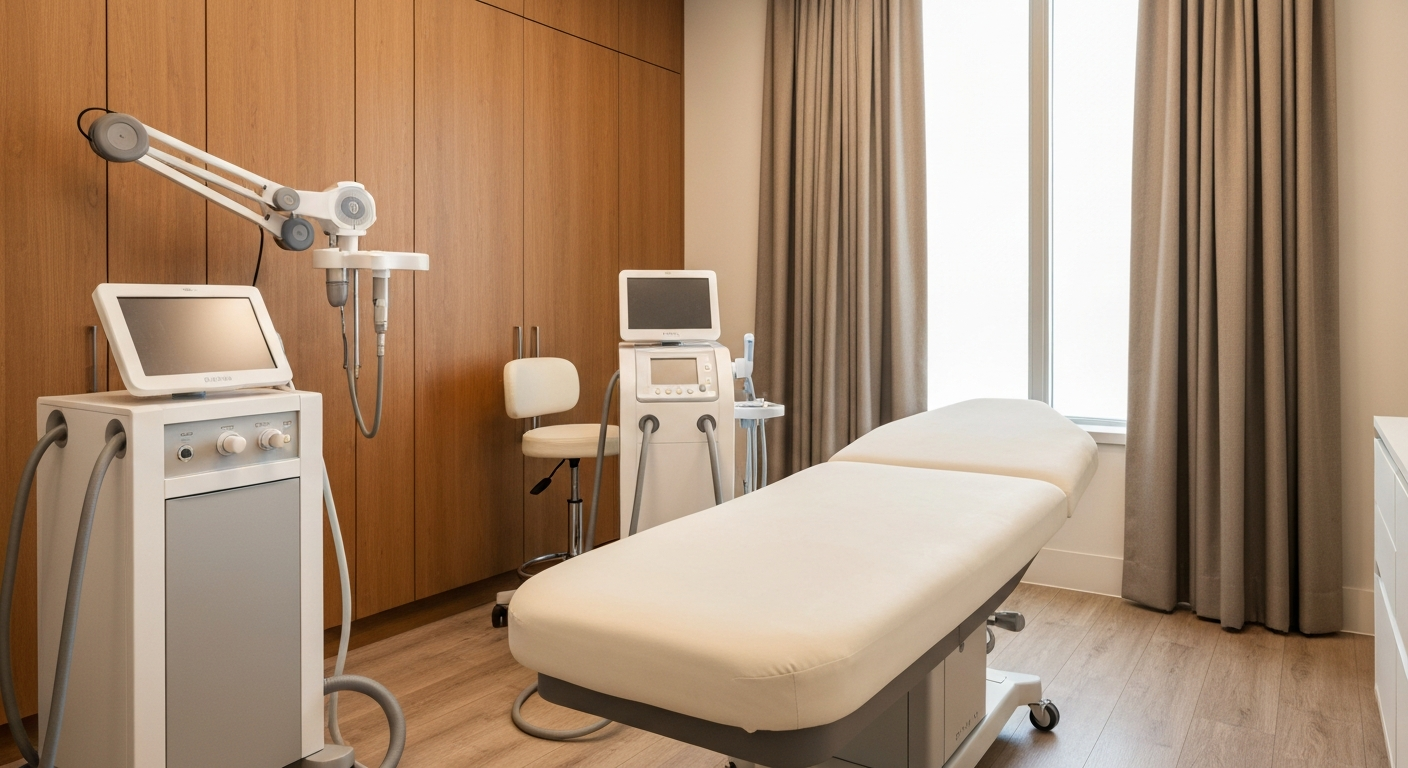
Build-Out Treatment rooms need medical-grade finishes: proper ventilation, appropriate lighting, cleanable surfaces, and enough space for both the procedure and emergency response if needed. A waiting area, front desk, and consultation space add square footage. Budget $50,000–$150,000 for a quality build-out. Location matters — some landlords have experience with medical tenants and understand the requirements; others don’t.
Insurance Full insurance package: $10,000–$25,000/year. Front-load this cost in your projections.
Supplies and Consumables Initial inventory of Botox, dermal fillers, skincare products, and disposables: $10,000–$30,000. These are ongoing costs — they show up on your P&L every month. Botox and filler wholesale pricing requires an account with a licensed pharmaceutical distributor, which requires your medical director’s involvement.
Total Startup Range $150,000–$500,000+, depending on location, service menu, equipment decisions, and whether you’re building out a new space or moving into an existing medical office. The lower end is possible with leased equipment, a modest build-out, and a part-time medical director. The higher end reflects a full laser suite, purpose-built space, and employed medical staff.
The Real Foundation
The paperwork and licenses are manageable. The harder work is building a medical director relationship that actually holds up — someone with the credentials, time, and genuine involvement to make your clinical operation compliant. That’s not a legal technicality. It’s the structure that makes everything else possible.
Start with the Virginia SCC to form your entity. Then get a healthcare attorney familiar with Virginia med spa law to review your medical director agreement and organizational structure before you sign anything. The legal consultation fee is a rounding error compared to the cost of unwinding a bad arrangement after you’ve already built the business around it.
The Virginia Department of Health’s website (vdh.virginia.gov) is your first stop for Medical Facility License requirements. The SCC handles business formation at cis.scc.virginia.gov. And the Department of Health Professions at dhp.virginia.gov lets you verify that every provider on your team is currently licensed before they see a single patient.