How to Start a Lawn Care Business in Virginia
How to Start a Lawn Care Business in Virginia
Virginia has no state license for basic lawn care. You can buy a mower, print some business cards, and start cutting grass legally tomorrow. That’s genuinely rare — plenty of states require licensing even for basic maintenance — and it makes lawn care one of the fastest businesses to launch here.
But “no license for basic mowing” doesn’t mean no requirements at all. The moment you apply anything chemical to a customer’s property — weed killer, fertilizer, pre-emergent — you need a state certification. And if a customer wants a patio, retaining wall, or irrigation system, that’s contractor territory with different rules entirely.
Three tiers. Different requirements for each. Here’s how they work.
Do You Need a License for Lawn Care in Virginia?
It depends entirely on what services you offer.
Mowing, trimming, edging, leaf removal, basic yard maintenance: No state license required. Virginia doesn’t regulate these services at the state level. You can operate legally as soon as you have a business entity and your local BPOL license (more on that below).
Pesticide, herbicide, or fertilizer application: Yes, you need a license. Specifically, a Commercial Pesticide Applicator license from the Virginia Department of Agriculture and Consumer Services (VDACS). This catches a lot of new operators off guard — many assume that spraying a customer’s lawn with Roundup or laying down granular weed-and-feed is just part of basic lawn care. It’s not, legally. If you’re applying anything regulated as a pesticide to someone else’s property for compensation, you need certification first.
Landscape construction — hardscaping, grading, retaining walls, irrigation installation: If any single project exceeds $1,000, you need a DPOR contractor license. This is the same licensing system that governs general contractors, plumbers, and electricians in Virginia. Landscape construction isn’t casual add-on work. It’s regulated.
Local BPOL license: Required regardless of which tier you operate in. Virginia has no statewide general business license, but every city and county has its own Business, Professional, and Occupational License system. If you’re servicing customers in Loudoun County, you need a Loudoun BPOL. If you cross into Fairfax, same deal. The tax is based on your gross receipts, not profit — rates vary by locality.
This three-tier structure is the right mental model for building your service menu. Start where you’re legally clear to operate, then expand as you add certifications.
Pesticide Applicator Certification
This is the requirement that catches most people. Someone starts a mowing operation, picks up a few accounts, and thinks offering weed control is an obvious upsell. They buy a backpack sprayer, hit the lawn with herbicide, and charge for it. That’s illegal in Virginia without certification — and VDACS enforces it.
Who regulates this: The Virginia Department of Agriculture and Consumer Services at vdacs.virginia.gov. They’re the authority on commercial pesticide application in the state.
The formal requirement: A Commercial Pesticide Applicator license is required to apply any pesticide to another person’s property for compensation. “Pesticide” in Virginia law includes herbicides, fungicides, insecticides, and fertilizers classified as pesticides. This isn’t a gray area — if you’re being paid to apply it to someone else’s property, you need the license.
How to get certified: You pass two exams. First is the core exam, which covers pesticide safety, handling, and regulations. Second is a category-specific exam based on the type of work you do. For lawn care operators, Category 3a: Ornamental and Turf is the standard. It covers turf management, weed control, pest identification, and pesticide application techniques relevant to lawn and landscape maintenance.
Exam fees run approximately $50-$100 depending on the testing pathway. VDACS provides study materials and a list of approved testing centers. It’s not a trivial exam — you need to actually know the material — but it’s not a multi-year certification process either. Most people study a few weeks and pass.
Keeping the license current: Recertification is required every two years through approved continuing education. VDACS has a list of approved courses and providers. Missing recertification means your license lapses, which means you can’t legally apply until you’re current again.
Record-keeping: Once you’re licensed and operating, you’re required to maintain records of every pesticide application for two years. That means the date, location, product used, rate applied, and target pest. This isn’t optional paperwork — it’s a legal requirement and your protection if a customer ever disputes a treatment or claims property damage.
If you plan to hire employees to apply pesticides, at least one licensed applicator must be responsible for supervising those applications. Your business can’t just hand a sprayer to an unlicensed employee and call it done.
Business Structure and Registration
Before you take on a single paying customer, you need a legal business structure. For most lawn care operators, an LLC makes sense. It separates your personal assets from business liability — important when you’re operating heavy equipment on someone else’s property.
Forming an LLC in Virginia: File Articles of Organization with the Virginia State Corporation Commission through the online Clerk’s Information System at cis.scc.virginia.gov. The filing fee is $100. After that, Virginia charges a $50 annual registration fee to keep the LLC active. That’s it — no franchise tax, no minimum business income tax like some other states impose.
If you want to operate under a name different from your LLC’s legal name (say your LLC is “Smith Outdoor Services LLC” but you market as “Green Turf Virginia”), you’ll need to register that trade name with the SCC for $10.
Getting an EIN: Get your Employer Identification Number from the IRS at irs.gov/ein. It’s free, takes about 10 minutes online, and you need it to open a business bank account, hire employees, and file business taxes. Even if you’re a solo operator with no employees, get the EIN — it keeps your Social Security number off paperwork you hand to clients.
State tax registration: Lawn care services in Virginia are subject to sales tax. That’s a detail many new operators miss. Register with the Virginia Department of Taxation at tax.virginia.gov to get your sales tax account set up. Virginia’s base sales tax rate is 4.3% state plus 1% local, though some regions add a regional component. You’ll collect sales tax from customers on taxable services and remit it to the state.
If you hire employees, you’ll also register for employer withholding through the same portal.
BPOL license: Contact the business licensing office in each city or county where you plan to work. Not just where you’re headquartered — where your customers are. Some localities require you to register before you start operating; others assess the tax after your first year based on reported gross receipts. Call the county or city finance office to get the specifics. BPOL rates for service businesses typically run a few dollars per thousand in gross receipts, but the minimums and structures vary enough that you need to check each locality directly.
Insurance and Equipment
Liability insurance is non-negotiable. You’re running a commercial mower at high speed near someone’s home, windows, landscaping, and — sometimes — their kids and pets. A rock through a window is a $500 problem. A serious injury is a lawsuit. General liability insurance for lawn care typically costs $500-$1,500 per year and provides $500,000 to $1 million in coverage. Most clients won’t care about your policy until something goes wrong. Then they’ll care a lot.
Many commercial property managers and HOAs require proof of insurance before they’ll sign a contract. Get it early — it also makes you look like a legitimate operation when you’re competing against unlicensed operators.
Workers’ compensation: Virginia requires workers’ comp when your business has three or more employees. That includes part-time workers, seasonal workers, and — critically — employees of subcontractors you hire can count toward the threshold. If you’re a solo operator, you’re exempt. Once you start building a crew, get the coverage before you hit the threshold, not after.
Commercial auto insurance: Your personal auto policy won’t cover a work truck loaded with equipment being used for business. Commercial auto coverage is separate and required. If you’re pulling a trailer, make sure your policy explicitly covers the trailer and its contents.
Equipment — what you actually need to start:
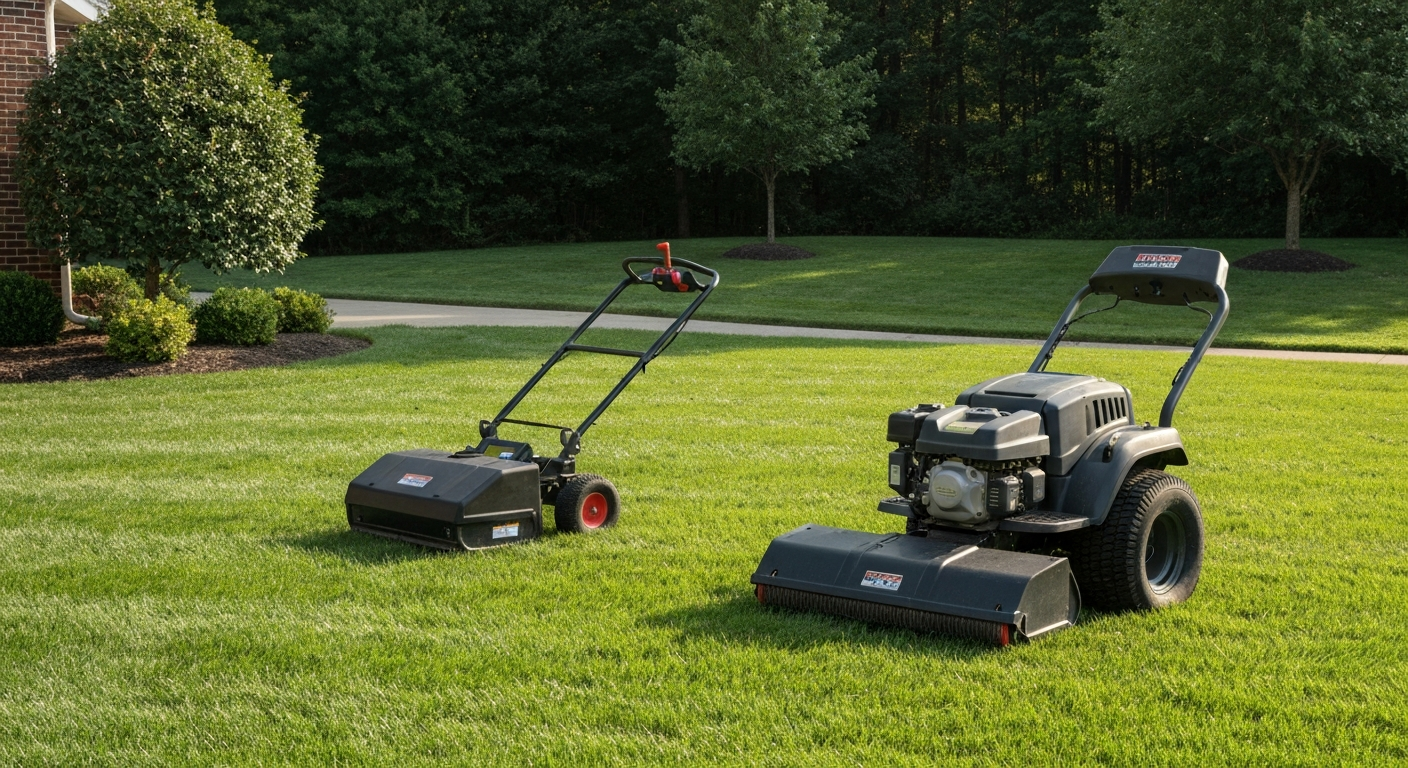
A commercial-grade walk-behind or zero-turn mower is your primary investment. Residential mowers from the big box stores aren’t built for daily commercial use — they’ll fail faster than you can recoup the cost. A quality commercial mower runs $3,000 on the low end for a reliable walk-behind up to $12,000+ for a zero-turn with a wide deck. Buy used from a reputable dealer if capital is tight, but inspect carefully.
Trimmer, blower, and edger: budget $500-$2,000 for a solid set of commercial-grade handheld equipment. Brands like Stihl and Husqvarna hold up to daily use. Cheap equipment breaks during the season when you can’t afford downtime.
A trailer to haul it all: $1,000-$5,000 depending on size and condition. A used open trailer gets the job done to start.
Work vehicle: a used pickup truck runs $5,000-$20,000 depending on age, mileage, and condition. You need something that can handle towing a loaded trailer in Virginia summers without overheating on every job.
Startup Costs at a Glance
Here’s what you’re actually looking at to get off the ground:
| Item | Cost |
|---|---|
| LLC filing (Virginia SCC) | $100 |
| Annual LLC registration fee | $50/year |
| VDACS pesticide applicator exams (if applicable) | ~$50-$100 |
| BPOL license | Varies by locality |
| Commercial mower | $3,000-$12,000 |
| Trailer | $1,000-$5,000 |
| Trimmers, blowers, edgers | $500-$2,000 |
| General liability insurance | $500-$1,500/year |
| Workers’ comp (if applicable) | Varies |
| Commercial auto insurance | $1,000-$2,500/year |
| Work vehicle (used truck) | $5,000-$20,000 |
Total lean startup, mow-only operation: roughly $5,000-$15,000. That assumes a used mower, a basic trailer, and an existing vehicle that can be converted to commercial use with proper insurance.
Total full-service operation with chemical application: $10,000-$30,000. The extra cost comes from a better equipment package, the pesticide application setup (commercial sprayer, spreader, storage), and slightly higher insurance premiums once you’re applying chemicals.
These are honest ranges. You can spend less if you buy used and start small. You can spend more if you try to launch at full scale immediately. Most successful lawn care businesses in Virginia started with one truck, one mower, and a handful of accounts — then reinvested revenue into equipment.
The Practical Sequence
Start with your business structure and local licensing — those are prerequisites for everything else. File your LLC with the SCC, get your EIN, register with the Virginia Department of Taxation, and pull your BPOL license from your home locality.
If you’re starting mow-only, you can begin taking customers immediately after that. Use the first season to build routes, establish pricing, and learn your local market.
If you want to offer chemical services, start studying for your VDACS pesticide applicator exams now — don’t wait until a customer asks for weed control. Category 3a study materials are available through VDACS at vdacs.virginia.gov. Get certified before you start selling the service.
Landscape construction is a longer path. DPOR contractor licensing requires documented experience, a passing score on business and trade exams, and a fee of $235-$385 depending on the license class. That’s a separate buildout from basic lawn care — most operators add it after they’ve established a solid maintenance revenue base.
The Virginia SCC can be reached at (804) 371-9733 or toll-free at (866) 722-2551 if you have questions about your formation. For pesticide licensing questions, contact VDACS directly through their website.
Lawn care in Virginia has a genuine low barrier to entry. Use that. Start legally, start lean, and add services as you earn the right to offer them.