How to Start a Laundromat Business in Virginia
How to Start a Laundromat Business in Virginia
Virginia has no state-level laundromat license. No certification, no industry-specific registration, no approval from Richmond before you open your doors. That’s the good news.
The less good news: opening a laundromat in Virginia is one of the most capital-intensive small businesses you can start. You’re looking at $200,000 on the low end — and more realistically $350,000–$500,000 by the time you’ve signed a lease, plumbed the building, bought equipment, and have enough cash reserve to cover utilities while you build a customer base.
But here’s why people do it anyway: a well-located laundromat, once established, runs close to semi-passively. You’re not trading hours for dollars the way a service business does. The machines do the work. Your job is maintenance, collections, and keeping the place clean enough that people come back.
This guide covers what you actually need to open — permits, water compliance, equipment, and what the numbers look like.
Licensing and Permits
There’s no statewide laundromat license. What you do need is a stack of local approvals plus one potential state-level environmental permit that most guides skip entirely.
BPOL License
Virginia doesn’t have a general statewide business license. All business licensing is handled locally under the Business, Professional, and Occupational License (BPOL) tax. You get this from whatever city or county you’re operating in — Fairfax County, the City of Richmond, Virginia Beach, wherever you’re located.
BPOL rates vary by locality and by business type. Most localities assess it based on gross receipts. Some charge a flat fee for low-revenue businesses in their first year. Contact your local commissioner of the revenue before you sign a lease — you want to know your tax obligation as part of your financial model, not after.
Certificate of Occupancy
Before you can open, the building has to pass inspection and receive a certificate of occupancy (CO) from your local building department. For a laundromat, this matters more than average. You’re putting heavy commercial equipment into a space, running significant plumbing, and — depending on your water heating setup — potentially installing commercial gas lines.
Any substantial plumbing or electrical work will require permits pulled before the work starts, inspections during, and sign-off at the end. Budget for this in your build-out cost. Trying to get a CO on work that wasn’t permitted is expensive and slow.
Zoning
Your location must be in a commercially zoned area that permits a laundromat or coin-operated laundry. This sounds obvious, but zoning isn’t just commercial vs. residential — there are subcategories. Some commercial zones allow retail but not service businesses with heavy water use. Some mixed-use zones have restrictions on laundry facilities beyond a certain size.
Check the zoning before you fall in love with a space. Your local planning or zoning department can confirm whether the property’s current zoning allows a laundromat. If it doesn’t, you’d need a special use permit or variance — that’s a public hearing process, and it’s not guaranteed.
Fire Department Inspection
Commercial laundry operations require a fire inspection before you open. Dryers are a fire risk — lint accumulation in commercial dryers is a documented cause of business fires. Your local fire marshal will want to see proper ventilation, accessible fire suppression equipment, and clear egress. This is a routine inspection for a new commercial occupancy, not a special laundromat-specific hurdle. Plan for it in your opening timeline.
VPDES: The Permit Most People Don’t Know About
Here’s the Virginia-specific environmental piece that almost never shows up in generic laundromat guides.
If your facility discharges wastewater to surface waters — a stream, a ditch, anything that connects to Virginia’s waterways — you need a Virginia Pollutant Discharge Elimination System (VPDES) General Permit from the Virginia Department of Environmental Quality (DEQ).
Most laundromats discharge to the municipal sewer system, which means the municipal wastewater treatment plant handles it — and you don’t need a VPDES permit. But if you’re in a location where the drainage situation is anything other than “straight to city sewer,” you need to determine your discharge path before you open, not after.
Laundry wastewater contains surfactants, phosphates, and sometimes bleach. DEQ takes this seriously. If VPDES applies to your situation, contact DEQ early — the permitting process takes time, and operating without a required permit creates real liability.
For most urban and suburban Virginia laundromat locations, this won’t apply. But if you’re looking at a rural property or an older commercial space with nonstandard drainage, ask the question.
Utility and Water Considerations
Water is your biggest operational variable. Get this wrong and you’ll be cash-flow negative no matter how busy you are.
How Much Water You’ll Actually Use
A mid-size laundromat — somewhere in the range of 20 to 40 machines — uses between 10,000 and 30,000 gallons of water per day when running at capacity. That’s not a typo. Commercial front-load washers are more efficient than the top-loaders people have at home, but volume is volume. Run 30 machines through multiple cycles all day and the water consumption is enormous.
This means two things practically. First, you need to confirm with your local utility that the water and sewer infrastructure at your location can handle that load. Second, your water and sewer bill will be one of your largest monthly expenses — potentially $2,000–$6,000 per month depending on your locality’s rates and your volume. Model this carefully.
Municipal Connection Requirements
You need municipal water and sewer connections. A laundromat cannot operate on well water and a septic system — the volume alone makes that impractical, and most localities wouldn’t permit it anyway. If the property you’re considering isn’t already connected to municipal water and sewer, or if the existing connections are undersized, factor in the connection and upgrade costs. That can run $10,000–$50,000 or more depending on the situation.
Water Heating
Hot water heating is a major cost center. You have two choices: gas or electric.
Gas is almost always cheaper to operate for high-volume hot water demand. A commercial gas water heater or boiler system for a laundromat costs more upfront but pays for itself in lower utility bills over time. Electric resistance heating is simpler to install but expensive to run at this scale.
Some operators use heat pump water heaters, which are significantly more efficient than electric resistance — but the upfront cost is higher and the systems require space and ventilation. If you’re building out a new space, get a mechanical engineer or experienced plumber to spec the water heating system for your machine count. Undersizing it means cold water complaints and rewashing cycles.
Energy-Efficient Equipment
Modern commercial washers with high-efficiency (HE) ratings use significantly less water and energy per cycle than older equipment. The machines cost more — sometimes substantially more — but the operating cost reduction over a 10-year equipment lifespan can be meaningful.
If you’re financing the build-out anyway (which most laundromat owners do), it often makes sense to finance better equipment rather than save money upfront on less efficient machines and pay for it every month in utility bills. Run the numbers for your specific situation.
Equipment
Equipment selection is where a lot of first-time laundromat owners make expensive mistakes — usually by buying too few machines, buying the wrong mix of capacities, or underinvesting in payment systems.
Washers
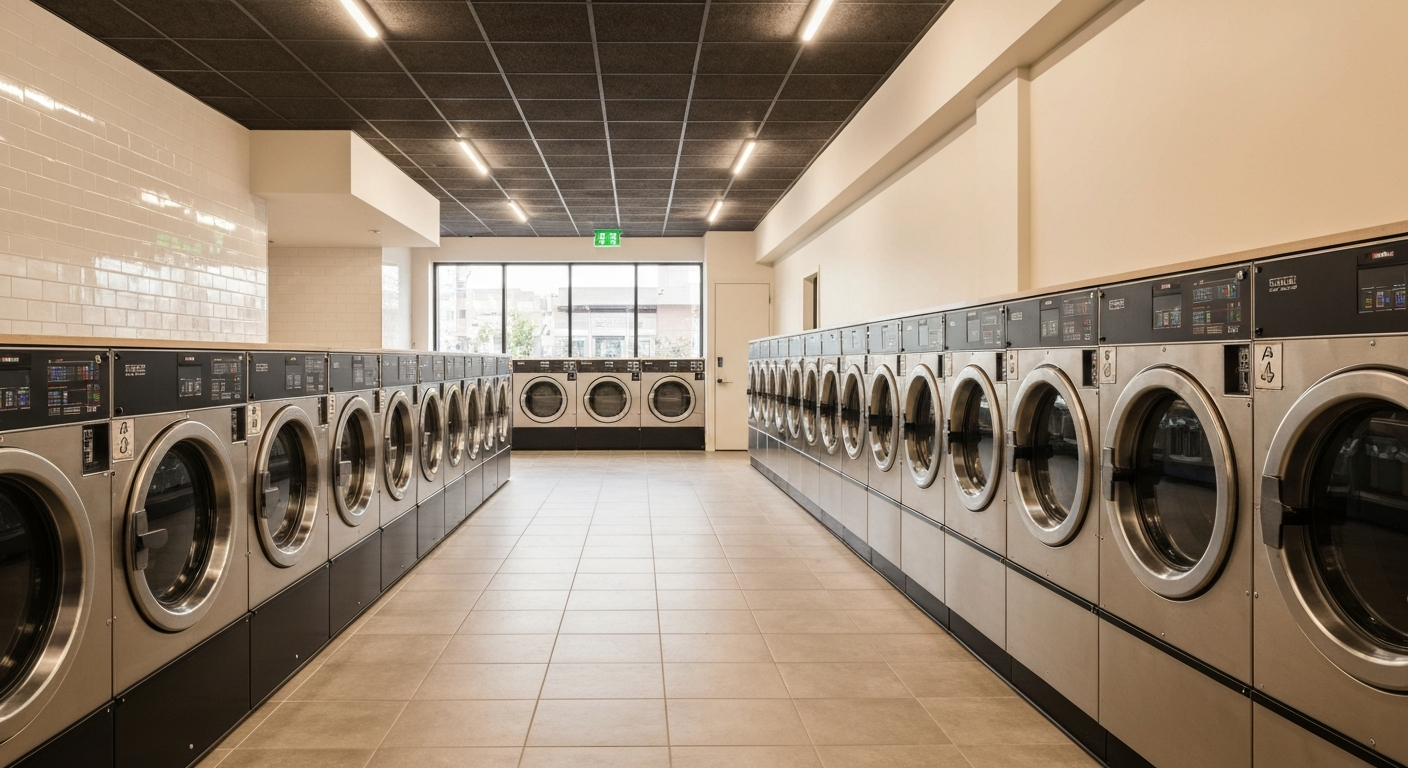
Commercial front-load washers run $800 to $5,000 or more per machine, depending on capacity. Small machines (18–20 lb capacity) sit at the lower end. Large-capacity washers (50–80 lb) — the kind people use for comforters and sleeping bags — can run $4,000–$8,000 each. A good laundromat has a mix.
The capacity mix matters. If you only have small machines, you’ll lose the customers who need to wash bulky items. Those customers often become regulars because they have no other option. Large-capacity machines also command higher prices per cycle, which improves your revenue per square foot.
Dryers
Commercial dryers run $800 to $3,000-plus each. Gas dryers cost more upfront than electric but are cheaper to operate — same principle as the water heaters. If you have gas service at the location, use gas dryers.
The standard rule of thumb is roughly a 2:1 ratio of dryer capacity to washer capacity — dryers need to keep pace with washers or you get bottlenecks that frustrate customers and slow turnover.
Payment Systems
This is where the industry has changed dramatically in the last decade. Coin-only laundromats are becoming harder to sustain — fewer people carry quarters, and younger customers in particular expect card or app-based payment.
A change machine or two is still necessary ($2,000–$5,000 each). But you’ll also want card readers or an app-based payment system. Modern laundromat payment systems — like those from Laundry Boss, PayRange, or SpyderWash — run $2,000–$10,000 to set up for a full facility and charge transaction fees ongoing.
The operational upside of app-based systems is real: you can monitor machine status remotely, adjust pricing without physical visits, and reduce the cash handling and coin collection burden. For a semi-passive operation model, this matters.
Fixtures and Furnishings
Folding tables, seating, laundry carts, and trash receptacles run $2,000–$5,000 for a mid-size location. Don’t cut corners here. Customers spend 45–90 minutes in your facility. If the seating is uncomfortable and the folding tables are cramped, they go somewhere else next time. A clean, functional, reasonably comfortable space retains customers.
Startup Costs at a Glance
Here’s the full financial picture for a mid-size Virginia laundromat with 20–40 machines:
Business formation
- LLC with Virginia SCC: $100 filing fee + $50/year annual registration fee
Licensing
- BPOL license: varies by locality, typically based on gross receipts
Equipment
- Washers and dryers (20–40 machines, mixed capacity): $100,000–$300,000
- Payment systems (card readers, app infrastructure, change machines): $2,000–$10,000
- Folding tables, seating, carts: $2,000–$5,000
Build-out
- Plumbing, electrical, flooring, HVAC, ventilation: $50,000–$150,000
- This is the hardest number to predict without a site-specific estimate
Insurance
- General liability + property insurance: $2,000–$5,000/year
- Workers’ compensation required once you have 3+ employees
Working capital
- 3–6 months of utilities, rent, and operating expenses: $15,000–$50,000
- Don’t skip this. Laundromats take time to build a customer base.
Total startup range: $200,000–$500,000+
The spread is wide because location makes a huge difference. A turnkey laundromat acquisition (buying an existing operation) often costs more upfront but skips the build-out nightmare and comes with an existing customer base. A ground-up build in a space that needs significant plumbing work hits the top of that range fast.
Financing
SBA 7(a) and SBA 504 loans are the most common financing vehicles for laundromat startups. The equipment and real improvements serve as collateral, which makes lenders more comfortable than with a pure service business. Expect to put down 10–30% and to have solid personal credit and financial history. Some equipment manufacturers offer financing directly, which can help with the machine costs specifically.
Location Is Everything
No permit or equipment decision matters as much as where you put the store.
The demographics that support a successful laundromat are specific: high density of renters (apartment and condo dwellers who don’t have in-unit washers), moderate to lower income households, and limited access to on-site laundry facilities. Areas with a lot of older apartment buildings — common in Northern Virginia suburbs, Richmond neighborhoods, and Hampton Roads — are worth serious evaluation.
Visibility and parking matter too. A laundromat tucked behind another building with no street presence will struggle. Customers are hauling laundry bags — parking needs to be close to the entrance. And visibility from a main road drives the impulse visits and new customer discovery that build your base.
Before you sign a lease, find out if there’s an existing laundromat within a half-mile. Competition in this business is brutal because customers default to the closest option. Saturation in a market makes it very hard to build volume fast enough to cover fixed costs.
Talk to residents in the area. Walk the neighborhood. The research takes a few days and can save you from a very expensive mistake.
Getting Started
The path forward is straightforward, even if the investment isn’t small.
Form your LLC through the Virginia SCC’s CIS portal ($100). Get your EIN from irs.gov/ein (free). Then focus on site selection — it deserves more time than any other decision you’ll make in this process.
Once you have a location, pull zoning confirmation, contact the local commissioner of the revenue about BPOL, and connect with a commercial plumber who has laundromat experience. That last part sounds niche, but plumbers who’ve done laundromat build-outs understand the water volume requirements. A general contractor who hasn’t done one before will underbid the plumbing and leave you with cost overruns.
The permitting stack is manageable. The capital requirement is real. Go in clear-eyed on both and you’re starting from the right place.