How to Start a Hair Salon Business in Virginia
How to Start a Hair Salon Business in Virginia
Virginia has no shortage of hair salons. But the ones that close within two years almost always have the same problem: the owner treated licensing as an afterthought and got surprised by the timeline. DPOR’s Board for Barbers and Cosmetology takes up to 45 days to review a salon license application. If you sign a lease, spend $60,000 on build-out, and then apply for your license, you’re paying rent on a space you legally cannot operate.
Start with the license. Build around it.
Here’s everything you need to open a hair salon in Virginia — licenses, staffing structure, insurance, and realistic costs.
DPOR Salon License Requirements
Every establishment offering cosmetology services in Virginia must hold a salon license issued by the DPOR Board for Barbers and Cosmetology. This isn’t optional, and it isn’t a formality. Operating without one is a Class 1 misdemeanor.
You apply through DPOR at dpor.virginia.gov. The review process takes up to 45 days — and that clock doesn’t start until DPOR has a complete application. Missing documents or fees reset the timeline. Before you commit to a lease, factor in that you may be 45+ days from opening day once you file.
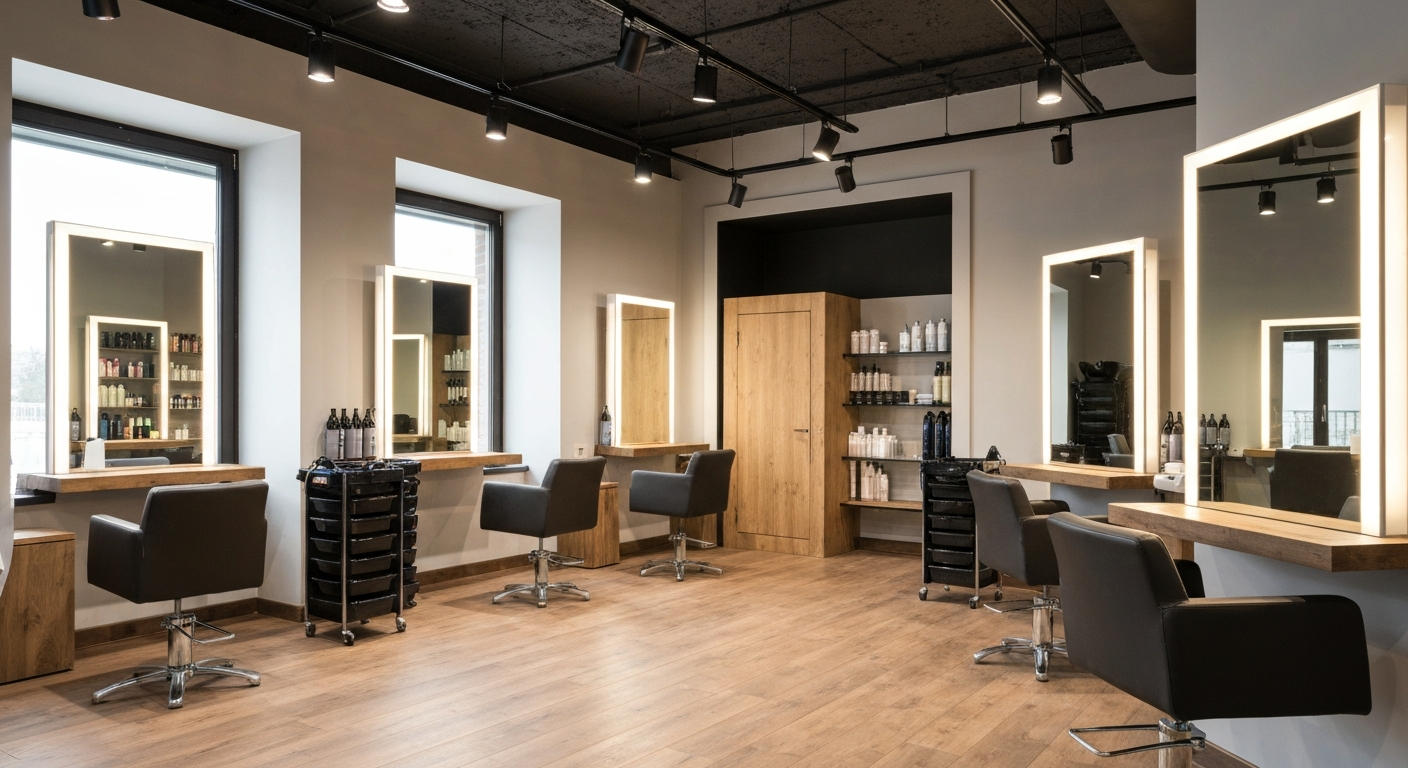
The application isn’t just paperwork. DPOR may inspect your premises before issuing the license, so your space needs to meet facility requirements for sanitation, ventilation, and equipment before you open your doors. That means proper ventilation for chemical services, sanitation stations, sterilized equipment, and enough space per styling station to meet the board’s standards. Build out your space with those requirements in mind from the start — retrofitting is expensive.
One thing that surprises a lot of first-time owners: you don’t need a cosmetology license to own a salon. Virginia doesn’t require the owner to be a licensed cosmetologist. If you’re a business-minded person who wants to own and manage a salon without cutting hair, that’s fully legal. But every single person who performs services in your salon — cuts, color, chemical treatments, styling — must hold an active individual DPOR license. You’re responsible for verifying that. Employing an unlicensed service provider exposes your salon license to revocation.
Once issued, the salon license must be displayed prominently in your establishment. Not in a back office. Somewhere clients can see it.
Contact DPOR at (804) 367-8509 or [email protected] with questions about your specific space or application.
Cosmetologist License Requirements
If you’re hiring cosmetologists — or getting licensed yourself — here’s what Virginia requires.
Training: 1,500 hours at a DPOR-approved cosmetology school. This is non-negotiable. Hours from unaccredited programs don’t count. When evaluating candidates, ask for their school transcripts, not just their license number. The license number tells you they passed; the transcript tells you what they actually learned.
Exams: After completing training, candidates must pass both a written exam ($99) and a practical exam ($95). Both are required. The written tests theory and sanitation knowledge; the practical tests hands-on technique. Some candidates clear the training hours and then stall on scheduling their exams — so if you’re hiring recent graduates, ask directly whether they’ve passed both.
New curriculum requirement: As of September 2024, DPOR-approved cosmetology programs must include a minimum of 25 hours of textured hair instruction. This is a meaningful change. If your salon serves clients with natural or curly hair — and most salons in Virginia do — this baseline training helps. But 25 hours is a floor, not a ceiling. When hiring, ask candidates specifically about their experience with textured hair beyond the curriculum minimum.
Ongoing requirements: All cosmetologists must maintain active DPOR licenses, renewed every two years. If a stylist’s license lapses and they continue working in your salon, that’s your problem too. Build a system — a calendar reminder, a spreadsheet, something — to track renewal dates for every person performing services. DPOR contact for licensing questions: (804) 367-8509.
Barbers operating in your salon fall under a slightly different license (1,100 hours of training, $105 application fee), and nail technicians require 150 hours and a separate DPOR license. If your salon offers those services, each category needs its own licensing verification.
Business Model — Booth Rental vs. Employee
This is the decision that shapes everything else about how your salon runs. Get it wrong and you’ll have IRS problems, insurance gaps, or a team that doesn’t feel like a team. Get it right and it sets your whole financial structure.
Booth rental model: Stylists pay you rent for use of a station — typically weekly or monthly. They’re independent contractors. They set their own hours, keep their own revenue, handle their own taxes, and carry their own professional liability insurance. Your income is predictable rent. Your management headaches are lower. But you have limited control over how they work, what products they use, or how they interact with clients. You can’t require them to attend staff meetings or wear a uniform without risking misclassification.
Employee model: You hire stylists as W-2 employees. You withhold payroll taxes, pay employer FICA, and potentially offer benefits. You control scheduling, service menu, product use, and client experience. Your revenue upside is higher because you’re capturing a percentage of every service rather than flat rent. But your overhead is higher too, and you’re responsible for making payroll whether or not the chairs are full.
Workers’ compensation: Virginia requires workers’ comp when you have three or more employees. That threshold includes part-time and seasonal workers — not just full-timers. If you’re running an employee model with three stylists, you need workers’ comp. Booth renters who are genuinely structured as independent contractors don’t count toward that threshold. Contact the Virginia Workers’ Compensation Commission for specifics.
The misclassification risk is real. The IRS looks at the actual working relationship, not just what your contract says. If you’re telling your “independent contractors” when to come in, requiring them to use specific products, setting their prices, and reviewing their work — that looks like employment. Misclassifying employees as booth renters exposes you to back taxes, penalties, and interest. The safer path: if you want control, hire employees. If you want simplicity and predictability, run a true booth rental model with contracts that hold up to IRS scrutiny. Have an employment attorney review your booth rental agreement before you use it.
Most successful salon owners pick one model and commit to it. Mixing both — some employees, some booth renters — is legally possible but administratively messy and harder to defend in an audit.
Insurance Requirements
Salons have specific liability exposures that general business insurance doesn’t always cover. You need several types, and cheap coverage in this industry has a way of not paying out when you actually need it.
General liability: This is your baseline coverage. Standard for salons is $1 million per occurrence. Annual cost runs $400-$1,200 depending on your location, size, and claims history. It covers slip-and-fall incidents, property damage to clients’ belongings, and basic bodily injury claims. Every salon needs this.
Professional liability (errors and omissions): General liability doesn’t cover claims arising from the services themselves. A client who has an allergic reaction to a color treatment, a chemical burn from a relaxer, or hair damage from an incorrect process — those are professional liability claims. This coverage is especially important if your salon does chemical services. Make sure it’s in your policy, not just assumed.
Property insurance: Covers your equipment, furniture, and inventory. Styling chairs, shampoo bowls, mirrors, color inventory, tools — that’s real money. If a pipe bursts or there’s a fire, property insurance is what gets you back open. If you’re leasing, your landlord’s insurance covers the building structure, not your contents. You need your own.
Workers’ compensation: Required at three or more employees in Virginia. If you hit that threshold, this isn’t optional — it’s state law. Even if you never have a claim, operating without required workers’ comp exposes you to fines and personal liability if a worker is injured. The Virginia Workers’ Compensation Commission website at workcomp.virginia.gov has employer resources and carrier options.
Budget $1,500-$4,000 per year total for a comprehensive insurance package for a small to mid-size salon. Don’t buy the cheapest policy. Read the exclusions.
Startup Costs at a Glance
Opening a hair salon is not cheap. Anyone who tells you otherwise is selling something. Here’s what you’re actually looking at:
Business formation and licensing:
- LLC filing with Virginia SCC: $100 (Articles of Organization) + $50/year ongoing
- DPOR salon license: application fee (confirm current fee at dpor.virginia.gov)
- BPOL business license: varies by locality — check with your city or county directly, as rates are based on gross receipts
Build-out and equipment:
- Salon build-out (stations, plumbing for shampoo bowls, electrical, flooring, decor): $20,000-$75,000. The plumbing alone can run $5,000-$15,000 depending on how many shampoo stations you’re adding and whether the space has existing plumbing in the right locations. This is the biggest variable in your budget.
- Styling chairs and stations (6-10): $5,000-$15,000. Quality matters here. Cheap hydraulic chairs fail under daily commercial use. Budget for mid-grade commercial equipment at minimum.
- Shampoo bowls and backwash units: $2,000-$8,000. Again, commercial-grade. The units that look nice in the catalog but aren’t built for 30 washes a day will cost you more in repairs than you saved upfront.
Operating startup costs:
- Product inventory (color lines, retail products, tools, supplies): $2,000-$5,000
- Insurance (first year): $1,500-$4,000
- Signage, POS system, booking software: $1,000-$3,000
- Security deposit and first/last month rent: varies significantly by market — Northern Virginia rents are dramatically different from Roanoke or Harrisonburg
Total realistic ranges:
- Lean startup, 4-6 stations: $40,000-$80,000
- Mid-range salon, 8-12 stations with full build-out: $80,000-$150,000
These ranges assume you’re leasing a space, not building from scratch. They also assume you’re not paying yourself during the build-out phase — which you won’t be.
If you’re in Northern Virginia, add 20-30% to the build-out estimates. Labor and commercial rents in Fairfax, Arlington, or Alexandria are not comparable to central or western Virginia. Know your market before you model your budget.
The Order of Operations
Given the 45-day DPOR review window, here’s the sequence that avoids expensive mistakes:
- Form your LLC with the Virginia SCC at cis.scc.virginia.gov — $100, done in a day or two online
- Get your EIN from the IRS at irs.gov/ein — free, immediate
- Identify your space and negotiate a lease with a delayed start date or rent abatement period that accounts for licensing time
- Begin DPOR salon license application — attach your space address and facility plan
- Complete build-out to DPOR facility standards
- Pass any DPOR inspection
- Receive salon license, display it, open
The gap between steps 3 and 6 is where most first-time owners lose money. Negotiate hard for a rent-free build-out period. Landlords in most Virginia markets will give you 30-60 days of free rent for a build-out — ask for 60-90 given the licensing timeline, and put it in writing.
One more thing: verify every stylist’s DPOR license before their first day of work. You can confirm license status through DPOR’s online lookup at dpor.virginia.gov. Takes two minutes and protects you from the liability of employing an unlicensed provider. Do it for every hire, every time.