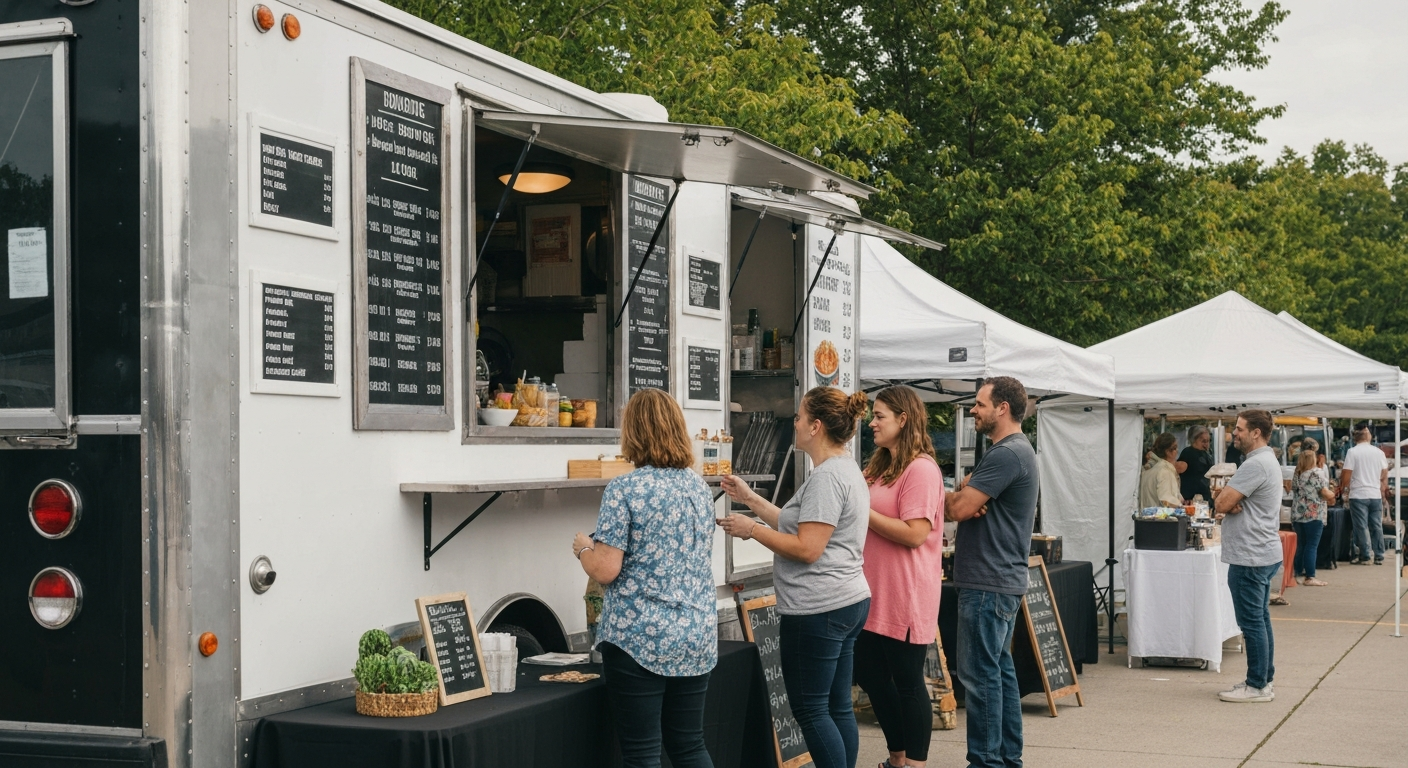
How to Start a Food Truck Business in Virginia
How to Start a Food Truck Business in Virginia
Virginia food trucks don’t answer to one permit authority. They answer to four.
Before you serve your first customer, you’ll need a mobile food unit permit from the Virginia Department of Health, a separate inspection from the Virginia State Fire Marshal’s Office, a physical inspection from your local health district, and a business license from every city or county where you operate. Some localities add a fifth layer — their own mobile food vendor permit on top of the BPOL.
That’s before you factor in the commissary kitchen requirement that most first-timers don’t see coming until it’s already delaying their launch.
The truck itself is the biggest line item — anywhere from $28,000 for a used setup to $175,000 for a custom build. But the permit stack, commissary costs, and insurance are what create the real surprises. This guide walks through every layer in sequence so nothing blindsides you.
Permits You Need for a Virginia Food Truck
There are four distinct regulatory layers. Each involves a separate agency, separate fees, and separate timelines. Don’t conflate them.
Layer 1: Virginia Department of Health (VDH) Mobile Food Unit Permit
VDH treats your food truck as a food establishment. That means it requires the same foundational permitting as a brick-and-mortar restaurant — just in mobile form.
The process starts with a plan review application. Submit it to your local health department (not VDH directly) at least 30 days before you plan to open. The fee is $40. You’ll submit equipment specs, your menu, a layout of the truck’s interior, water tank capacities, and commissary information. The health department reviews it to confirm your setup meets food safety requirements before anything gets built or purchased.
Once you pass plan review and the physical inspection, VDH issues a permit sticker that must be prominently displayed on your truck. The annual food establishment permit costs $40/year. That sticker is what health inspectors in the field will check.
If you want to look up your local health district or find VDH food establishment resources, start at vdh.virginia.gov/environmental-health.
Layer 2: Virginia State Fire Marshal’s Office Inspection
This one costs $200/year and covers your truck as a mobile food preparation vehicle. It’s a separate inspection from the health department — different agency, different focus.
The fire marshal inspects fire suppression systems, propane storage and line connections, electrical systems, ventilation adequacy, and extinguisher placement. If you’re running fryers or a flat-top grill, the suppression system over your cooking equipment is scrutinized closely. Any deficiencies need to be corrected before you get clearance.
Budget this into your annual operating costs from day one. You can find more information at vafire.com.
Layer 3: Local Health Department Inspection
Virginia has 35 local health districts, and your district’s environmental health team conducts the physical inspection of your truck. This is the inspection that follows plan review approval — they come out to the actual vehicle to verify that what you submitted on paper matches what’s been built.
Don’t assume this is a rubber stamp. If your three-compartment sink doesn’t meet specs, or your water tank is undersized for your menu volume, you’ll get sent back for corrections. Schedule this inspection early and leave buffer time before your planned opening date.
Layer 4: City/County BPOL License
Virginia has no statewide general business license. All business licensing is local. Every city and county uses the BPOL (Business, Professional, and Occupational License) system, and the tax is based on gross receipts — not profit.
If you operate in multiple localities, you may owe BPOL in each one. Rates and minimum fees vary. A few jurisdictions also require a separate mobile food vendor permit in addition to the BPOL — check with each locality’s commissioner of the revenue or business licensing office before you start operating there.
Mobile Food Unit Physical Requirements
Your truck has to meet VDH’s physical requirements to pass plan review and inspection. These aren’t suggestions — if your equipment doesn’t meet the standard, you don’t operate.
Handwashing sink. You need a dedicated handwashing sink with hot and cold running water. It must be separate from your food prep sink. This is non-negotiable.
Three-compartment sink. Required for washing, rinsing, and sanitizing equipment and utensils. Each compartment needs to be large enough to accommodate your largest piece of equipment. Size matters here — undersized sinks are a common plan review rejection.
Commercial-grade refrigeration and heating. Standard household refrigerators don’t meet the standard. You need commercial refrigeration capable of holding cold foods at 41°F or below, with thermometers installed. Hot-holding equipment must maintain 135°F or above.
Ventilation. If you’re running a grill, fryer, flat-top, or oven, you need proper exhaust hoods and a ventilation system. This ties directly to the fire marshal inspection — the two agencies are essentially checking the same equipment from different safety angles.
Water tanks. Potable water tank and wastewater holding tank, both sized for your menu and daily volume. Virginia requires your wastewater tank to be at least 15% larger than your fresh water tank. The higher your volume, the larger the tanks you’ll need — and large tanks eat into your truck space and payload capacity.
One more hard rule: all operations and equipment must be integral to and within or attached to the unit. No external cooking setups. You can’t set up a portable burner outside the truck and call it part of your operation.
Commissary Kitchen Requirements
Here’s what trips up most first-timers.
Many Virginia localities require a commissary agreement — a written contract with an approved commercial kitchen where you handle food prep, food storage, equipment cleaning, and wastewater disposal that exceeds what the truck can handle alone. Some localities require you to return to the commissary every day, even if your truck has adequate onboard capacity.
The commissary must have its own valid VDH food establishment permit. You can’t use a neighbor’s restaurant kitchen or a church kitchen that hasn’t been inspected. It has to be a properly licensed commercial kitchen.
Your commissary agreement is something you’ll submit during plan review. Don’t try to finalize your permit application without it — you’ll be asked.
Costs vary significantly depending on what you need:
- Shared commissary kitchen access: $400–$1,200/month — typically includes a reserved storage space, parking, and scheduled kitchen time
- Full-service commissary with dedicated parking, storage, and prep space: $1,000–$3,000/month
- Pay-as-you-go at a shared commercial kitchen: $15–$45/hour
If you’re doing low-volume service to start, hourly access might be more economical. But if you’re running five days a week and need reliable parking and cold storage, a monthly arrangement is usually worth it.
Don’t underestimate this ongoing cost. For a truck grossing $8,000/month, commissary fees alone can represent 10–15% of revenue before you’ve paid for food, insurance, or labor.
Business Structure and Registration
Form your LLC first. It separates your personal assets from the business — important when you’re operating a vehicle, handling food, and employing staff. File your Articles of Organization with the Virginia State Corporation Commission at cis.scc.virginia.gov. The filing fee is $100. Annual registration costs $50/year.
Get your EIN. Free at irs.gov/ein. You need it to open a business bank account, hire employees, and register for state taxes.
Register for sales tax. Prepared food sold from a food truck is taxable in Virginia at the full rate — 4.3% state + 1% local + applicable regional taxes. Register through the Virginia Department of Taxation at tax.virginia.gov. Don’t wait until you’re open to figure this out. You need to be collecting and remitting from day one.
Alcohol. If you want to serve beer, wine, or mixed drinks, you’ll need an ABC license. The specific license category depends on your model — a caterer’s license works differently than a mobile vendor license. Either way, the application goes through the Virginia Alcoholic Beverage Control Authority at abc.virginia.gov, and the processing time averages 60–90 days. Plan accordingly. A mixed beverage restaurant license starts at $1,050 for up to 100 seats — the equivalent tier for your operation depends on how the ABC classifies your service model, so call them early.
Food handler certification. Every food employee must be certified within 30 days of hire. Virginia law caps the cost at $15 per person. This isn’t optional and it applies to everyone working with food on the truck.
Insurance for Virginia Food Trucks
A food truck is a commercial vehicle AND a food production facility. That means you need insurance built for both — standard auto insurance won’t cover it, and a general liability policy alone won’t cover an accident on the road.
General liability insurance: Covers customer injuries, property damage claims, and similar third-party exposure. Expect to pay $300–$700/year for $1 million in coverage.
Commercial auto insurance: Required for the truck itself. This is typically the most expensive policy in your stack — $2,000–$5,000/year depending on the truck’s value, your driving record, and how many miles you’re putting on it annually.
Product liability insurance: Covers claims arising from foodborne illness or allergic reactions. Some general liability policies include this; others exclude it or require an endorsement. Read the policy language carefully.
Equipment and contents insurance: Covers your commercial cooking equipment, POS system, and food inventory inside the truck. If a fire or theft takes out your generator and fryer, this is what replaces them.
Workers’ compensation. Virginia requires workers’ comp once you hit three or more employees — including part-time, seasonal, and temporary workers. Subcontractor employees can count toward that threshold too. The penalty for non-compliance is up to $250/day, with a maximum of $50,000 plus costs. More information at workcomp.virginia.gov.
Startup Costs for a Virginia Food Truck
Don’t go into this undercapitalized. Food trucks are real businesses with real capital requirements. Here’s what you’re actually looking at.
The truck. A used, pre-equipped food truck runs $28,000–$77,000 depending on age, condition, equipment quality, and how much work it needs before passing inspection. A new custom build runs $85,000–$175,000 depending on size and customization. The cheapest truck isn’t always the best deal — an older truck with aging equipment might need $10,000 in repairs before it passes the fire marshal inspection.
Commissary: $400–$1,200/month for shared access, more for full-service. Budget this as a fixed monthly operating cost before you calculate any profit.
Permits and licensing: Your first-year government fee stack looks something like this:
- VDH plan review: $40
- VDH annual food establishment permit: $40
- Fire marshal inspection: $200
- LLC filing: $100
- BPOL license: varies by locality, but commonly $50–$500+ depending on estimated gross receipts
- Any additional local mobile vendor permits: varies
Budget $500–$1,500 for the permit stack in year one, not counting the truck inspection costs if your equipment needs upgrades to pass.
Initial food inventory: $1,000–$3,000 to stock up for opening. Depends heavily on your menu — a taco truck has a different inventory profile than a lobster roll truck.
POS system and payment processing: $500–$2,000 upfront for a tablet-based system, card reader, and receipt printer. Monthly software fees apply separately.
Branding and vehicle wrap: $2,500–$5,000. Your truck is your billboard. A cheap wrap looks cheap. This is not a place to cut corners if you care about street-level visibility.
Costs at a Glance
| Item | Cost |
|---|---|
| LLC filing (one-time) | $100 |
| LLC annual registration | $50/year |
| EIN | Free |
| VDH plan review | $40 (one-time) |
| VDH annual food establishment permit | $40/year |
| Fire marshal inspection | $200/year |
| BPOL license | Varies by locality |
| Food handler certification | Up to $15/person |
| General liability insurance | $300–$700/year |
| Commercial auto insurance | $2,000–$5,000/year |
| Workers’ comp (at 3+ employees) | Varies by payroll and classification |
| Food truck (used, pre-equipped) | $28,000–$77,000 |
| Food truck (new custom) | $85,000–$175,000 |
| Commissary kitchen | $400–$1,200/month (shared) |
| Initial food inventory | $1,000–$3,000 |
| POS system | $500–$2,000 |
| Vehicle wrap | $2,500–$5,000 |
Total first-year costs including a used truck purchase: approximately $40,000–$90,000. That range is wide because the truck purchase dominates the number — a $28,000 used truck and a $77,000 used truck create very different starting points.
The Sequence That Actually Works
Don’t run these permits in parallel without understanding the dependencies.
Start with your business formation — LLC, EIN, tax registration. Then find your commissary before you finalize your truck purchase, because your commissary determines where you’ll be operating out of, which determines which local health district handles your plan review. Then submit your plan review application with your commissary agreement in hand.
After plan review approval, schedule your local health department truck inspection and your fire marshal inspection. Get your BPOL license from every locality you plan to operate in. Then open.
That sequence takes most operators three to six months from decision to first service. Rushing it doesn’t compress the timeline much — VDH plan review alone has a 30-day minimum. Budget the time the same way you budget the money.
One resource worth bookmarking: the Virginia Business One Stop portal at Virginia.gov provides a state-level checklist and links to the relevant agencies. It won’t replace the locality-specific research you’ll need to do, but it’s a useful starting point for the state-layer requirements.
For direct questions on Virginia SCC filings, call (804) 371-9733 or toll-free at (866) 722-2551.