How to Start a Dental Practice in Virginia
Dental License Requirements
Before you sign a lease or buy a single piece of equipment, you need a valid Virginia dental license. Everything else — the LLC, the build-out, the staff — comes after this.
The Virginia Board of Dentistry operates under the Department of Health Professions (DHP) at dhp.virginia.gov. That’s your primary resource for applications, fee schedules, and renewal requirements. The Board sets the standards for who can legally practice dentistry in Virginia, and there’s no shortcut around it.
The requirements to get licensed:
You must have graduated from an accredited dental school — accredited by the Commission on Dental Accreditation (CODA). Foreign-trained dentists face a separate, more involved process; this guide focuses on the standard domestic path.
You need to pass the National Board Dental Examination. All parts. The NBDE (now transitioning to the INBDE for newer graduates) covers basic biomedical sciences and dental clinical sciences. No exceptions for partial completion.
You also need to pass a clinical competency exam — Virginia accepts the CDCA (Commission on Dental Competency Assessments) exam or other approved regional clinical exams. The clinical exam is where a lot of dentists hit delays, since exam dates fill up and scheduling can add months to your timeline. Plan for this early.
All applications go through DHP’s online portal exclusively. There’s no paper application. You’ll upload your credentials, transcripts, and exam scores through the system. Processing times vary, so don’t assume approval is immediate — apply well before your planned opening date.
Already licensed elsewhere? Licensure by Credentials is your path.
If you’ve been practicing in another state, Virginia offers licensure by credentials rather than requiring you to retake exams. The requirement: 600 hours of practice in each of 5 of the 6 preceding years. That’s a meaningful threshold — it’s designed for active practitioners, not someone who let their license lapse. If you meet it, you avoid the clinical exam entirely, which is a significant time and cost savings.
Practice Ownership Structure
Once you have (or are on track for) your license, you need a legal entity to own and operate the practice. This is where the business side starts.
Virginia gives you several options: sole proprietorship, general partnership, LLC, or Professional Corporation (PC). For a dental practice, the choice almost always comes down to LLC versus PC.
LLC: File Articles of Organization with the Virginia State Corporation Commission (SCC) at cis.scc.virginia.gov. The filing fee is $100, and you’ll pay $50/year to keep it active. An LLC gives you liability protection, flexible management structure, and pass-through taxation by default. Most small and solo practices go this route.
Professional Corporation (PC): The Articles of Incorporation for a PC cost $75 with the SCC. A PC is specifically designed for licensed professionals — it offers liability protection similar to an LLC but operates under corporate formality rules. Some dental accountants prefer the PC structure for tax planning reasons, particularly around S-corp elections. Worth a conversation with a CPA before you decide.
A sole proprietorship costs nothing to set up but gives you zero liability protection. If a patient sues your practice, they’re suing you personally. Don’t do it.
Here’s the genuinely good news for Virginia: the state does not require a separate dental facility license. Some states — Maryland, for example — require a facility permit before you can open the doors of a dental office. Virginia doesn’t. Your individual dentist license covers your ability to practice. The practice entity handles the business. That removes one entire regulatory layer from your startup checklist.
You will, however, need a BPOL license (Business, Professional, and Occupational License) from your local jurisdiction. Virginia has no statewide general business license — all of that is handled at the county or city level. BPOL fees vary by locality and are typically calculated on gross receipts after your first year. Contact your city or county commissioner of revenue’s office to find out the exact requirement for your location. This is not optional, and the penalties for operating without it aren’t worth ignoring.
One more registration: get your EIN (Employer Identification Number) from the IRS at irs.gov/ein. Free, takes about 10 minutes, and you need it to open a business bank account and handle payroll.
Insurance and Compliance
A dental practice carries more liability exposure than most small businesses. You’re performing invasive procedures, handling controlled substances, and maintaining sensitive health records. The insurance and compliance requirements reflect that.
Malpractice insurance is non-negotiable. Budget $3,000–$8,000 per year for a general dentistry practice. The range depends on your coverage limits, location, claims history, and whether you carry occurrence-based or claims-made coverage. Occurrence-based is generally better long-term (it covers incidents that happened during the policy period regardless of when the claim is filed), but it costs more upfront. Don’t cut corners here — a single malpractice claim without adequate coverage can end your practice before it starts.
General liability insurance covers slip-and-falls, property damage, and other non-clinical incidents at your office. Figure $1,000–$3,000/year. Most landlords require proof of general liability before you occupy the space anyway.
Workers’ compensation: Virginia requires it once you have 3 or more employees. You’ll likely hit that threshold quickly — a solo dentist typically needs at least a front desk person and a dental assistant on day one. Don’t wait until you’re already at three employees to figure this out.
HIPAA compliance applies to every dental practice without exception. You’re handling protected health information (PHI) — patient records, treatment histories, insurance data. You need written privacy policies, staff training, a designated privacy officer (can be you), and a Business Associate Agreement process for any vendor who touches patient data. HIPAA violations carry fines starting at $100 per violation and going up to $50,000 per violation for willful neglect. A basic compliance setup isn’t expensive; a HIPAA violation is.
OSHA compliance is equally mandatory. Dental offices deal with bloodborne pathogens, sharp instruments, and aerosol-generating procedures. OSHA’s Bloodborne Pathogens Standard (29 CFR 1910.1030) and Hazard Communication Standard apply directly to your practice. You need an Exposure Control Plan, documented staff training, proper sharps disposal, and personal protective equipment protocols. OSHA can inspect without advance notice.
DEA registration is required if you plan to prescribe controlled substances — Schedule II through V. For most general dentists prescribing opioids for post-operative pain or benzodiazepines for anxiety management, this applies. The DEA registration fee is $888 for a three-year registration. Apply at the DEA Diversion Control Division’s website. If you’re not prescribing controlled substances, you can skip this one — but most general practices eventually need it.
Startup Costs at a Glance
Opening a dental practice is not a $10,000 side hustle. It’s one of the most capital-intensive businesses you can start outside of a restaurant or manufacturing operation. Going in with accurate numbers prevents the kind of mid-construction cash crisis that derails practices before they open.
Here’s what to expect:
Entity formation: $75–$100 to file with the SCC (PC or LLC), plus $50/year for the annual registration fee. Cheap. This is the only cheap line item.
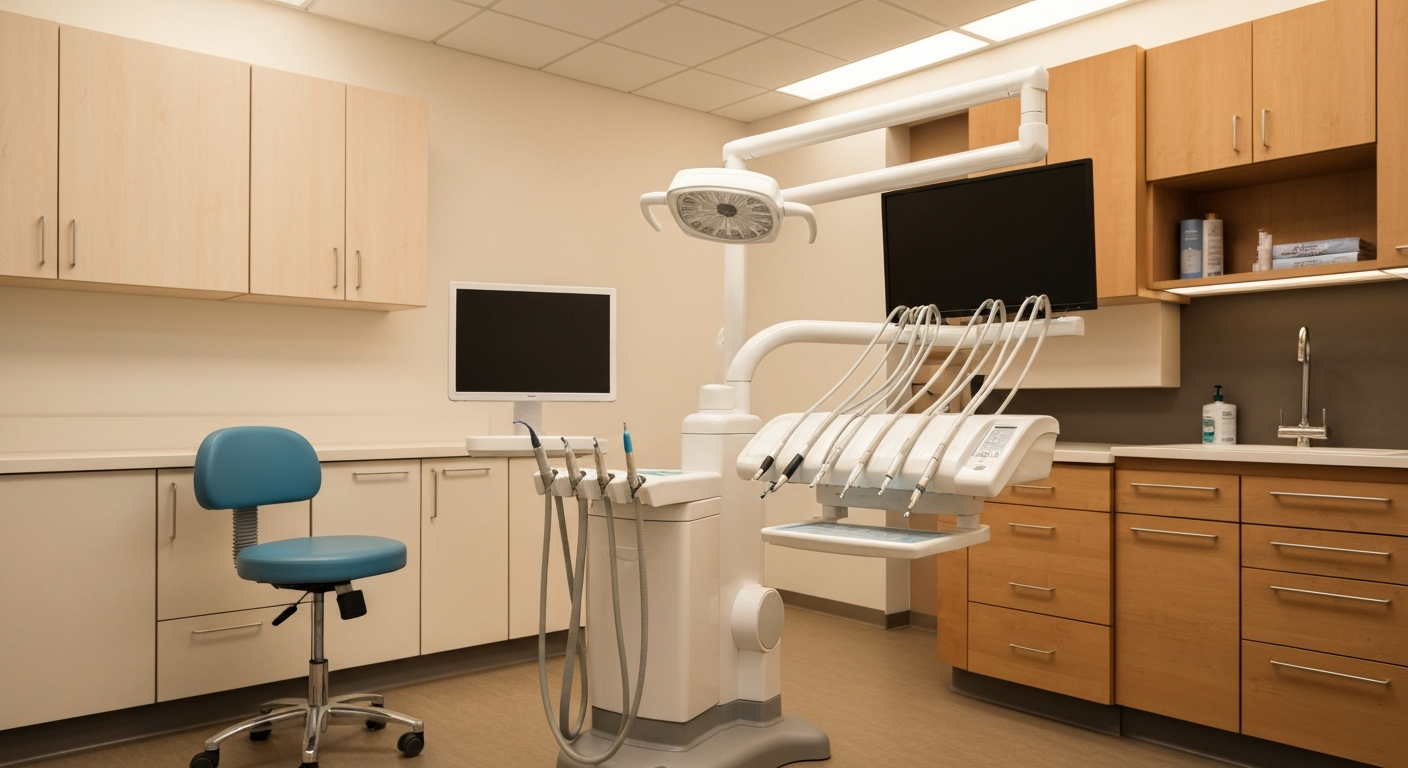
Dental equipment package: $150,000–$300,000. This covers dental chairs (operatory units), delivery systems, overhead lights, X-ray units, sterilization equipment, and cabinetry. A single fully-equipped operatory — chair, delivery, light, X-ray arm — runs $30,000–$60,000 on the low end for new equipment. Most practices open with 2–4 operatories. Equipment dealers often bundle packages, and financing is widely available through dental-specific lenders.
Build-out costs: $100,000–$250,000. This is where dental offices diverge sharply from general commercial office space. A dental office requires plumbing to every operatory (for water lines and drainage), a central vacuum/suction system, a central air compressor for handpieces, and proper electrical for equipment loads. Landlords who haven’t done a dental build-out before will underestimate this. Get a contractor who has built dental offices. The difference in cost estimation accuracy is significant.
Technology: $25,000–$75,000. Digital X-ray sensors and panoramic imaging, intraoral cameras, and practice management software (Dentrix, Eaglesoft, Open Dental, etc.) are all standard now. Patients expect digital records and online scheduling. Paper charts are essentially obsolete in new practices. Digital X-rays alone — sensors plus software — can run $15,000–$30,000 depending on your sensor count and imaging needs.
Insurance package: $5,000–$15,000/year. This is the combined annual cost for malpractice, general liability, and workers’ comp. Get all three before you see your first patient. Some carriers offer dental practice bundles that package these together at better rates than buying each separately.
Initial supplies and inventory: $10,000–$25,000. Consumables — gloves, masks, anesthetics, composites, impression materials, sterilization pouches, paper products — add up fast. Your equipment dealer or dental supply rep (Patterson, Schein, Benco) can help you build an opening order list.
Total startup range: $300,000–$700,000+. That’s not a typo. A lean 2-operatory practice in a pre-plumbed space with used equipment can come in under $300,000. A 4-operatory de novo build in a suburban market with all-new equipment and full technology stack will hit $500,000–$700,000 easily. Budget conservatively and add a 15–20% contingency for construction overruns, which are common.
How dentists finance this: Most don’t write a check. Dental practice lending is a mature, specialized market. SBA 7(a) loans are one option — they go up to $5 million, offer long repayment terms, and the SBA guarantee makes lenders more willing to extend credit to new practices without significant collateral. But dental-specific lenders — Bank of America Practice Solutions, TD Bank, Provide (formerly known as Lendio’s dental arm), and others — often offer better terms for dental startups specifically because they understand the revenue model and collateral value of dental equipment. These lenders will want to see a business plan, a market analysis showing patient demand in your area, your personal credit history, and projections. Get your financial documents in order before you approach lenders.
The Regulatory Sequence, Simplified
People often ask what order to do things in. Here’s a practical sequence:
1. Get licensed. Apply through DHP at dhp.virginia.gov. Don’t sign a lease before you have your license or at minimum have a confirmed exam date and a clear timeline.
2. Choose and form your business entity. File your LLC or PC with the SCC at cis.scc.virginia.gov. Get your EIN from the IRS. Open a business bank account.
3. Secure financing. Apply with dental-specific lenders or SBA-approved banks. This process takes 30–90 days and requires a business plan. Start it earlier than you think you need to.
4. Sign a lease and start build-out. Dental build-outs routinely take 3–6 months. Factor that into your timeline. Many dentists work as associates while their space is under construction.
5. Order equipment. Lead times on dental equipment run 4–12 weeks. Coordinate delivery with construction completion.
6. Get your BPOL license. Apply with your city or county before opening.
7. Get your DEA registration if applicable. Apply after you have a practice address.
8. Get insurance in place. Before your first patient is scheduled.
9. Complete HIPAA and OSHA setup. Policies, training, documentation. This can run parallel to build-out.
10. Open. Market early. Many successful practice owners start building their patient pipeline — website, Google Business Profile, insurance credentialing — months before opening day.
One Thing Most Guides Skip
Insurance credentialing takes longer than almost everything else on this list. Getting paneled with Delta Dental, MetLife, Cigna, and other major insurers can take 60–120 days per carrier. If you want to accept insurance (and in most markets, you need to), start the credentialing process as soon as you have your NPI number and practice address. Patients who call and find out you’re not yet in-network with their plan will go elsewhere. A credentialing delay of 90 days is a 90-day delay in revenue.
That one timeline item kills more dental practice launches than any regulatory requirement.
Start your application at dhp.virginia.gov, form your entity at cis.scc.virginia.gov, and get a dental lender on the phone before you finalize your location. Those three moves, in that order, will structure everything else that follows.