How to Start a Coffee Shop in Virginia
How to Start a Coffee Shop in Virginia
Virginia charges $40 for a VDH food establishment permit. The espresso machine to make the coffee costs $5,000–$20,000. That gap between the cheap permit and the expensive equipment is the story of opening a coffee shop — the regulatory path is straightforward, but the capital requirements catch a lot of first-timers off guard.
The good news: coffee margins are genuinely excellent. A shot of espresso costs $0.25–$0.50 in materials. It sells for $4–$6 as a latte. That’s an 80–90% gross margin on your flagship product. The bad news: getting to profitability requires the right location, the right equipment, and enough runway to survive the first 6–12 months while your regulars find you.
Here’s what it actually takes to open a coffee shop in Virginia — permits, build-out, equipment, and realistic total costs.
Permits and Licenses for a Virginia Coffee Shop
Coffee shops follow the same regulatory path as any food establishment in Virginia. The permits aren’t complicated, but you need to hit them in the right order and leave enough time.
VDH Food Establishment Permit
The Virginia Department of Health regulates all food establishments, including coffee shops, cafes, and espresso bars. You need two things from them: a plan review and an annual operating permit.
Submit your plan review application to your local health department at least 30 days before construction begins. The plan review fee is $40 (one-time). Inspectors will review your layout, equipment placement, plumbing, and food handling setup. Get this done early — changes after construction costs real money.
The annual food establishment permit is $40/year. Low cost, but skipping it isn’t an option.
Certificate of Occupancy
Before you open, your local building department needs to sign off that the space meets code for its intended use. If you’re moving into a former retail space and converting it to food service, expect a formal CO process that runs alongside your build-out. This is handled at the city or county level.
Fire Inspection
Local fire marshals inspect for code compliance — exit signage, fire suppression, hood systems if you have cooking equipment, extinguishers. Budget this into your pre-opening timeline, not as an afterthought.
BPOL License
Virginia has no statewide general business license. Licensing is entirely local under the Business, Professional, and Occupational License (BPOL) system. You’ll pay a fee to your city or county based on gross receipts. Rates and minimums vary by locality — contact your city or county business office directly.
Sales Tax Registration
Register with the Virginia Department of Taxation for sales tax collection. Prepared beverages and food — meaning everything you make and sell at the counter — are taxable at the full Virginia rate: 4.3% state plus 1% local, plus any applicable regional tax. That full rate applies to your lattes, drip coffee, sandwiches, and pastries.
One nuance worth knowing for your pricing strategy: packaged retail coffee beans sold as grocery items may qualify for the reduced grocery tax rate (1% local only, since Virginia eliminated the state portion on January 1, 2023). Whether your bags of whole beans qualify depends on how they’re classified. If you plan to sell retail bags — which many specialty coffee shops do — verify this with your accountant or the Department of Taxation before you build your pricing model.
Food Handler Certification
All food employees must complete food handler certification within 30 days of hire. Virginia law caps the cost at $15 per person. Budget this for every employee you bring on.
Alcohol License (If Applicable)
Some coffee shops serve wine, beer, or cocktails — particularly afternoon/evening-focused cafes. If that’s part of your concept, you need a Virginia ABC license from the Virginia Alcoholic Beverage Control Authority.
The Limited Mixed Beverage Restaurant license starts at $945 for 1–100 seats, $1,385 for 101–150 seats, and $1,875 for 151+ seats. ABC processing takes 60–90 days on average. Start this application early — it won’t arrive on your schedule if you submit it late.
Business Structure and Registration
Form Your LLC First
Before you sign a lease or buy equipment, set up your legal entity. An LLC is the right structure for most coffee shops — it separates your personal assets from business liability and keeps your taxes manageable.
File your Articles of Organization with the Virginia State Corporation Commission at cis.scc.virginia.gov. Filing fee: $100. Annual registration fee: $50/year. That’s the whole cost of the state filing.
Get Your EIN
Apply for an Employer Identification Number at irs.gov/ein. Free, takes about 10 minutes, available immediately. You need this to open a business bank account, hire employees, and register for state taxes.
Register for State Taxes
Register with the Virginia Department of Taxation at tax.virginia.gov for both sales tax collection and employer withholding. Do this before you open — you need to be collecting and remitting sales tax from day one.
Location and Build-Out
Location is the single most consequential decision you’ll make. Not your menu. Not your equipment brand. Location.
Foot traffic, parking, and visibility determine your walk-in customer base. Proximity to offices drives morning rush volume. Residential density drives weekend traffic. A beautifully designed cafe in a low-traffic strip mall is a hard business to run. A modest but well-positioned corner spot near a commuter corridor will outperform it almost every time.
Size
A small cafe or kiosk concept typically runs 800–1,500 sq ft. A full cafe with real seating runs 1,500–3,000 sq ft. Bigger isn’t always better — labor costs scale with size, and a tight, efficient floor plan often produces better unit economics than an oversized space you’re heating and staffing.
Rent
Virginia rents vary enormously by market:
- Suburban areas: $15–$35/sq ft/year
- Urban or high-traffic locations: $25–$60+/sq ft/year
A 1,200 sq ft space in a suburban strip center might run $2,400–$3,500/month. The same square footage in a walkable urban district in Richmond, Arlington, or Alexandria can run $5,000–$8,000/month or more. Know what your rent-to-revenue ratio needs to look like before you commit to a lease.
Build-Out Costs
This is where the budget reality sets in. Full renovation of a raw or incompatible space runs $50–$150/sq ft. Cosmetic updates to an existing cafe space (a former coffee shop or restaurant) run $20–$50/sq ft.
The non-negotiable build-out elements for a coffee shop:
- Dedicated water line with filtration for the espresso machine — water quality directly affects espresso quality and equipment longevity
- Electrical capacity — commercial espresso machines draw significant amperage; your space may need a panel upgrade
- Ventilation if you’re adding any cooking equipment
- Three-compartment sink (required by VDH)
- Handwashing station separate from the prep sink (also VDH requirement)
If you’re adding a drive-through — which can meaningfully increase revenue per square foot by serving customers without seating — budget an additional $20,000–$50,000+ for the window, queuing lane, and associated build-out.
Equipment for a Virginia Coffee Shop
The equipment list for a coffee shop is shorter than a full restaurant, but the costs are concentrated. The espresso machine alone can represent 10–20% of your total startup budget.
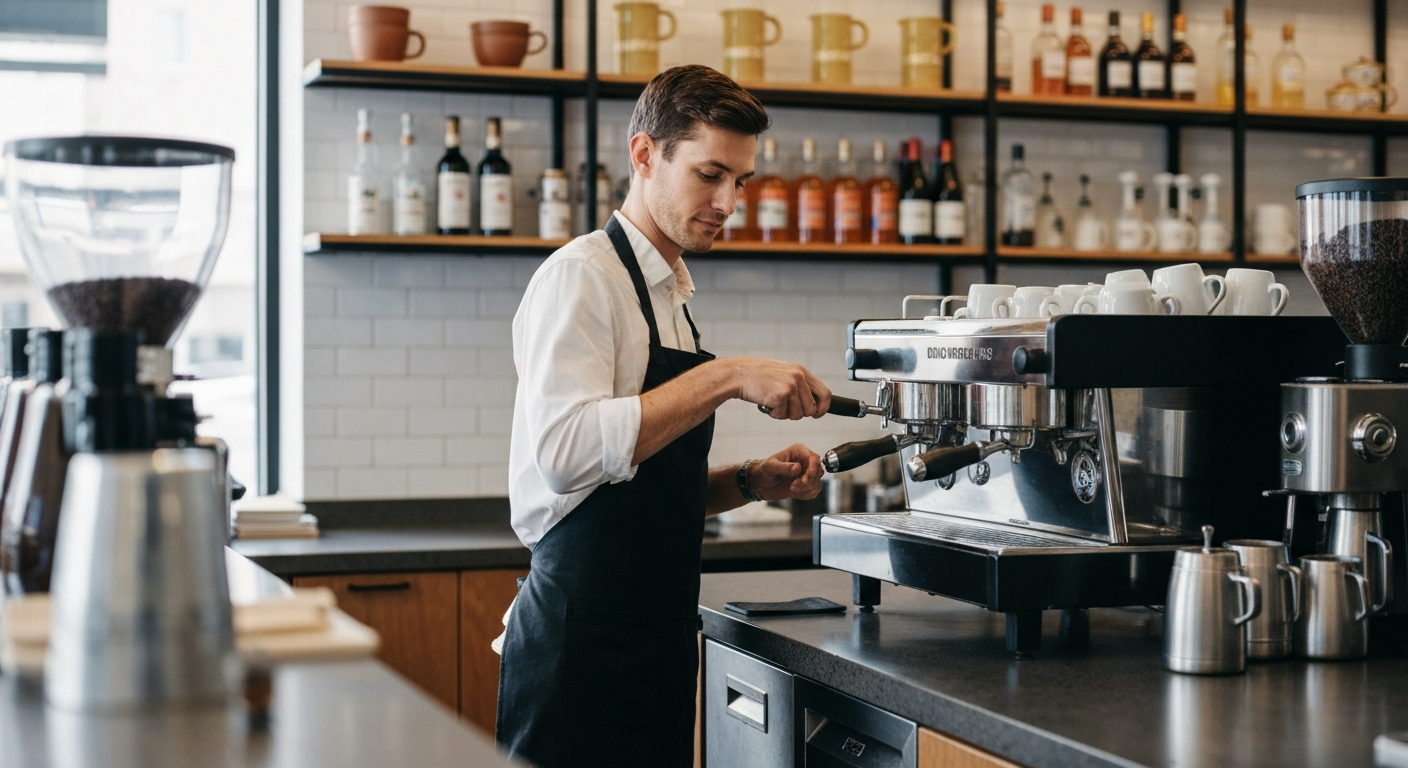
Espresso Machine: $5,000–$20,000
This is your highest-cost single piece of equipment and your revenue engine. Commercial 2–3 group machines from La Marzocco, Nuova Simonelli, and similar manufacturers run $8,000–$15,000 for mid-tier commercial models. Budget toward the higher end if you’re expecting high volume. Don’t buy used for your primary machine unless you have a reliable service relationship — a broken espresso machine on a busy Saturday morning is a revenue emergency.
Coffee Grinders: $500–$3,000
You need at least two grinders — one dedicated to espresso, one for drip or pour-over. Commercial burr grinders from Mazzer, Mahlkönig, and similar brands run $800–$2,000 each for quality equipment. Grinder quality directly affects shot consistency.
Drip/Batch Brewer: $200–$1,000
Commercial batch brewers for drip coffee. Budget for a quality unit from Fetco or similar — cheap equipment breaks under commercial volume.
Refrigeration: $2,000–$5,000
Under-counter refrigeration for milk and perishables behind the bar, plus reach-in for food display. Budget separately if you’re adding a walk-in cooler.
Pastry Display Case: $1,000–$3,000
Most coffee shops carry pastries, which are a high-margin add-on sale. A quality refrigerated or ambient display case runs $1,500–$2,500.
POS System: $1,000–$3,000
Square for Restaurants and Toast are common in the cafe space. Factor in monthly software fees beyond hardware costs.
Furniture: $3,000–$15,000
Tables, chairs, counter seating, and bar stools. The range here depends almost entirely on aesthetic choices — basic commercial furniture is on the low end; custom millwork and seating is on the high end.
Signage: $2,000–$8,000
Exterior signage for visibility plus interior menu boards. Digital menu boards are increasingly common and give you pricing flexibility.
Small Wares: $1,000–$3,000
Pitchers, tampers, scales, cups, lids, sleeves, carafes, and the hundred other things behind the bar. This category consistently runs over budget because the items are small and the list is long.
Insurance for Virginia Coffee Shops
Business Owner’s Policy (BOP)
A BOP bundles general liability and property coverage — the most practical option for most coffee shops. General liability alone runs $1,000–$3,000/year depending on size and seating. A BOP typically runs $2,000–$5,000/year and also covers your espresso equipment, furniture, fixtures, and tenant improvements. Given that your equipment alone might be worth $30,000–$50,000, skimping on property coverage is a mistake.
Liquor Liability
If you hold an ABC license, you need liquor liability coverage. Budget $500–$1,500/year.
Workers’ Compensation
Virginia requires workers’ comp once you have 3 or more employees — and that threshold includes part-time and seasonal workers. Most coffee shops hire their third employee quickly. Premium varies based on payroll and classification, so get a quote early in your planning process rather than discovering the cost after you’ve built your budget.
Startup Costs for a Virginia Coffee Shop
Here’s what the ranges actually look like once you add everything up:
Small cafe or kiosk: $80,000–$150,000
Minimal build-out, basic equipment, small footprint. This tier works for a focused concept — espresso and drip, minimal food program, limited seating or no seating. Drive-through-only concepts can fit here if you find the right existing structure.
Mid-range coffee shop with full seating: $150,000–$300,000
This is the most common real-world range for a neighborhood cafe opening in Virginia. Includes a genuine renovation, quality commercial espresso equipment, furniture, branding, and signage. Most first-time coffee shop owners end up here.
High-end specialty cafe: $300,000–$500,000+
Custom build-out, top-tier equipment, a full food program, premium location with the rent to match. This is a restaurant-level investment with coffee as the anchor.
Operating Reserves
Budget 3–6 months of operating expenses in reserve before you open. That’s typically $15,000–$50,000+ depending on your rent and payroll. Coffee shops routinely take 6–12 months to build a stable customer base. Running out of cash at month four because you opened with no cushion is how otherwise viable concepts fail.
Permits and Licensing Timeline
Start the permit process 3–6 months before your target opening. VDH plan review needs 30 days minimum. ABC licensing needs 60–90 days if you’re serving alcohol. Building permits for construction can take weeks to months depending on your jurisdiction. These timelines stack — they don’t run in parallel unless you plan carefully.
First-year government fees for permits and licensing typically run $500–$2,000, not counting the ABC license if applicable.
Startup Costs at a Glance
| Item | Cost |
|---|---|
| LLC filing (one-time) | $100 |
| Annual LLC registration | $50/year |
| EIN | Free |
| VDH plan review | $40 (one-time) |
| VDH annual food establishment permit | $40/year |
| Food handler certification | Up to $15/person |
| BPOL license | Varies by locality |
| ABC license (if serving alcohol) | $945+ depending on type and seat count |
| Business Owner’s Policy (BOP) | $2,000–$5,000/year |
| Liquor liability (if applicable) | $500–$1,500/year |
| Workers’ comp | Varies by payroll and classification |
| Espresso machine | $5,000–$20,000 |
| Total startup investment (mid-range cafe) | $150,000–$300,000 |
Where to Go From Here
Start with your location search and your VDH plan review — those are your two longest lead items. While you’re shopping spaces, file your LLC with the Virginia SCC and get your EIN. Once you have a signed lease and construction drawings, submit your VDH plan review application immediately.
If you’re unsure whether your concept is financially viable at a specific location, build a simple monthly P&L before you sign anything. Take your projected transaction count, multiply by average ticket size, and see if the rent-to-revenue math works. A coffee shop generating 150 transactions/day at a $6 average ticket does $27,000/month in revenue. Whether that supports your rent, payroll, and loan payment is a math problem — and it’s worth solving before you sign a 5-year lease.
The margins are there. The regulatory path is manageable. The capital requirement is real, and the location decision is permanent. Get those two right and everything else is solvable.