How to Start a Catering Business in Virginia
How to Start a Catering Business in Virginia
Virginia doesn’t have a standalone “catering license.” What it has is a food establishment permit system run by the Virginia Department of Health, and catering falls squarely inside it — same plan review, same annual inspections, same food handler requirements as a restaurant. What makes catering different is the operational complexity: you’re producing food in one location and serving it somewhere else entirely. That means your base kitchen needs a permit, food safety has to hold during transport, and if you’re serving alcohol, Virginia ABC has its own separate licensing path with a real revenue threshold attached.
This guide covers the full regulatory path for Virginia catering startups, with exact fees, realistic cost ranges, and the practical details most guides skip.
Permits and Licenses for a Virginia Catering Business
VDH Food Establishment Permit
Your base kitchen — the facility where you prep food — needs a permit from the Virginia Department of Health. This applies whether you’re leasing your own commercial kitchen or renting space in a shared commissary.
The fee structure is simple: a one-time plan review fee of $40, submitted to your local health department at least 30 days before you open, and a $40 annual permit fee after that. Compared to most states, those are low numbers. But the inspection itself is the real gate — your kitchen needs to meet VDH standards for equipment, layout, temperature control, and sanitation before you’ll get the permit.
Submit your plan review application early. Health departments can move slowly, and you can’t legally operate until the permit is issued.
Food Handler Certification and CFPM
Every food employee must have food handler certification within 30 days of hire. Virginia law caps the cost at $15 per person, so you won’t be stuck paying inflated rates for online courses.
Beyond basic food handler cards, you should have at least one Certified Food Protection Manager (CFPM) on your team — someone who has passed an ANSI-accredited exam like ServSafe. Expect to pay $150–$200 for the course and exam. It’s not mandatory in every Virginia locality, but many health departments expect it, and it’s a genuine credential that matters to corporate and wedding clients who are vetting vendors.
BPOL License
Virginia doesn’t have a statewide business license. Instead, each city and county runs its own Business, Professional, and Occupational License (BPOL) system. You’ll register with your local government and pay a tax based on gross receipts — not net income, gross receipts. Rates and minimum fees vary by locality. Contact your city or county’s Commissioner of the Revenue office to get the exact rate for your business classification.
ABC Caterer’s License (If You’re Serving Alcohol)
If you want to serve alcohol at events — wine at a wedding, beer at a corporate dinner — you need a Virginia ABC Caterer’s license.
Here’s the requirement that trips people up: to qualify for a caterer’s license, you need an established place of business with catering gross sales averaging at least $4,000 per month. That means you can’t get the license on day one. You need a track record.
Think of it this way: build your catering business first, get to consistent revenue, then add alcohol service. It’s not a barrier — it’s a sequencing issue. Most caterers grow into it naturally. Once you apply, budget 60–90 days for ABC to process the application.
Kitchen Options for Virginia Caterers
This is one of the most consequential decisions you’ll make. Your kitchen situation affects your permit path, your overhead, and your ability to scale.
What’s Off the Table First: Home Kitchens
Your home kitchen doesn’t qualify for commercial catering in Virginia. The state’s cottage food exemption allows home kitchen production, but it caps sales at $25,000 per year and restricts you to direct sales only. For most catering operations — events, corporate clients, recurring contracts — that’s a non-starter. You need a permitted commercial facility.
Option 1: Lease Your Own Commercial Kitchen
Full control. Your own schedule, your own equipment, no competing with other tenants for prep time. The tradeoff is cost: kitchen-equipped commercial space in Virginia runs roughly $2,000–$6,000 per month depending on size and market. Northern Virginia and the Richmond metro are at the higher end. Southwestern Virginia and rural markets are lower.
This option makes sense once you have enough volume to justify the fixed overhead. If you’re consistently booking 15–20 events per month, the math starts to work.
Option 2: Shared or Commissary Kitchen
A shared commercial kitchen gives you access to a fully equipped, VDH-permitted facility without the full cost of a lease. You pay $500–$2,000 per month for scheduled access, often with assigned prep times and shared cold storage. The facility already has its VDH permit — but you still need your own permit listing that facility as your licensed base of operations.
The limitation is scheduling. Peak event seasons (spring weddings, fall corporate events) mean competing for kitchen time with other tenants. Book your slots early.
Option 3: Rental Kitchen by the Hour
Ghost kitchens and rental kitchen facilities charge $15–$45 per hour, which works well for smaller operations that are still testing the market. You pay only for time used, which keeps startup costs low. The math gets worse as volume increases — at a certain point, the hourly rate exceeds what a monthly shared kitchen contract would cost.
All three options require a valid VDH food establishment permit for the facility you’re operating out of.
Business Structure and Registration
Form Your LLC
An LLC is the standard choice for a catering business — it separates your personal assets from business liability, which matters in an industry where a foodborne illness claim can be significant. File your Articles of Organization with the Virginia State Corporation Commission for $100. Annual registration runs $50 per year after that.
If you have questions, the SCC help line is (804) 371-9733 or toll-free at (866) 722-2551.
Get Your EIN
An Employer Identification Number is free from the IRS at irs.gov/ein. You need it to open a business bank account and to hire employees. Takes about 10 minutes online.
Register for Sales Tax
Register with the Virginia Department of Taxation for sales tax collection. Catered meals are taxable at the full Virginia rate — 4.3% state plus 1% local, plus any applicable regional tax for your area.
The detail most caterers overlook: if you’re serving events in multiple localities, you collect the tax rate for the location where the food is served — not where your kitchen is. A wedding in Fairfax County is taxed at Fairfax County’s rate. A corporate lunch in Richmond is taxed at Richmond’s rate. Keep records by event location.
Insurance for Virginia Catering Businesses
Catering has specific liability exposure that standard business insurance doesn’t always cover. Build your coverage intentionally.
General liability insurance covers bodily injury and property damage at event venues — someone slips near your setup, your equipment damages a venue floor. Expect $500–$1,500 per year for most small catering operations.
Product liability insurance covers foodborne illness claims and allergic reaction incidents. This is the coverage that matters most in food service. It’s usually bundled with general liability, so ask specifically about it when you get quotes.
Liquor liability insurance is essential if you’re serving alcohol. It covers claims arising from alcohol service at events. If you have an ABC caterer’s license and you’re not carrying liquor liability, you’re exposed.
Commercial auto insurance covers vehicles used for food transport. Your personal auto policy won’t cover a vehicle used for business purposes — and if you’re hauling chafing dishes and hot food to an event, that’s commercial use.
A Business Owner’s Policy (BOP) bundles general liability and commercial property coverage in one policy. For most small catering businesses, a BOP runs approximately $60–$115 per month ($720–$1,380 per year). It’s a reasonable starting point before layering in specialized coverage.
Workers’ compensation is required in Virginia once you have three or more employees — that includes part-time, seasonal, and temporary workers. Penalties for non-compliance run up to $250 per day uninsured, with a maximum of $50,000 plus costs. Don’t skip it. For more information, contact the Virginia Workers’ Compensation Commission.
One practical note: many event venues require proof of insurance before they’ll allow you on the property. A $1 million general liability minimum is the typical threshold. Have your certificate of insurance ready to send before you pitch venues.
Startup Costs for a Virginia Catering Business
Catering has a wide cost range depending on your model. Here’s how it breaks down by tier.
Small Catering Operation (Shared Kitchen): $10,000–$25,000
This is where most catering businesses start. You’re renting kitchen time, buying used equipment, driving your own vehicle, and handling events yourself with minimal staff. The major cost buckets: kitchen access deposits and early rental payments, basic equipment, food transport containers, and insurance.
Mid-Range Catering Business (Own Kitchen): $25,000–$75,000
You’ve signed a commercial kitchen lease, you’re building out the space, and you’re hiring part-time staff. Add a delivery vehicle, more equipment, and the overhead of a real commercial space. This tier is where operations start to look like a business rather than a side hustle.
Full-Service Catering Company: $75,000–$150,000+
Dedicated kitchen, full service equipment inventory, at least one vehicle, employees, marketing budget, and professional branding. This is the “launch it properly” version, typically backed by either savings, a loan, or an investor.
Key Equipment Costs
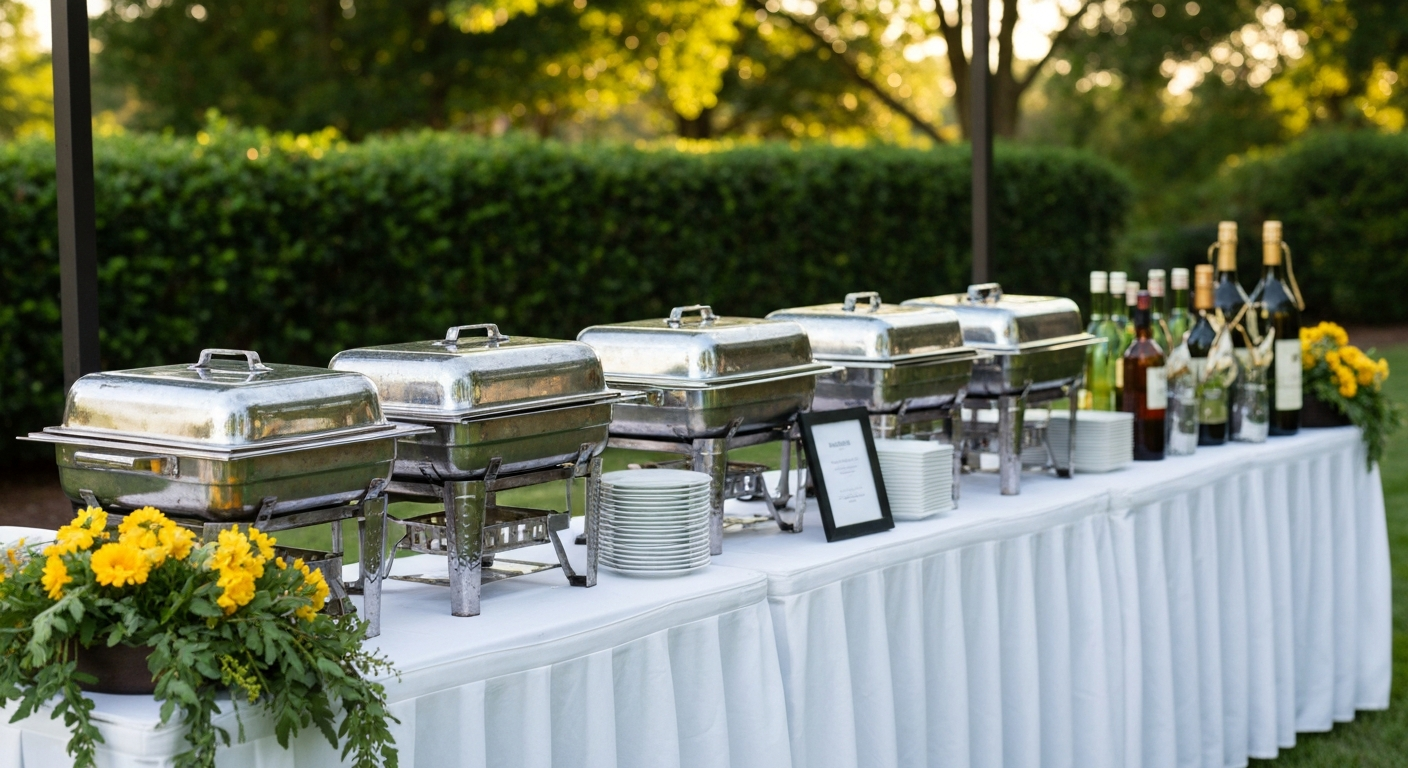
- Chafing dishes and serving equipment: $1,000–$5,000
- Food transport containers and hot/cold holding equipment: $500–$3,000
- Portable cooking equipment: $1,000–$5,000
- Delivery vehicle (used cargo van or truck): $10,000–$30,000, or lease
Equipment costs can be compressed significantly by buying used. Restaurant supply stores and auction sites for restaurant equipment are worth checking before buying new.
Costs at a Glance
| Item | Cost |
|---|---|
| LLC filing (Virginia SCC) | $100 one-time |
| Annual LLC registration | $50/year |
| EIN | Free |
| VDH plan review | $40 one-time |
| VDH annual food establishment permit | $40/year |
| Food handler certification | Up to $15/person |
| CFPM certification (ServSafe or equivalent) | $150–$200 |
| BPOL license | Varies by locality |
| ABC caterer’s license (if serving alcohol) | Contact Virginia ABC for current fee schedule |
| General liability + product liability insurance | $500–$1,500/year |
| Business Owner’s Policy (BOP) | $720–$1,380/year |
| Workers’ comp (3+ employees) | Varies by payroll and classification |
| Total first-year (shared kitchen model) | ~$12,000–$30,000 |
The total first-year estimate assumes shared kitchen access, basic equipment, proper insurance, and all required permits and licensing. It doesn’t include the ABC caterer’s license — you’ll add that once your business qualifies.
Where to Start
Pick your kitchen situation first. Everything else follows from it — your VDH permit path, your cost structure, your timeline to launch. Once you have a facility lined up, file your LLC with the SCC, apply for your VDH plan review at least 30 days out, register with the Virginia Department of Taxation for sales tax, and get your BPOL sorted with your local government.
If you’re planning to eventually serve alcohol, start building your revenue records from day one. The ABC caterer’s license requires documented catering gross sales — good bookkeeping now makes that application straightforward later.
The Virginia Business One Stop portal is worth bookmarking as a state-level checklist. For VDH questions, start with your local health department directly. For ABC questions, the agency’s website at abc.virginia.gov has the most current licensing information and fee schedules.