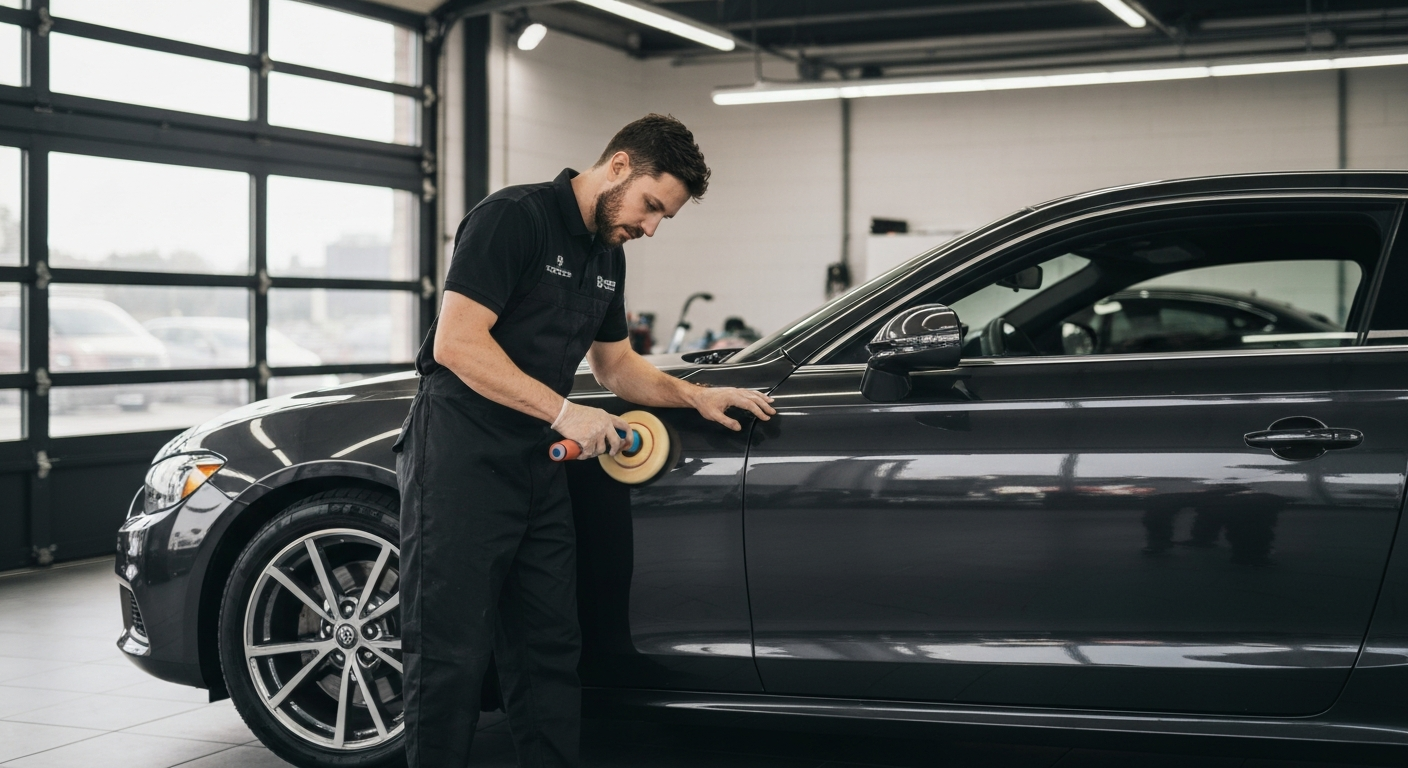
How to Start an Auto Detailing Business in Virginia
How to Start an Auto Detailing Business in Virginia
Auto detailing is one of the most accessible businesses you can launch in Virginia. No state license. No DPOR involvement. No trade certification required. A motivated person with the right equipment can go from idea to first paying customer in a matter of weeks.
But there’s one regulation that trips up almost every new detailer, and it has nothing to do with business licensing. It has to do with where your soapy water goes. Get that wrong, and you’re looking at federal Clean Water Act violations before you’ve booked your tenth client.
Here’s everything you actually need to know.
Do You Need a License to Detail Cars in Virginia?
Not at the state level. Virginia’s Department of Professional and Occupational Regulation (DPOR) does not regulate auto detailing. There’s no state-issued detailing license, no required certification, and no exam to pass. Anyone can legally offer auto detailing services in Virginia.
Your licensing obligation is local. Every city and county in Virginia operates under the Business, Professional, and Occupational License (BPOL) system, and you’ll need a BPOL license from whichever locality you operate in. The cost is based on your gross receipts — not profit — and the rate varies by locality and business category. Contact your city or county commissioner of the revenue to get the exact rate and minimum fee for your area before you open.
One important tax note: auto detailing is a service, not a product sale. Virginia does not impose sales tax on services. So if you’re charging $150 to detail a car, that $150 is not subject to sales tax. But if you sell tangible products alongside your service — wax kits, air fresheners, ceramic coating packages the customer takes home — those retail sales are taxable and you’ll need a sales tax certificate from the Virginia Department of Taxation.
If you’re opening a fixed shop location, your city or county will likely require a Certificate of Occupancy before you open. This confirms the space is approved for commercial use and meets zoning requirements. You’ll apply through your local building department, and the timeline varies — budget at least a few weeks.
Mobile detailing looks simpler, but check your local zoning ordinances. Some Virginia localities restrict commercial activity in residential areas, meaning you may not be able to park your van and detail a car in a customer’s driveway without running into zoning issues. It’s rare enforcement, but it exists. Call your locality’s planning department and ask directly.
Business Structure and Registration
You can operate as a sole proprietor without forming a legal entity, but forming an LLC is the smarter move. Auto detailing involves working on other people’s expensive property. A customer’s $80,000 truck gets scratched during a detail, and if you’re operating as a sole proprietor, your personal assets are on the table in any lawsuit.
Forming an LLC in Virginia costs $100. File your Articles of Organization online through the Virginia State Corporation Commission’s Clerk’s Information System at cis.scc.virginia.gov. After that, you pay a $50 annual registration fee every year to keep the LLC in good standing.
Once your LLC is formed, get your EIN (Employer Identification Number) from the IRS at irs.gov/ein. It’s free and takes about ten minutes online. You need this to open a business bank account and pay employees if you hire.
Register with the Virginia Department of Taxation at tax.virginia.gov. This sets you up for any state tax obligations. If you plan to sell retail products — wax, cleaning supplies, detailing kits — register for a sales tax certificate at the same time. If you’re service-only, you still need to register with the Department of Taxation for income tax purposes.
Environmental Compliance — Wastewater
This is the section most detailing guides skip. Read it carefully.
When you wash a car, the water that runs off picks up soap, degreasers, brake dust, motor oil residue, and whatever else was on that vehicle. That runoff is contaminated. And if it flows into a storm drain — the ones at the edge of parking lots and streets — you’re violating the federal Clean Water Act and Virginia DEQ regulations.
Storm drains don’t go to a treatment plant. They go directly to rivers, streams, and the Chesapeake Bay watershed. Virginia takes this seriously.
The Virginia Department of Environmental Quality issues stormwater permits under the Virginia Pollutant Discharge Elimination System (VPDES). The relevant general permit for vehicle wash activities is 9VAC25-194. Depending on your operation’s scale and location, you may need to comply with this permit. Contact Virginia DEQ directly to determine your specific obligations — their information is available at deq.virginia.gov.
Mobile Detailing
This is where most new mobile detailers make their mistake. You pull up to a customer’s driveway, run your pressure washer, and all that soapy water runs down the driveway into the street and into a storm drain. That’s illegal.
The practical solution: a water reclamation mat. These are bermed containment mats that you set up around the vehicle. All runoff collects inside the mat. You then vacuum the collected water using a wet/dry vac or a dedicated reclaim system and dispose of it properly — typically at a utility sink, a toilet, or a dump station connected to the sanitary sewer.
Water reclamation mats run $200–$500 depending on size and quality. It’s not optional equipment. It’s what separates a compliant mobile detailing business from one operating illegally.
Some mobile detailers work in commercial parking lots or at auto dealerships. Same rule applies — all runoff must be contained and properly disposed of, not left to flow into parking lot drains.
Shop-Based Operations
If you’re leasing a commercial space, you need to verify one thing before you sign: where do the floor drains connect?
Some commercial buildings — especially older ones or industrial spaces — have floor drains that connect to the storm sewer, not the sanitary sewer. If you’re washing cars over those drains, you’re sending contaminated water directly into waterways. That’s a violation regardless of whether you knew about it.
Before signing a lease, ask the building owner for plumbing diagrams or contact your local utility authority to verify the drain connections. If drains connect to the storm system, the space is not suitable for auto detailing without significant modification. A shop with sanitary-sewer-connected floor drains — or the ability to retrofit — is what you need.
Fines for Clean Water Act violations can run into thousands of dollars per day. This isn’t a corner to cut.
Insurance for Virginia Auto Detailing Businesses
Two policies are non-negotiable. Everything else is secondary.
General liability insurance covers you if someone is injured at your shop, or if you damage property that isn’t a vehicle in your care. For a $1 million policy, expect to pay $400–$900 per year. Reasonable. Essential.
Garagekeeper’s liability insurance is the one that matters most in this business. General liability does not cover damage to a customer’s vehicle while it’s in your possession. That gap is exactly what garagekeeper’s liability fills. If you scratch a customer’s paint, crack a windshield, or — worst case — a fire damages vehicles parked at your shop, garagekeeper’s liability is what pays.
Do not operate without this coverage. One claim on an expensive vehicle without it could wipe out everything you’ve built.
You can often get a combined GL and garagekeeper’s package from commercial insurers. Combined coverage typically runs $500–$2,500 per year, depending on your coverage limits and how many vehicles you’re handling at once. A solo mobile detailer doing five cars a week pays less than a shop handling twenty cars daily.
Commercial auto insurance is required if you’re using a van or truck for your mobile operation. Your personal auto policy won’t cover a vehicle used for business purposes. If you get in an accident while driving to a customer’s location, a personal policy will deny the claim.
Workers’ compensation kicks in when you hire your third employee. Virginia requires it at three or more employees — and that threshold includes part-time and seasonal workers. The penalty for being uninsured is up to $250 per day, capped at $50,000 plus costs. Get coverage before you hit that threshold, not after. More information is available at workcomp.virginia.gov.
Startup Costs for a Virginia Auto Detailing Business
The mobile vs. shop decision shapes everything — your costs, your insurance needs, your environmental compliance approach, and your realistic timeline to profitability.
Mobile Detailing
Mobile is the lower-barrier entry point. Total startup costs for a solo mobile operation run $2,000–$10,000, depending on whether you’re converting a vehicle you already own or buying a dedicated van.
Essential equipment:
- Pressure washer: $300–$800 (electric is quieter and fine for most work; gas has more power for heavy jobs)
- Wet/dry vacuum or extractor: $200–$500 (an extractor handles carpet and upholstery cleaning properly)
- Dual-action polisher/buffer: $100–$400
- Water reclamation mat: $200–$500 — again, this is not optional
- Initial supplies (soaps, waxes, ceramic coatings, microfiber towels, brushes, applicators): $300–$600
Van conversion is the biggest variable. If you’re adding a water tank, generator, hose reels, and equipment mounting to a cargo van, expect to spend $3,000–$15,000 depending on tank capacity and how professionally it’s outfitted. Some detailers start with a car hauling supplies in bins and a portable electric pressure washer running off a customer’s outdoor outlet — that’s a $2,000 startup, not a $10,000 one.
Shop-Based Detailing
A brick-and-mortar operation costs significantly more. Realistic startup range: $15,000–$50,000+.
The big variables are your lease deposit and build-out costs. If the space needs drainage modifications, HVAC for chemical fumes, or a water reclamation system, costs climb fast. Budget for signage, a reception area, lifts or detailing bays if needed, and a higher equipment investment for throughput.
The upside: a shop location builds credibility faster, lets you handle higher volumes, and allows you to take on commercial accounts (fleets, dealerships) that mobile-only operators can’t serve as efficiently.
Costs at a Glance
| Item | Cost |
|---|---|
| LLC filing (Virginia SCC) | $100 one-time |
| Annual LLC registration | $50/year |
| EIN | Free |
| BPOL license | Varies by locality (based on gross receipts) |
| General liability insurance | $400–$900/year |
| Garagekeeper’s liability | Included in GL package, or $500–$1,500/year standalone |
| Commercial auto insurance | Varies by vehicle and coverage |
| Workers’ comp (3+ employees) | Varies by payroll and classification |
| Equipment and supplies | $1,000–$5,000+ (mobile vs. shop) |
| Water reclamation mat (mobile) | $200–$500 |
| Total first-year (solo mobile LLC) | ~$2,500–$5,000 |
That first-year estimate for a solo mobile operation — LLC formation, insurance, BPOL, and core equipment — is achievable. It’s one of the few businesses where a person can go from zero to profitable in a single season without taking on debt.
The Actual Barrier to Entry
It’s not licensing. It’s not certification. The real work is understanding your environmental obligations before your first wash, getting garagekeeper’s liability coverage before you touch a single car, and deciding whether mobile or shop fits your capital situation.
Start with the SCC at cis.scc.virginia.gov to form your LLC. Then call your city or county commissioner of the revenue about your BPOL. Then get your insurance lined up — specifically garagekeeper’s liability — before you book that first appointment.
The SCC help line is (804) 371-9733 or toll-free at (866) 722-2551 if you have questions about the registration process. For environmental questions specific to your operation, reach out to Virginia DEQ before you start, not after something goes wrong.
The regulatory path is genuinely straightforward. The environmental piece requires real attention. Get both right, and you’ve got a business that can run for years.