How to Start a Business in Roanoke, Virginia
Why Roanoke Is Western Virginia’s Business Capital
Roanoke is the largest city in western Virginia, anchoring a metropolitan statistical area of approximately 315,000 people. With a city population of roughly 100,000 and a regional economy stretching across the Blue Ridge and Allegheny mountain corridors, Roanoke functions as the commercial, healthcare, and cultural hub for a vast swath of southwestern Virginia.
The city’s quality of life advantages are substantial and increasingly recognized by national publications and relocation services. The Blue Ridge Parkway is virtually in the city’s backyard. Carvins Cove Natural Reserve — the second-largest municipal park in the United States — sits just outside city limits. McAfee Knob, one of the most photographed spots on the Appalachian Trail, is accessible from the Roanoke Valley. This outdoor infrastructure draws a steady stream of visitors and supports a strong hospitality and outdoor retail sector.
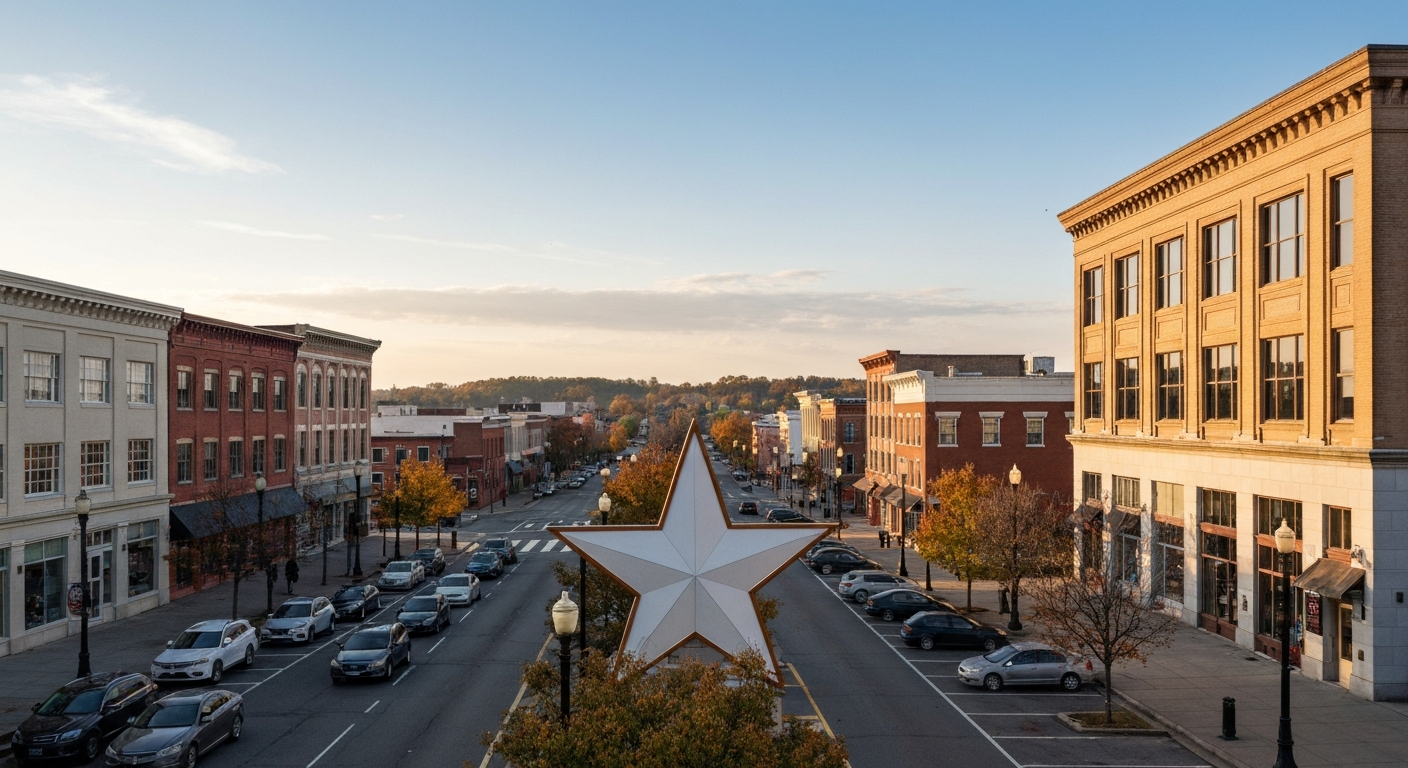
Downtown Roanoke centers on the City Market, recognized as the oldest continuously operating farmers and produce market in the United States. The Market District has undergone sustained revitalization and hosts an active cluster of restaurants, boutique retail, breweries, art galleries, and event venues. Grandin Village is a walkable neighborhood commercial corridor with an independent retail and dining character distinct from the downtown core. Williamson Road and Valley View anchor Roanoke’s major retail corridors. The Roanoke Center for Industry and Technology (RCIT) serves industrial and flex businesses in the eastern part of the city.
Carilion Clinic, one of the largest health systems in Virginia, is Roanoke’s dominant employer with thousands of workers across its hospital and clinic network. Virginia Tech is approximately 40 minutes away in Blacksburg, creating a research and talent pipeline with the Roanoke Valley through the Virginia Tech Carilion School of Medicine and the Fralin Biomedical Research Institute at VTC.
The RAMP (Roanoke-Blacksburg Technology Council’s startup accelerator) provides mentorship, programming, and community for technology and innovation-focused startups in the region.
Understanding Roanoke’s Two-Step Business License Process
Roanoke’s business licensing process includes a distinctive two-step sequence that new applicants must follow in order. Skipping or reversing these steps will delay your license.
Step 1: Business License Verification at roanokeva.gov/1231/Business-License-Verification
Step 2: Commissioner of Revenue application at 215 Church Avenue Room 251
The verification step confirms that your business location and type are compliant with local requirements before you move to the formal license application. Do not go directly to the Commissioner of Revenue without completing the verification step first.
Step 1: Register Your Business Entity with the SCC
Before initiating either step of Roanoke’s licensing process, establish your legal business entity through the Virginia State Corporation Commission (SCC) at cis.scc.virginia.gov.
Filing fees:
- LLC: $100
- Corporation: $75
- Trade name (DBA): $10
An LLC is the most common choice for small businesses due to liability protection combined with pass-through tax treatment. Corporations are suited for businesses anticipating investor equity. Sole proprietors and partnerships using a business name different from the owner’s legal name should file a trade name certificate.
Your SCC registration number and certificate of organization or incorporation will be needed when completing Roanoke’s business license application.
Step 2: Obtain a Federal Employer Identification Number
Get a free EIN from the IRS at irs.gov/ein. The online application takes about 15 minutes and issues your EIN immediately. You need an EIN to open a business bank account, hire employees, file taxes, and complete business registration paperwork.
Step 3: Register with Virginia Department of Taxation
File Form R-1 with the Virginia Department of Taxation to set up your state business tax accounts. Include the FIPS code for the City of Roanoke to designate your locality. This covers income tax withholding, sales and use tax, and other state-administered obligations.
Roanoke’s combined sales tax rate is 5.3% — composed of the 4.3% state rate and 1% local option. This is the standard Virginia statewide rate. Roanoke is in western Virginia and is not subject to the 1% Northern Virginia Transportation Authority (NVTA) regional tax or any Hampton Roads regional tax, so its sales tax is lower than jurisdictions in those regions.
This is a meaningful operational advantage for product-based businesses comparing Roanoke to Northern Virginia or Hampton Roads locations.
Step 4: Complete the Business License Verification Step
Before applying for your Roanoke business license, complete the Business License Verification process at:
roanokeva.gov/1231/Business-License-Verification
This verification step confirms that your proposed business location and type are compliant with Roanoke’s requirements, including zoning. The online verification system walks you through the relevant questions and ensures you arrive at the Commissioner of Revenue with the appropriate clearances.
If your business type or location raises flags during verification, you will be directed to the appropriate city department to resolve the issue before proceeding. Address any verification issues fully before attempting to file your license application.
Step 5: Address Zoning and Use Permits
Roanoke’s Department of Planning, Building, and Development administers zoning. The city has distinct commercial, industrial, residential, and mixed-use zones, and your business must operate in a location properly zoned for its activities.
Downtown and Market District: This area has been designated for mixed-use development with active ground-floor commercial requirements in many zones. The historic character of the Market District means that exterior modifications, signage, and renovations may require additional review.
Grandin Village: A Village Center zone with specific standards for scale, character, and use that differ from typical commercial corridors.
Home occupations: Roanoke permits home-based businesses subject to zoning restrictions that limit client visits, on-site employees, exterior signage, and other activities that would change the residential character of the neighborhood. Check with Planning before assuming your home occupation is unrestricted.
Step 6: Obtain State and Professional Licenses
The Virginia Department of Professional and Occupational Regulation (DPOR) licenses many professions operating in Roanoke. Contractors, real estate agents, architects, engineers, home inspectors, cosmetologists, and dozens of other occupations require DPOR licensing before they can operate.
DPOR: dpor.virginia.gov
Your Roanoke business license does not substitute for required professional licenses. Obtain all state-level credentials before opening.
Additional state regulatory contacts depending on business type:
- Virginia ABC: Restaurants, bars, wineries, and breweries
- Virginia Department of Health: Food service permits and inspections
- Virginia Department of Social Services: Childcare facility licensing
Step 7: File Your Roanoke Business License with the Commissioner of Revenue
After completing the verification step and addressing all prerequisites, submit your business license application to:
Commissioner of Revenue Ryan S. LaFountain, Commissioner 215 Church Avenue, Room 251 Roanoke, VA 24011-1588 Phone: (540) 853-2524 Email: [email protected]
The Commissioner’s office is located in the Noel C. Taylor Municipal Building in downtown Roanoke. Applications can be submitted in person, by email, or by mail.
The $50 Minimum Fee — and When It Does NOT Apply
Roanoke’s business license fee structure is straightforward but has an important nuance:
Under $100,000 in gross receipts: $50 flat fee. That is the only amount due — there is no additional tax on top of it.
Over $100,000 in gross receipts: The rate for your business classification is applied to your gross receipts. Do NOT also pay the $50 minimum. When your gross receipts exceed $100,000, the classification rate replaces the flat fee entirely — you pay one or the other, not both.
This is a common point of confusion for new applicants. If your gross receipts put you in the rate-based tier, paying $50 in addition to your calculated rate is incorrect.
Flat-Fee Categories
Certain business categories in Roanoke pay a flat fee regardless of gross receipts level. These include:
- Itinerant merchants: flat fee
- Peddlers: flat fee
- Real estate salespersons: flat fee (this applies to the individual salesperson, not the brokerage)
If your business falls into one of these categories, confirm the current flat fee with the Commissioner’s office rather than applying the standard rate-based calculation.
Alcoholic Beverage License Fees Are Additional
If your business serves or sells alcohol, the alcoholic beverage license fee is charged in addition to your standard BPOL license fee. It is not included in the $50 or the rate-based calculation. Budget for this additional fee when planning your startup costs.
Trust Taxes on the Same Application Form
Roanoke’s business license application also covers trust taxes — taxes collected from customers and remitted to the city. These are filed on the same application form:
- Meals tax: If you operate a restaurant, food truck, or other food service business, you collect meals tax from customers and remit it to the city
- Lodging tax: Hotels, motels, bed-and-breakfasts, and short-term rentals collect and remit lodging tax
- Admissions tax: Applicable to businesses that charge admission fees
Trust taxes are separate from your BPOL obligation, but the initial registration happens on the same form. Failing to remit trust taxes after collection is treated as a serious compliance violation — these are funds collected on the city’s behalf.
Step 8: Understand Renewal Deadlines and Address Changes
Annual Renewal Deadline: March 2
Roanoke’s renewal deadline is March 2 — not March 1 as in many other Virginia localities. This one-day difference matters if you are managing renewals across multiple Virginia jurisdictions. File by March 2 each year to avoid late fees and penalties. The renewal is based on prior calendar year gross receipts.
Address Changes: February 15 Deadline
If your business moves to a new location, Roanoke has a specific procedure:
- Mark through your old address on your license
- Write in your new location address and the date of the move
- Return the amended license to the Commissioner’s office by February 15
The February 15 deadline for address changes is earlier than the March 2 renewal deadline. If you moved locations in the prior year, handle the address update by February 15 to ensure your renewal is processed at the correct address.
RAMP and the Roanoke-Blacksburg Innovation Corridor
RAMP (Roanoke-Blacksburg Technology Council’s accelerator) supports technology, innovation, and high-growth startups in the Roanoke-Blacksburg metro corridor. RAMP provides:
- Mentorship from experienced entrepreneurs and investors
- Programming on product development, marketing, and fundraising
- Community events connecting founders with talent, advisors, and capital
- Connections to Virginia Tech research resources and the broader Blacksburg innovation ecosystem
For tech-enabled businesses, healthcare innovation ventures, and startups with growth potential, RAMP is the primary regional resource for entrepreneurial support.
Roanoke Small Business Resources
City of Roanoke Economic Development: Provides business attraction and retention support, site selection assistance, and connections to city incentive programs.
Small Business Development Center (SBDC): The Region 2000 SBDC and affiliated centers provide free one-on-one consulting, financial analysis, and business planning assistance to Roanoke-area entrepreneurs.
SCORE: Volunteer mentors with executive experience serve Roanoke-area business owners through the regional SCORE chapter.
Virginia Small Business Financing Authority (VSBFA): State-level financing programs including loan guarantees, capital access programs, and industrial development bonds are administered through VSBFA for Virginia businesses that need financing beyond conventional bank sources.
City Market and Downtown Roanoke, Inc.: The downtown business improvement organization manages the City Market and supports downtown retail, restaurant, and cultural businesses with marketing, events, and advocacy.
Ongoing Compliance After Opening
After your business is licensed and operating in Roanoke, ongoing obligations include:
- Annual renewal: by March 2 each year based on prior year gross receipts
- Business Personal Property Tax: Roanoke assesses personal property taxes on furniture, fixtures, machinery, tools, equipment, and other tangible property used in your business. The due date is May 1 each year.
- Trust tax remittance: Meals, lodging, and admissions taxes collected from customers are remitted monthly to the Commissioner of Revenue
- State withholding: Virginia income tax withheld from employee wages is remitted to the Department of Taxation on your assigned schedule
- State sales tax: Remitted monthly or quarterly depending on your volume
- SCC annual registration: Maintain LLC and corporation good standing by paying annual fees to the SCC
Roanoke Business Formation Checklist
- Register business entity with Virginia SCC at cis.scc.virginia.gov — $100 LLC, $75 corp, $10 trade name
- Obtain EIN from irs.gov/ein (free)
- Register with Virginia Department of Taxation on Form R-1 with Roanoke FIPS code
- Note: Roanoke sales tax is 5.3% (4.3% state + 1% local) — no NVTA or Hampton Roads regional surcharge
- Complete Business License Verification at roanokeva.gov/1231/Business-License-Verification
- Confirm zoning compliance for your business location
- Obtain required DPOR professional licenses as needed
- File business license application with Commissioner of Revenue Ryan S. LaFountain at 215 Church Avenue Room 251, Roanoke VA 24011-1588, (540) 853-2524, [email protected]
- Pay $50 flat fee if under $100K gross receipts — do NOT also pay $50 if gross receipts exceed $100K
- Register for trust taxes (meals, lodging, admissions) on the same application form
- Note alcoholic beverage fees are charged in addition to standard license fee
- Renew by March 2 each year; update address by February 15 if you moved
For questions about Roanoke business licensing, contact the Commissioner of Revenue at (540) 853-2524 or [email protected].