How to Get a Business License in Harrisonburg, Virginia
The Two-Step Process: Zoning First, Then License
Harrisonburg’s business licensing process has a mandatory sequence that catches most first-time applicants off guard: you must complete the zoning approval step before the Commissioner of the Revenue will accept your license application. This is not optional, and you cannot do these steps in reverse order.
Here is the sequence:
- Step 1 — Zoning and Building Form: Department of Community Development, City Hall, 2nd Floor
- Step 2 — Business License Application: Commissioner of the Revenue, City Hall, 1st Floor
The Commissioner requires the signed Zoning and Building Form as a prerequisite. If you arrive at the Commissioner’s office without it, you will be sent back upstairs. Understanding this sequence before you walk into City Hall saves you a trip.
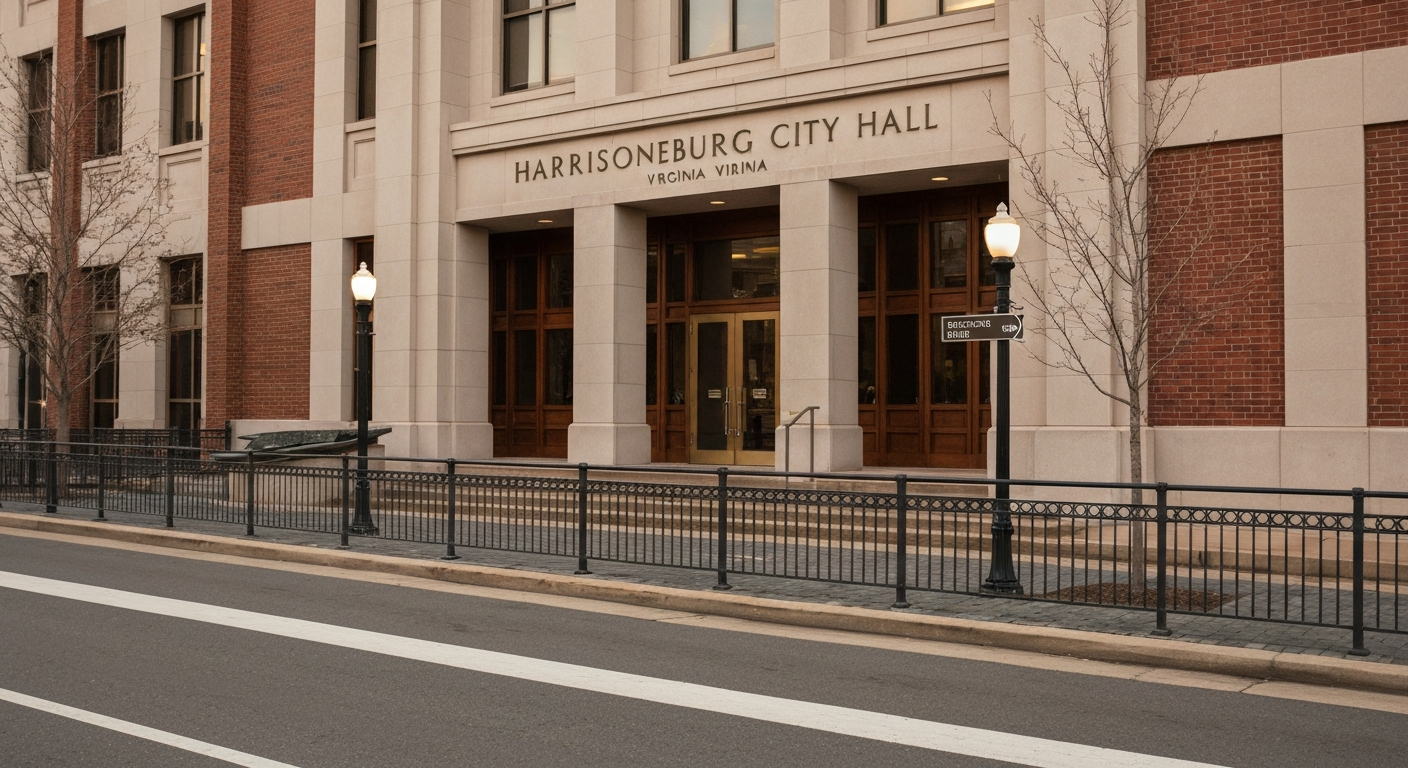
Both offices are at City Hall, 409 South Main Street, Harrisonburg, VA 22801 — just on different floors.
Step 1: Complete the Zoning and Building Form
The Zoning and Building Form is the document that confirms your proposed business location is properly zoned for your type of business and that the appropriate Certificate of Occupancy has been issued for that location. Community Development reviews and signs the form before you take it downstairs to the Commissioner.
Where to get the form: Download from harrisonburgva.gov, or pick it up at the Community Development office on the 2nd Floor.
How to submit:
- In person at City Hall, 2nd Floor
- By email: [email protected]
Complete page one of the form with your business information. Community Development verifies the zoning compliance and Certificate of Occupancy status for your address, then signs and returns the form to you.
Home-Based Businesses: Home Occupancy Permit
If your business will operate from your home, you need a Home Occupancy Permit rather than the standard Zoning and Building Form. The Home Occupancy Permit is free and is also administered by Community Development.
Harrisonburg’s home occupation rules are strict. Before applying, confirm that your intended business activity complies with all of the following:
- No advertising signs on the property — no yard signs, window signs, or vehicle signs parked on the property
- No exterior evidence of commercial activity — the business must be completely invisible from outside the property
- No outside employees working at the residential location
- No customer or client traffic beyond what is incidental to the residential character of the neighborhood
- Certain business types are prohibited from residential locations entirely
If your business creates any visible or audible evidence of commercial activity — deliveries, client vehicles, equipment storage, employees coming and going — you may not qualify for a home occupation permit, and a commercial location will be required.
Even if you receive the Home Occupancy Permit, you still need to obtain a business license from the Commissioner of the Revenue. The permit is a zoning approval, not a business license.
Step 2: Apply for Your Business License
With your signed Zoning and Building Form or Home Occupancy Permit approval in hand, go to the Commissioner of the Revenue on the 1st Floor.
Commissioner of the Revenue City Hall, 409 South Main Street, 1st Floor Harrisonburg, VA 22801 Phone: (540) 432-7704 Business License Compliance: Stephanie Forbus, Deputy Commissioner Email: [email protected]
All businesses must obtain their license and pay the required fee before commencing operations. This applies to businesses of all sizes — including very small businesses that owe no fee under the tiered structure.
What to Bring
- Signed Zoning and Building Form (or Home Occupancy Permit approval)
- SCC corporate charter: Certificate of Organization (LLC), Articles of Incorporation (corporation), or partnership agreement
- Trade name registration from the Virginia SCC (if using a fictitious name)
- Required permits for your business type (see Special Requirements section below)
- Government-issued photo ID
- EIN (if you have one — recommended for all business types)
Tiered Fee Structure
Harrisonburg uses a graduated fee system rather than a flat rate. Your fee depends on your estimated (or actual) gross receipts:
$10,000 or under: $0 — no fee, but a license is still required. You must file with the Commissioner even though you owe nothing. This creates a record of your business with the city and is not optional.
$10,001 to $100,000: Graduated flat fees at tiered levels. The specific fee amounts are published at harrisonburgva.gov — check the current schedule, as these are subject to revision.
Over $100,000: A tax rate per $100 of gross receipts is applied based on your business classification. The Commissioner determines your classification from the description of your business activity.
Classification matters. A professional service firm (attorney, accountant, architect) is taxed at a higher rate per $100 than a retail merchant or contractor. Confirm your classification with the Commissioner before calculating your expected tax — it is not always obvious which category applies.
New Business Estimates
New businesses estimate gross receipts from the start date through December 31 of the current year and pay on the basis of that estimate.
Reconciliation in year two: Your estimated first-year payment is compared against your actual gross receipts. If actual receipts were higher than estimated, you owe additional tax. If lower, you may receive a refund or credit. The reconciliation happens when you file your first renewal.
Renewals
Annual renewal is due March 1 each year, based on prior-year actual gross receipts. Late filing after March 1 may result in penalties — confirm with the Commissioner.
Special Requirements by Business Type
Different business types require additional permits or certifications before the Commissioner can issue your license:
Restaurants and food service: A Health Department permit is required before the business license is issued. This is a hard prerequisite — the Commissioner will not issue the license without it. Contact the Rockingham-Harrisonburg Health Department to begin the inspection process well in advance of your planned opening.
Contractors: Must provide a copy of your Virginia DPOR contractor license (Class A, B, or C depending on project scope and dollar amount) and a Workers’ Compensation insurance certificate (Form 61-A) at the time of application.
Beauty salons, nail salons, and spas: May require a Fire Department inspection and/or DPOR licensing depending on services. Confirm requirements with Community Development and the Commissioner before applying.
Alcohol sales or service: Obtain an ABC license from the Virginia Alcoholic Beverage Control Authority — this is a state-level process separate from and in addition to the local business license.
Licensed professions (real estate agents, insurance agents, CPAs, physicians, attorneys): Verify all state licensure requirements with the Virginia Department of Professional and Occupational Regulation (DPOR) in advance. Your DPOR license or registration number may be required on your business license application.
Child care: Licensing through the Virginia Department of Social Services — this is required in addition to local licensing.
Additional Local Taxes
A business license is not your only tax obligation in Harrisonburg. The Commissioner of the Revenue administers several additional taxes that may apply to your business:
Meals tax: Administered by the Commissioner — restaurants and food service businesses must register and remit meals tax collected from customers. Failure to register before your first sale is a compliance issue.
Lodging tax: Hotels, bed-and-breakfasts, and short-term rentals (Airbnb, VRBO) must register and collect the transient occupancy tax.
Admissions tax: Applies to entertainment venues and businesses charging admission fees.
Utility services tax: Applies to businesses providing certain utility-type services.
Short-term rental tax: A separate tax category for short-term rental operators in certain circumstances.
Business personal property: File your annual Business Tangible Personal Property Return by March 31 each year. This declaration covers equipment, computers, furniture, machinery, and all other tangible personal property used in business. This is separate from your BPOL license.
Harrisonburg Tax Calendar
Keep these deadlines on your calendar:
| Date | Obligation |
|---|---|
| January 15 | State estimated income tax payment |
| March 1 | Business license renewal |
| March 31 | Business personal property return |
Appeals and Classification Disputes
If you believe the Commissioner has incorrectly classified your business — which directly affects your tax rate — Virginia Code §58.1-3703.1(A)(5) gives you the right to request a review of your classification. You must apply within one year of the date the tax was assessed. Classification disputes can meaningfully reduce your BPOL tax if, for example, you were classified as a professional service provider but believe your business is more accurately classified as a personal service or retail business.
Closing Your Business
When you close your business, file the Out of Business Form available at harrisonburgva.gov with the Commissioner of the Revenue. Your tax liability does not automatically end when you stop operating. Until you file the formal closure notice, the Commissioner may continue to assess taxes against your account. Do not simply stop filing — formally close the record.
Contact Summary
Commissioner of the Revenue — Business License Division City Hall, 409 South Main Street, 1st Floor, Harrisonburg, VA 22801 Phone: (540) 432-7704 Business License Compliance: Stephanie Forbus, Deputy Commissioner: Karen Rose — [email protected]
Department of Community Development — Zoning Division City Hall, 409 South Main Street, 2nd Floor, Harrisonburg, VA 22801 Zoning submissions by email: [email protected]
Harrisonburg Economic Development harrisonburgdevelopment.com — startup resources, demographic data, incentive programs.
SBDC and SCORE Free consulting and mentoring — no cost to clients.
Practical Summary
The Harrisonburg business licensing process is well-organized once you understand the two-step sequence. The most common mistake is going to the Commissioner first — go to Community Development on the 2nd Floor first, get your Zoning and Building Form signed, and then proceed downstairs.
The tiered fee structure is genuinely helpful for small businesses. If your gross receipts are under $10,000, you pay nothing — but you still file. If you are between $10,001 and $100,000, you pay a modest flat fee that scales with your revenue level. Only when you exceed $100,000 do rate-based BPOL taxes kick in.
And if you are operating from home, read the Home Occupancy Permit rules carefully before committing to that model. Harrisonburg’s standards — no exterior evidence of commercial activity, no outside employees, no client traffic — are stricter than most Virginia cities. If your business model requires any visible or traffic-generating activity at your residence, plan for a commercial location instead.
Call (540) 432-7704 with any questions before your first visit to City Hall.