How to Start a Business in Fredericksburg, Virginia
Fredericksburg has a geography that almost no other Virginia city can match. It sits exactly between Washington, DC (50 miles north) and Richmond (60 miles south), with I-95 running through it and VRE commuter rail connecting it to both metro areas. For a business that needs to serve both markets — or attract employees from either — there is no better-positioned city in the state.
The business case gets stronger when you look at the tax rates. Fredericksburg’s BPOL rates have not increased since 1986. They have remained at 50% of Virginia’s statutory maximums for nearly 40 years. Contractors pay $0.08 per $100 of gross receipts. Retail pays $0.10. Professional services pay $0.29. These are among the lowest rates in Virginia’s independent cities, and they’re locked in by policy.
The one process step that catches people off guard: you cannot apply for a business license in Fredericksburg without a Certificate of Zoning Use in hand. That certificate — from the city’s Planning and Zoning department — confirms your business location is properly zoned for your intended use. The Commissioner of the Revenue will not process your application without it. It’s a mandatory first step, and it adds time to your timeline. Plan for it.
Why Fredericksburg for Your Business
Fredericksburg’s city population is approximately 29,000, but that number understates the market. The broader Fredericksburg metropolitan area — including Spotsylvania, Stafford, and Caroline counties — has around 385,000 residents and is one of the fastest-growing regions in Virginia. The city proper is an independent jurisdiction separate from Spotsylvania and Stafford Counties, with its own licensing, its own taxes, and its own planning department.
The I-95 corridor position is the headline. Fredericksburg is equidistant between Washington, DC and Richmond, with direct highway access and VRE commuter rail service on the Fredericksburg Line running to DC with daily service. Businesses serving federal contractors, government agencies, or corporate clients in both metro areas can operate from Fredericksburg at substantially lower real estate costs than either city while maintaining reasonable access to both.
University of Mary Washington anchors the talent pipeline. With approximately 4,500 students, UMW isn’t a mega-university, but it provides a steady pipeline of graduates in liberal arts, business, and education who often stay in Fredericksburg after graduation. Germanna Community College, nearby in Culpeper and Fredericksburg, provides workforce training programs that support manufacturing, healthcare, and trades businesses.
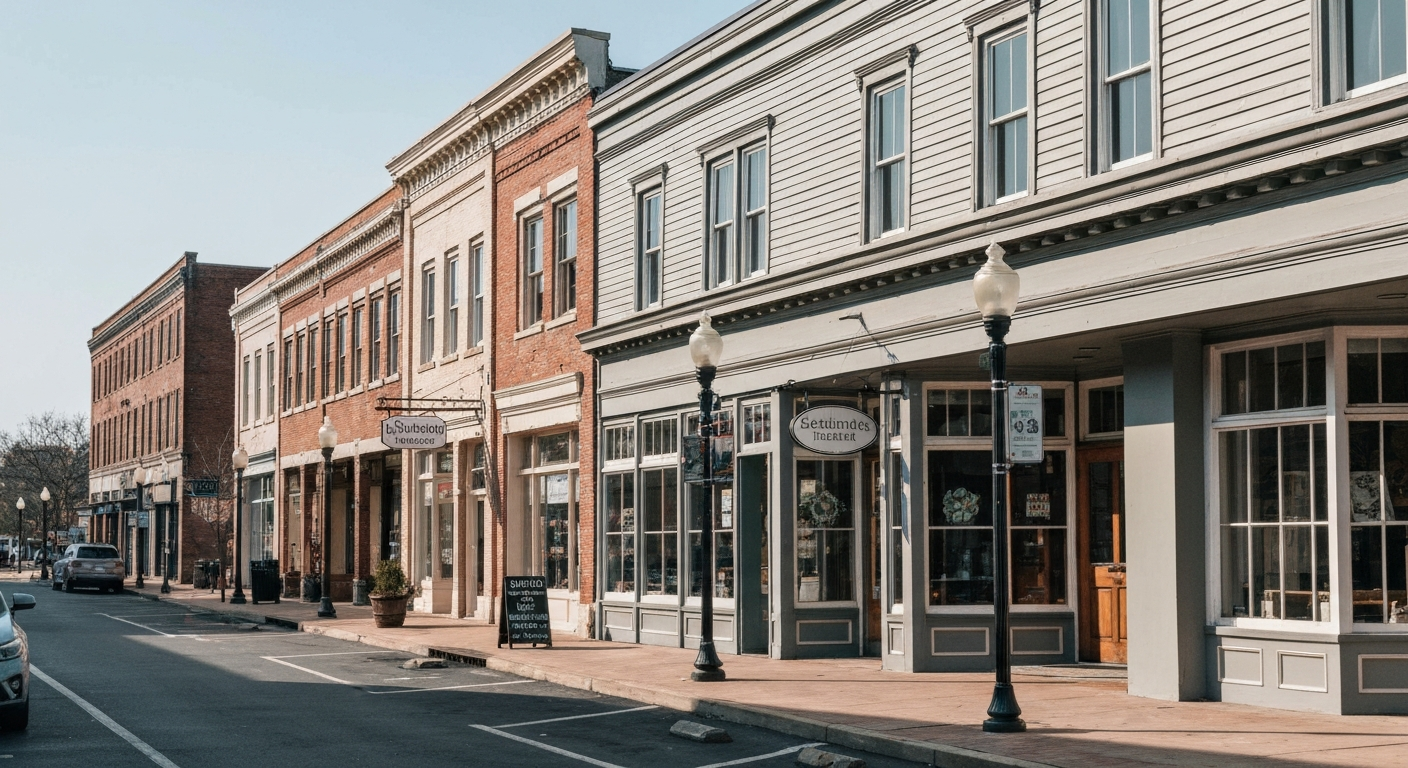
The downtown is a genuine economic asset. Caroline Street and the surrounding National Register-listed historic downtown form a walkable retail and restaurant district with real foot traffic — driven by local residents, commuters, and a consistent stream of Civil War heritage tourists visiting the Fredericksburg and Spotsylvania National Military Park and surrounding battlefields. The tourism economy isn’t hypothetical; it generates real demand for hospitality, retail, and service businesses.
The growth trajectory is favorable. Fredericksburg and the surrounding region have grown consistently as DC-area workers seek more affordable housing within commuting range. That demographic — dual-income households with suburban DC incomes choosing to live in Fredericksburg — creates sustained consumer demand well above what the city’s population alone would suggest.
The Fredericksburg Economic Development Authority provides business resources and incentive programs. The city has an active interest in attracting and retaining businesses, particularly in the downtown corridor.
Virginia is a right-to-work state. There is no city income tax in Fredericksburg. The Virginia corporate income tax is a flat 6%.
Choose Your Business Structure
LLC (Limited Liability Company): File Articles of Organization with the Virginia SCC at cis.scc.virginia.gov. Filing fee: $100. Annual registration fee: $50. The LLC is the right choice for most small businesses in Fredericksburg — it provides liability protection and flexibility on taxation.
Sole Proprietorship: No SCC filing required unless you’re operating under a trade name. If you use a fictitious business name, register it with the SCC for $10. No liability protection — your personal assets are exposed to business debts and claims.
Corporation: File Articles of Incorporation with the SCC. Filing fee: $75. Better suited for businesses seeking outside investment, issuing stock, or structured for larger operations.
S-Corp Election: An IRS federal tax election made by filing Form 2553 after your LLC or corporation is formed. This is a tax treatment, not a separate entity type.
For LLC formation guidance, see How to Start an LLC in Virginia. To compare services, see Best LLC Services in Virginia.
Register with the State
Virginia SCC Registration
File at cis.scc.virginia.gov. LLCs: $100. Corporations: $75. Processing takes one to three business days online.
Federal Employer Identification Number (EIN)
Apply free at irs.gov/ein. Issued instantly. Required for your bank account, payroll, and business license application. See Get an EIN in Virginia.
Virginia Department of Taxation
Register for sales tax and employer withholding at tax.virginia.gov.
Sales Tax Rate in Fredericksburg: 5.3% — made up of 4.3% state and 1% local. This is the standard Virginia rate that applies outside the Northern Virginia and Hampton Roads regional bands. No regional surcharge applies here.
Step 1: Certificate of Zoning Use (Mandatory First Step)
Before you can obtain a business license in Fredericksburg, you need a Certificate of Zoning Use. This is not optional. The Commissioner of the Revenue will not process your license application without it.
The Certificate of Zoning Use confirms that your intended business use is permitted at your specific address. It is obtained from the City’s Planning and Zoning department — not from the Commissioner.
What it covers:
- Verifies your business type is allowed in the zone where your address is located
- For home-based businesses, confirms that a home occupation is permitted at your residence with any applicable restrictions on signage, customer traffic, and on-site employees
- If you’re changing business types at an existing location, you may need a new certificate
Process: Contact Planning and Zoning directly to initiate the request. Provide your business address, a description of your business activity, and your intended use. They will review the zoning and issue the certificate or advise on what’s required.
Do not submit your business license application to the Commissioner until the Certificate of Zoning Use is in your hands. The Commissioner’s office will return incomplete applications.
Step 2: Get Your Fredericksburg Business License
With the Certificate of Zoning Use in hand, apply to the Commissioner of the Revenue for your BPOL license.
Commissioner of the Revenue 715 Princess Anne Street, Room 102 Fredericksburg, VA 22401 Mailing: PO Box 644, Fredericksburg, VA 22401 Phone: (540) 372-1004 Fax: (540) 372-1197
Office Hours:
- Monday: 8 AM – 12 PM only (note the limited hours — do not arrive Monday afternoon)
- Tuesday–Wednesday: 8 AM – 4 PM
- Friday: 8 AM – 4 PM
What to bring:
- Completed Business License Application PDF (available at fredericksburgva.gov)
- Certificate of Zoning Use
- Estimated gross receipts through December 31 of the start year
- Federal EIN (or SSN for sole proprietors)
- Description of business activities
- Business physical address and mailing address
- Virginia SCC registration number (LLCs and corporations)
Fee Structure: Fredericksburg uses a tiered system that is particularly favorable to new and small businesses:
- Gross receipts $50,000 or less: $25 flat fee
- Gross receipts $50,001–$200,000: $25 fee plus applicable tax rate on gross receipts
- Gross receipts over $200,000: applicable tax rate on total gross receipts (no flat fee component)
A startup that makes under $50,000 in its first year pays only $25. That’s a meaningful accommodation for new businesses.
Renewals: Renewal notices are mailed annually. Renewals are due March 1.
BPOL Tax Rates (50% of Virginia Maximums)
Fredericksburg’s BPOL rates have not changed since 1986. They are set at 50% of Virginia’s statutory maximums — a policy the city has maintained for nearly four decades. This makes Fredericksburg one of the most cost-competitive independent cities in Virginia for business licensing.
| Business Type | Rate per $100 Gross Receipts |
|---|---|
| Contractors | $0.08 |
| Retail merchants | $0.10 |
| Wholesale merchants | $0.025 |
| Business/personal/repair services | $0.18 |
| Photographers | $0.18 |
| Professional services | $0.29 |
| Out-of-area contractors | $0.08 |
| Landlords (on gross rental income above $50,000) | $0.16 |
These rates are among the lowest in Virginia’s independent cities. A professional services firm in Fredericksburg pays $0.29 per $100 — compared to $0.58 in Harrisonburg or higher rates in many other cities.
How to Calculate Your BPOL Tax
Divide your gross receipts by 100, then multiply by the applicable rate.
Example: a business service company with $175,000 in gross receipts falls in the middle tier: $25 + ($175,000 ÷ 100 × $0.18) = $25 + $315 = $340
Example: a contractor with $250,000 in gross receipts falls in the top tier: $250,000 ÷ 100 × $0.08 = $200
Meals, Lodging, and Other Local Taxes
Fredericksburg levies several local excise taxes in addition to the BPOL. If your business falls into any of these categories, you’ll need to register with the Commissioner and file separately.
Meals Tax: 6% Applies to all prepared food and beverages sold at retail. Filed and paid monthly. This applies to restaurants, food trucks, cafes, catering operations, and any business selling prepared food.
Lodging Tax: 8% Applies to hotels, bed and breakfasts, and short-term rentals (including Airbnb and VRBO). Filed and paid monthly.
Admissions Tax: 7% Applies to entertainment venues and ticketed events. Filed monthly.
Short-Term Rental Tax: 1% Separate from the lodging tax — filed quarterly.
Business Tangible Personal Property Tax Separate from the business license — all businesses must file. Assessed by the Commissioner of Revenue on equipment, furniture, and fixtures used in business. Due dates: first half December 5, second half June 5.
Cigarette Tax Stamps If your business sells cigarettes, contact the Commissioner for applicable requirements.
Hospitality business owners — particularly restaurants — need to budget all three applicable taxes: 6% meals tax, standard BPOL on gross receipts, and sales tax on retail items. Run the math before you sign a lease.
Business Resources in Fredericksburg
Fredericksburg Regional Chamber of Commerce The regional business advocacy and networking organization. Events, peer connections, and legislative advocacy for the Fredericksburg area business community.
Fredericksburg Economic Development Authority Business resources, site selection support, and incentive program information from the city’s economic development arm.
SBDC at University of Mary Washington The Small Business Development Center at UMW offers free one-on-one consulting for business planning, financial projections, marketing, and operations. A strong resource for new businesses.
SCORE Free mentoring from retired executives and business owners. Available in-person and virtually.
Main Street Fredericksburg Downtown business support focused on the historic commercial district. Useful for businesses locating in or near the Caroline Street corridor.
Virginia Business One Stop business.virginia.gov — the state’s consolidated portal for registrations, licenses, and permits.
Key Contacts at a Glance
| Department | Address | Phone |
|---|---|---|
| Commissioner of Revenue (BPOL) | 715 Princess Anne St, Room 102 | (540) 372-1004 |
| Real Estate Section | 715 Princess Anne St, Room 107 | (540) 372-1207 |
| Virginia SCC | cis.scc.virginia.gov | — |
| Virginia Dept. of Taxation | tax.virginia.gov | — |
Summary: Starting a Business in Fredericksburg
Fredericksburg’s licensing environment has two distinctive features: a mandatory Certificate of Zoning Use before anything else, and BPOL rates that haven’t budged since 1986. Both are worth knowing before you start the process.
The steps are: form your entity with the Virginia SCC → get your EIN → register with the Virginia Department of Taxation → get your Certificate of Zoning Use from Planning and Zoning → complete the Business License Application and submit to the Commissioner with the certificate and estimated gross receipts → note the Monday hours (8 AM – noon only) if you plan to visit in person → renew by March 1 each year.
The tiered fee structure means a business making under $50,000 in its first year pays a flat $25. That’s one of the most small-business-friendly entry points in Virginia. And those 50%-of-maximum BPOL rates represent genuine long-term cost savings versus most of the independent cities in the state.
Fredericksburg’s geographic position — midpoint between DC and Richmond, on I-95 with commuter rail — is a business infrastructure advantage that doesn’t show up in the BPOL table but compounds every year you operate there. It’s a city that has been growing, is projected to keep growing, and has structured its business licensing to be competitive with that growth in mind.