How to Start a Business in Fairfax City, Virginia
If you’re planning to open a business in Fairfax, Virginia, the single most important thing you need to know before you file anything is this: Fairfax City and Fairfax County are two entirely different jurisdictions. They have separate Commissioners of Revenue. Separate BPOL rates. Separate zoning. Separate tax systems. If your business address is inside Fairfax City limits, you license through the City of Fairfax Commissioner — not Fairfax County.
This distinction gets people wrong constantly. Someone searches “Fairfax business license,” lands on Fairfax County information, files there, and then discovers that their City of Fairfax address requires a completely separate city license. By that point, they’ve likely missed the city’s 30-day registration deadline — 45 days tighter than the county’s 75-day window — and triggered a late penalty.
Check your address first. Then read the rest of this guide.
Why Fairfax City for Your Business
Fairfax City is one of Virginia’s smallest independent cities. It covers just 6.3 square miles and has a population of approximately 24,000. It is completely surrounded by Fairfax County — making it what’s sometimes called an “independent city island” — with its own government, its own tax system, and its own economic identity.
The city/county distinction is not academic. Under Virginia law, independent cities are separate from the counties that surround them. Fairfax City is not a neighborhood of Fairfax County. It is not administered by Fairfax County. It has its own Mayor, City Council, Commissioner of Revenue, and full municipal government. If your business is inside city limits, every tax and licensing obligation runs through City of Fairfax — not Fairfax County.
George Mason University is a major anchor. GMU’s main campus borders the city, bringing more than 40,000 students and faculty into the economic orbit. That population drives demand for restaurants, retail, services, housing, and professional firms serving the university community. For businesses oriented toward education, technology, research, or the student and young-professional demographic, the GMU adjacency is a genuine advantage.
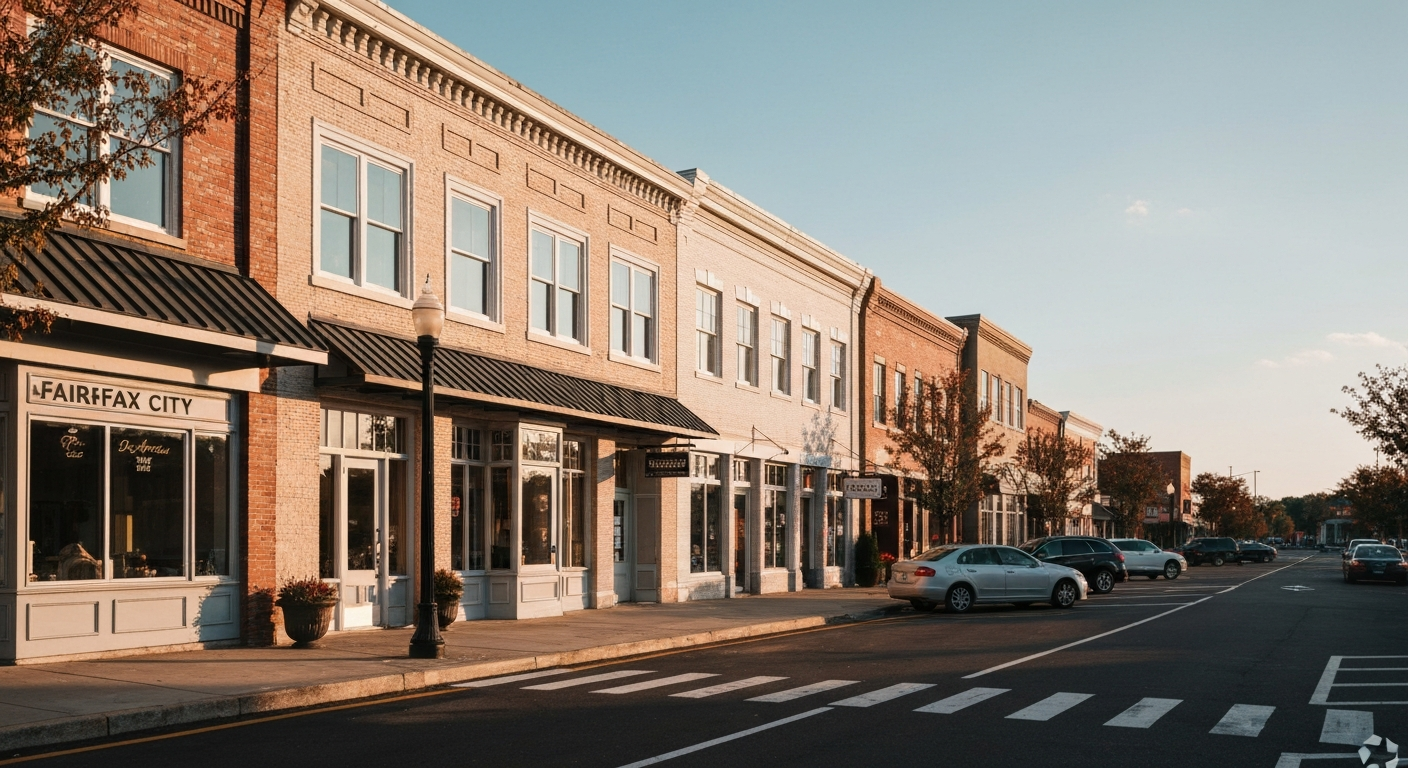
Old Town Fairfax is an active commercial district. The historic downtown around the Ratcliffe-Allison-Pozer House and the City of Fairfax courthouse area has restaurants, boutiques, professional offices, and year-round programming. It’s a functional commercial district with pedestrian traffic, not just a preserved historic streetscape.
Sales tax: 6.0% (Northern Virginia rate: 4.3% state + 1% local + 0.7% NVTA regional). There is no city income tax. Virginia’s corporate income tax is a flat 6%.
The city has its own meals tax — separate from Fairfax County’s meals tax. If you’re opening a restaurant or any food service establishment in Fairfax City, you register for and remit the city’s meals tax to the City of Fairfax, not to the county.
The Fairfax City Economic Development Authority provides business support and information for entrepreneurs considering a city location. Fairfax CORE (fairfaxcore.com) publishes startup guides and industry-specific resources for City of Fairfax businesses. These resources are worth reviewing early in your planning — they include information specific to city regulations, zoning, and the local business environment that generic statewide guides won’t cover.
Choose Your Business Structure
Your entity type shapes your tax treatment, liability exposure, and long-term flexibility. Most Fairfax City small businesses form as LLCs. Understanding the options — and choosing the right one — matters before you file anything with the state or the city.
LLC (Limited Liability Company): File Articles of Organization with the Virginia State Corporation Commission at cis.scc.virginia.gov. Filing fee: $100. Annual registration fee: $50 per year. The LLC shields your personal assets from business debts and gives you flexibility on federal tax treatment — you can elect disregarded entity status (sole proprietor for tax purposes), partnership treatment (for multi-member LLCs), S-Corp, or C-Corp. This is the most common structure for Fairfax City consultants, service businesses, and small retailers. It’s also the most common structure for GMU-adjacent businesses and tech startups.
Sole Proprietorship: No SCC filing required unless you’re operating under a trade name other than your legal name. Register a fictitious name with the SCC for $10. There is no liability protection — your personal assets are exposed to any business obligations or legal judgments. The sole proprietorship is the simplest and lowest-cost structure but leaves you personally at risk.
Corporation: File Articles of Incorporation with the SCC. Filing fee: $75. Corporations require more formalities — a board of directors, officers, annual meetings, written minutes — but offer the strongest structure for businesses seeking venture capital, planning to issue stock to employees through an options plan, or expecting complex ownership arrangements.
S-Corp Election: A federal tax election made by filing IRS Form 2553 after you’ve formed your LLC or corporation. Not a separate entity type. The S-Corp election can reduce self-employment tax exposure when net business income is significant — typically beneficial when net income exceeds roughly $50,000 to $80,000 per year, at which point the savings on self-employment tax may exceed the added cost of running payroll.
For guidance on entity formation and comparing your options, see How to Start an LLC in Virginia.
Register with the State
Complete your state-level registrations before approaching the City of Fairfax Commissioner. These are prerequisites for your BPOL application.
Virginia SCC Registration
Register at cis.scc.virginia.gov. LLCs pay $100; corporations pay $75. Processing is typically one to three business days online. Your SCC registration must be completed before you can apply for your Fairfax City business license — the city requires proof of SCC registration as part of the application. You’ll receive a Virginia SCC ID number to include on your license application.
Federal Employer Identification Number (EIN)
Apply free at irs.gov/ein. The EIN is issued instantly online. You need it to open a business bank account, pay contractors, handle payroll, and apply for your Fairfax City license. Even if you’re a sole proprietor with no employees, an EIN is recommended so you can use it instead of your Social Security Number on forms sent to clients.
Virginia Department of Taxation
Register at tax.virginia.gov for sales tax collection, employer withholding, and any other applicable state taxes. Fairfax City’s sales tax rate is 6.0% — the Northern Virginia regional rate (4.3% state + 1% local + 0.7% NVTA regional). This is higher than the 5.3% that applies to most of Virginia outside the Northern Virginia and Hampton Roads regions.
Get Your Fairfax City Business License
Every business operating inside Fairfax City limits must obtain a Business, Professional, and Occupational License (BPOL) from the Commissioner of the Revenue, City of Fairfax. The process runs through the city’s office at fairfaxva.gov.
Commissioner of the Revenue, City of Fairfax fairfaxva.gov
New Business Deadline: Unlike many Virginia localities, Fairfax City requires registration within 30 days of commencing operations. This is one of the tighter deadlines in Virginia — Fairfax County and Arlington give businesses 75 days. Missing the 30-day window triggers a 10% late penalty plus interest. If you’re planning to start in Fairfax City, have your license application ready before you open.
Prerequisites before applying: The City of Fairfax enforces a zoning-before-BPOL sequence. Before your business license application can be processed, you must:
- Complete your SCC registration
- Obtain zoning approval from the City’s Community Development and Planning department
- Comply with city occupancy code requirements
This zoning prerequisite is enforced in Fairfax City. Do not submit your BPOL application before you have zoning clearance.
Tiered Fee Structure:
| Gross Receipts | Annual License Fee |
|---|---|
| $10,000 or less | $0 |
| $10,001 – $50,000 | $30 |
| $50,001 – $100,000 | $50 |
| Over $100,000 | Rate-based by classification |
For businesses above $100,000, the rate applies to total gross receipts. Contact the Commissioner of Revenue for the specific rate applicable to your business classification.
License Renewal: The license expires December 31. Renewal is due March 1. A 10% late penalty applies for renewals filed after March 1.
First-year businesses: New businesses estimate their gross receipts for the current year. The second year, the estimate is reconciled against actual receipts from year one.
Zoning and Permits
Fairfax City enforces a zoning clearance requirement before issuing BPOL licenses. This is not a formality — it is a gate that must be cleared before the Commissioner of Revenue will process your application.
Contact: Community Development and Planning, City of Fairfax
Home-based businesses: Require a home occupation permit from Community Development before applying for a BPOL license. Fairfax City has specific standards for home-based operations — limitations on signage, customer visits, on-site employees, and activities that affect the residential character of the street.
Food businesses: In addition to BPOL and zoning, food businesses must obtain a Health Department permit and register for the city’s meals tax. The city meals tax is a separate obligation from the BPOL — it is remitted to the City of Fairfax Commissioner, not to Fairfax County.
Contractors: Must hold a Virginia DPOR state contractor license before applying for a BPOL in Fairfax City.
Commercial locations: Verify that your intended business use is permitted at the specific address under Fairfax City zoning. Not every commercial use is allowed in every zone.
Business Tangible Personal Property Tax
The City of Fairfax assesses its own tangible personal property tax on business equipment, furniture, computers, and tools. This is a separate obligation from your BPOL license, and it is assessed by the city — not Fairfax County. If your business is inside Fairfax City limits, you file this return with the City Commissioner. Filing with Fairfax County would be the wrong jurisdiction.
The tangible property return covers business personal property owned as of January 1 of the assessment year. Inventory held for sale is generally excluded. The return is due separately from your BPOL renewal — the filings have different deadlines, and submitting one does not satisfy the other.
Contact the Commissioner of Revenue at fairfaxva.gov for current assessment dates, rates, and filing procedures. Being late on the tangible property return can result in a statutory assessment — a default assessment by the Commissioner that may not reflect your actual property values.
One practical note: businesses that are new to Fairfax City, or that have been filing tangible property returns with Fairfax County under the mistaken assumption that the city and county share a system, need to switch to filing with the City Commissioner. This is one of the concrete, ongoing consequences of operating in the wrong jurisdiction without realizing it.
Additional City Taxes
Meals tax: The City of Fairfax imposes its own meals tax on food and beverage sales. Restaurants, cafes, food trucks, caterers, and any business selling prepared food within city limits must register for and remit this tax to the city. It is entirely separate from Fairfax County’s meals tax.
Business vehicle tax: Business vehicles are assessed by the City of Fairfax — separately from any county vehicle assessment.
Tangible personal property: As noted above, filed with the City Commissioner.
These city-specific taxes are among the practical reasons why the City/County distinction matters so much. A business that mistakenly files only with Fairfax County while operating inside city limits is non-compliant on multiple tax obligations simultaneously.
Business Resources
Fairfax City Economic Development Authority fairfaxva.gov The city’s economic development function provides information on business location, support programs, and city resources.
Fairfax CORE fairfaxcore.com A startup guide and resource hub specifically for City of Fairfax businesses. Includes industry-specific guides, permitting information, and connections to local resources.
Mason SBDC at George Mason University Free one-on-one consulting through George Mason’s Small Business Development Center, located directly adjacent to Fairfax City. Consulting is free, confidential, and available at any stage of the business. Particularly useful for business planning, financial projections, market research, and federal contracting guidance — the GMU ecosystem has deep expertise in the government contracting space that dominates Northern Virginia.
SCORE Northern Virginia Free mentoring from experienced business professionals and retired executives. The Northern Virginia SCORE chapter has strong representation from government contracting, technology, and professional services — the sectors that drive the Fairfax area economy. Mentoring is available in-person and virtually, and you can be paired with a mentor who has specific experience in your industry.
Key Steps in Order
- Confirm your address is inside Fairfax City limits — not Fairfax County
- Register your entity with the Virginia SCC at cis.scc.virginia.gov
- Obtain your EIN at irs.gov/ein
- Register with the Virginia Department of Taxation at tax.virginia.gov
- Contact Community Development and Planning for zoning approval
- Obtain any required home occupation permits or zoning clearances
- Apply for your BPOL license with the Commissioner of Revenue, City of Fairfax, within 30 days of starting operations
- Register for the city meals tax if applicable (food businesses)
- File your Business Tangible Personal Property return by the city deadline
- Set a March 1 calendar reminder for annual BPOL renewal
Summary
Fairfax City is a compact, active independent city anchored by George Mason University, with an operating historic downtown and its own complete licensing and tax system. The location works well for businesses oriented toward the GMU community, the Old Town retail and restaurant scene, or the professional services market in the heart of Northern Virginia.
The process requires getting one fundamental thing right: you’re dealing with the City of Fairfax, not Fairfax County. Everything — BPOL, zoning, meals tax, tangible property — runs through city offices. The 30-day registration deadline is real and enforced. The zoning-before-BPOL sequence is a prerequisite, not a suggestion.
Get those mechanics in order, and Fairfax City offers a well-resourced, well-connected location inside the Northern Virginia economic corridor.